Tag Archive for Preller school visits

Author Skype Visits: Three Perspectives

Last week I posted about doing a couple of Skype visits, complete with follow-up comments from a teacher-librarian. Because Skyping is a relatively new (and powerful, and affordable) educational tool, I thought I’d recap my experiences in more detail. To that end, I decided to share a couple of different comments that came out of one post-visit debriefing. As background, Skyping is new to me as an author; this year I’ve been dipping my toe into the water, testing the temperature.

For the visit under discussion, I met with a combined classroom of two 6th-grade classes from the region of my parents’ old stomping grounds, Queens, NY. The students had all read my book, Bystander, and came prepared to ask questions — essential ingredients for a successful visit.

After the event, I received a note from the teacher, Adam, who was most instrumental in making the visit happen. He wrote:

James,

Today was fantastic — hands down one of my career highlights. I am proud of the work that the students have done on this topic and I am so impressed with how today’s Skype conference went. You certainly were able to capture and hold the attention of everyone who was in the Media Center today. Their insightful questions about specific characters along with your humor and honesty made the experience something that I will look back on for a long time to come as a moment in their lives that actually came alive. It was a perfect moment in the school day that makes it all worth everything that we do.

In a separate exchange, I heard from another event organizer, a parent. Liza wrote:

Great presentation today. I was sitting off to the side and could tell the kids really loved it. So much energy in the room! Great topic and technology.

I replied with a confession:

Skyping is a little weird, there’s a strange disconnect to it, so I find it hard to read the audience (whereas I think, live, that’s one of my strengths — I can tell when they are bored, when it’s time to stir them up or settle them down).

Liza responded with this observation:

Regarding Skype, the funny thing is that although you were experiencing “a disconnect,” the opposite was happening in the classroom. With your enlarged face on the whiteboard, it created the illusion that you were speaking/connecting with the audience and the energy level was palpable. I might even go so far as to say that the “gee-whiz factor” related to use of this technology make the experience more exciting to the kids than if you’d actually been in the room. From the audience’s standpoint, Skype/whiteboard is a wonderful and surprisingly intimate experience.

The origin of Skype, from The Wizard of Oz. Who knew?

Conclusion: Well, I think Liza said it, and I can only trust her opinion — a Skype visit can be an exciting, oddly intimate experience. As an author, and a 50-year-old guy dealing with (scary) new technology, it takes some getting used to. I appreciate the magic of it, the pure thrill of seeing those faces — from Kentucky or Queens, California or Maine — and answering their questions directly. Admittedly, I still feel a little removed, still feel like I’m alone in my office, voice echoing, the cats looking at me weird, but amazingly that doesn’t seem to be what happens on the other end.

I think it works well for an interactive, book-specific, Q & A session not more than 30 minutes in length. I know that it doesn’t replace the impact of a live author visit. That’s as far as I’ll go right now. Feel free to contact me if you are interested in exploring this new technology together. My fee for next year will be what appears as the industry standard, $150.

Fan Mail Wednesday #113: Skype & Teaching in the 21st Century

Preamble: My friend, talented author/illustrator Matt McElligott, is a frequent presenter at schools. I saw him when he came to my local elementary school and he was spectacular. A total pro, funny, informative, and kind. For info on his author visits, read this. See what I mean about being a pro? He makes me feel like a dirtbag, a rank amateur getting by on shaggy charm. I learn things from Matt every time we speak (twice a year if I’m lucky).

The Point: Matt recently told a good story. A few days after a visit, a librarian called Matt to convey a conversation she had just had with the mother of a young child in the school.

The Joke: The girl came home and said, “Mom, guess what!? We had an author visit our school . . . AND HE WAS ALIVE!”

Maybe you’d find that funnier if, like me, you’d been introduced as a “real, live” author dozens of times over the years. Or maybe you find it hysterical already. I don’t know how you feel. What am I? A mind-reader??!! So just . . . BACK UP, PEOPLE. BACK — IT — UP!

Ah, so. This morning I did a couple of Skype visits. I’m relatively new to Skype and still figuring it out. It’s like we’re in the first few dates of our relationship, where I’m still dressing nice and pretending that hey, no, I actually love Julia Roberts movies. The first visit this AM was with an 8th-grade class from Duxbury, MA. They had all read Bystander as part of an anti-bullying initiative and had a lot of insightful questions. It was a cool way to connect directly with readers without putting on socks and shoes. And come to think of it, that might be the right word for it: Skyping is cool.

I got the nicest note shortly thereafter . . .

Dear James,

Thank you so much for the skype session this morning. It was a great experience for me and for my students to virtually talk to a real author. We all found your answers interesting and personal. The kids said they were surprised that you were “so normal and such a regular guy.” You were so personable, honest and down to earth with them. A few students wanted to ask some other questions and I said maybe they could send you an email sometime??? It was such a great example to the kids about teaching and learning in the 21st century.

Thanks again, Martha.

I replied:

The invoice is in the mail. Please remit within 30 days.

No, kidding!

I actually replied:

Thanks, Martha. When I first started author visits, back in the way back, I was a little uncomfortable with the star treatment. Sometimes I’d get put on a pedestal, the famous author! Well, that wasn’t me; I couldn’t live up to it. I soon realized that if I had anything of value to share, maybe that was it — that I was a (relatively) normal, average, everyday guy who happened to write books for a living. I was no more special than the neighborhood architect, doctor, midwife, lawyer, or . . . um, wait, actually I am more special than lawyers. But anyway!

The Irish have an expression, “Flowers for the living.” (Meaning: You don’t have to wait until someone dies to say something nice about them.) I appreciate your kind words. And I had a good time visiting with your bright, lively students. I’d be happy to answer their email.

My best,

JP

——

NOTE: I realize that I’ve been bad, bad, bad when it comes to Fan Mail Wednesday. I’ve got a huge backlog and I’m seriously in trouble. I’m going to start digging out asap. I mean it.

Too Much Awesome: Posters, Student Writing, etc.

I know, Dear Reader, I know.

You are getting tired of my slipshod approach, the endless excuses about how busy I am.

But!

Yesterday I coached two baseball practices, for two different teams. Threw batting practice to twenty-two different boys who are at a point, ages 11 and 12, where it’s no longer okay to just blob it over. They need the ball with a little heat. So my wing is sore.

Today I’m driving off to Geneseo with my oldest, Nick, for a second look-see. He’s a high school senior and we’re getting down to decision time for college. On Wednesday, my good wife Lisa flies down to Atlanta, where she’s going to learn how to perform minor surgery on a cervix — and frankly I do not want to know any more details than that. She comes home Sunday, the day I coach a doubleheader and drive down to Long Island for a week’s worth of school visits.

And, oh, yeah. There’s the job thing, too. Writing stuff.

So the blog suffers.

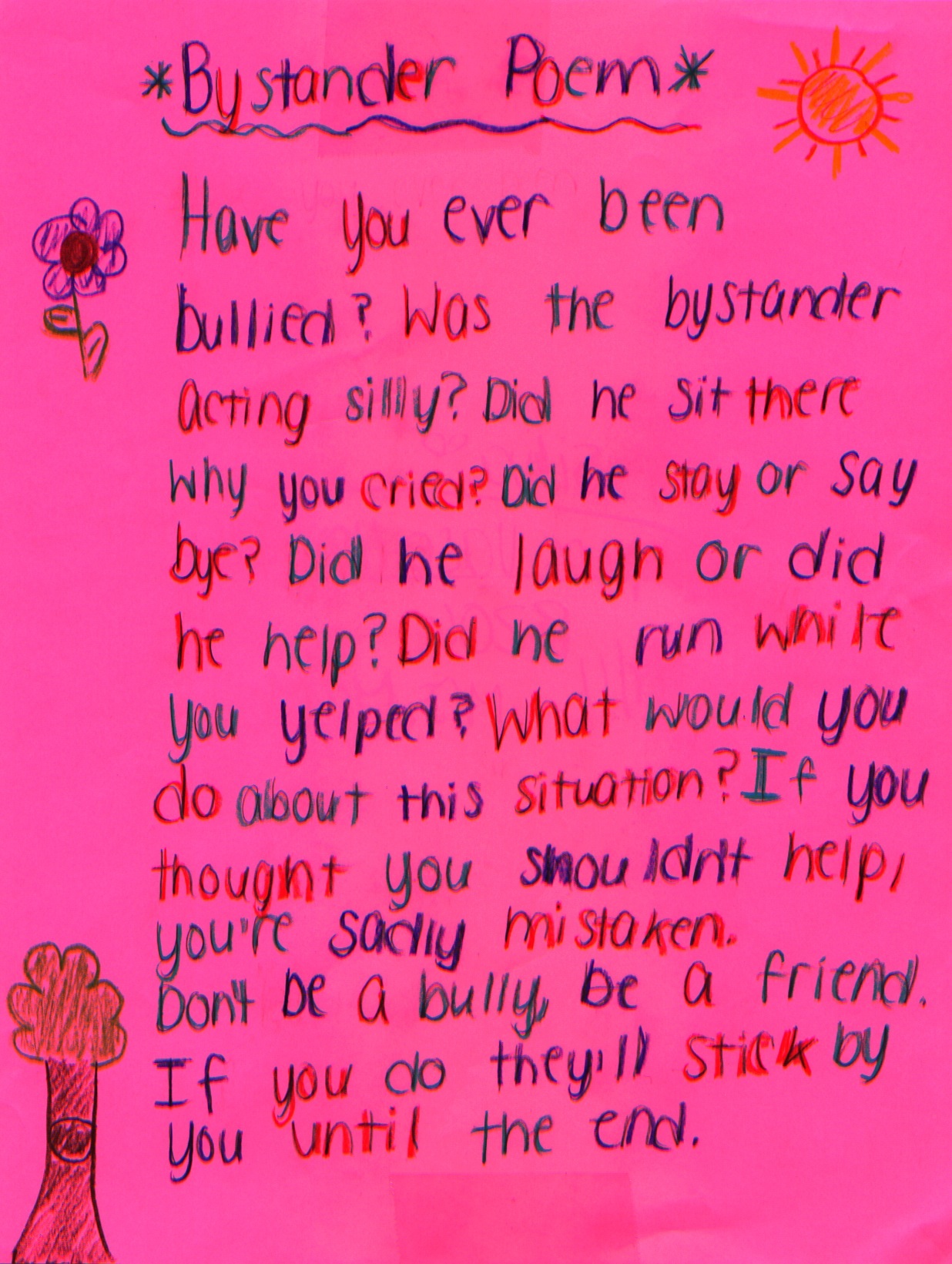
I wanted to share a few scans and photos. I recently visited a school down in Sicklerville, NJ, where the students filled the halls with creative responses to my book, Bystander.

There were posters and poems. Some students wrote journal entries from the perspective on a book character, and I thought those were particularly interesting and effective. Isn’t that the big lesson in To Kill a Mockingbird, when Scout stands on Boo Radley’s porch and sees the world from his perspective? When she stands in his shoes?

“You never really understand a person until you consider things from his point of view . . . until you climb into his skin and walk around in it.”Harper Lee.

So after my presentations were done, and the books signed, we walked around the halls and filled a big box with incredible artwork, posters, etc. I can’t show it all to you, but here’s a few samples:

Most posters were too big to scan. I loved the tagline that one boy came up with . . .

“DON’T BE A BULLY . . . DO THE NICE!”

Overheard: “Did anyone ever tell you that you look like David Hasselhoff?”

No, actually. You’re my first. Thanks a lot for that.

(Mutters under breath.)

There I was, speaking to a group of 4th-graders, probably about 125 or so, and the question — like a dart from a bamboo tube — was directed at me.

In retrospect, I regret weeping openly in front of such impressionable youth. The loud sobbing, etc. Not my most dignified moment. But I’d been Hasselhoffed — the verb! — and it shook me to the core.

In truth, hey, I laughed. It was funny. And I told them this . . .

In my long-haired, bandana-wearing college days, I sometimes heard the Jim Morrison comparison.

Then for a good stretch I heard Pierce Brosnan, circa “Remington Steele,” and even into the James Bond years.

Not terrible, right. Not an insult, even if somewhat odd and not at all me. (To be clear, I don’t think I ever looked like these guys.)

Then the comparisons fell mostly silent for long stretch, during a period when I (mercifully) didn’t look like anybody at all.

Hasslehoff was a new one. And a little disturbing.

I told the students that, obviously, things were not going in a good direction.

I dreaded the day, I told them, when somebody raises his hand and asks, “Did anyone ever tell you that you look like Wilford Brimley?”

I fear it’s just a matter of time.

And naturally they had no idea who Wilford Brimley was, which only underscored my dilemma — though it did get a chuckle from the adults in attendance.

Fan Mail Wednesday #111 (Re: Book Titles)

Don’t you love the icon that I use for every Fan Mail Wednesday? A word of explanation for younger readers: It’s an illustration of something we used to call “a letter.” You see, long ago, we used to — and you’re not going to believe this — write words on actual paper (made from trees!) to our friends and relatives and business associates. Then we’d place the paper in a sealed envelope, called an ENVELOPE, and then . . .
Nevermind.
A girl sent this one via the interwebs. I removed her name for privacy:
Hi, I was at the school that you were at today at Vail Farm 3/30.  I was wondering how you come up with titles because I’m a writer too. I’m writing a book that is about a girl who gets picked on a lot just like the book bystander. But just so you know I didn’’t steal it from you.  But any way I can’t come up with a title for it so that’’s all I want to know.
Love,
X
I replied:
Hey, X. Thanks for writing. You must have been one of those students with your hand raised when we ran out of time. Sorry I didn’t call on you.
Titles are a tricky business. I can’t say that I’m an expert. With books like Six Innings and Bystander, I had those titles very early on. In fact, writers will often plug in a “working title” for a book in progress. It’s not the final title, or at least doesn’t seem to be, it’s just something handy to call the untitled book. For Six Innings, my working title was . . . Six Innings. That was always the concept for the book from the beginning, very clear in my mind. So when it came time to officially name the book, I used the working title.
With Bystander, my first title idea was Predator. That’s because I began by focusing my research and note-taking on the bully character, Griffin Connelly. But after a short while, I became convinced that the real story was with the bystanders. In life, there are a few bullies and some victims, and then there’s the rest of us, the overwhelming majority, the bystanders. We are often silent, yet hold all the real power. I knew it should be the focus of my book, and the title. Of course, there are all sorts of bystanders. The floaters and the enablers, the watchers and the cheerers and the ones who simply walk away — all with our own roles to play in the schoolyard drama. Few of us are purely innocent.
Speaking of bullies, have you ever noticed that they almost always need an audience? They don’t bully unless there’s somebody to watch it, to cheer them on, to laugh. Fights are the same way. It’s interesting when you think about it, isn’t it? What would happen if there was no audience? Do bullies need bystanders in order to exist? Are we their oxygen?
Back to titles: In many cases, writers don’t have a title until the book is finished. Editors have told me not to worry about the title, just write the story, worry about the title later on. It can be hard, because you do need a good title. I wanted my title for Justin Fisher Declares War to be Justin Fisher Declares War on Fifth Grade, but that was vetoed due to length. I never felt that we got that title right.
When I begin a book, I often purchase a composition notebook. My working title for Justin was Talent Show. Maybe I should have stuck with that.
Here’s the first page from that notebook. I wrote it in the Bethlehem Library in Delmar. I had this idea of Justin defacing a poster in school and it’s the first scene I wrote, event though it doesn’t happen until Chapter Four of the book.
Often writers will go back over a story and see if there’s a word or phrase in the text that somehow stands out. You’ll see that a lot when you read books, the book’s title buried somewhere deep in the pages of the book. I’d recommend that strategy for you. Reread your story. Does a character say something that could work as a title? Is there a symbol in the book that somehow represents a character or an idea?
With Jigsaw Jones, my publisher wanted a title from me before I even wrote the book or, in some cases, knew what it was about. It drove me crazy.
The other strategy is to ask for help. That’s what I do. I’ll have a reader — my editor, almost always — read the manuscript and we’ll talk about titles together. Sometimes it takes another person who has some distance from the story to see what it’s really about. And isn’t that nice, when someone can give you the title?
Lastly, brainstorm. I’ve created long lists of potential titles. Then you can review them, whittle them down, and maybe share them with other people. Maybe even people who haven’t read your story. Which titles appeal to them? Is there a title that gets them curious? Nowadays this is called “crowd-sourcing,” when you simply ask a bunch of random people for their opinions.
Anyway, sorry, long letter. Good luck with your story. It’s always nice to meet a young author.
JP