Tag Archive for Iacopo Bruno

SCARY TALES SNEAK PREVIEW: Art & Excerpt from Book #2, “I Scream, You Scream”

I just got to see the illustrations for Book #2 in my upcoming SCARY TALES Series: I Scream, You Scream. Actually, what I saw was most of the art placed on the typeset pages, with some pages blank, art still-to-come. It’s exciting to see a book come together, especially one where the illustrations by Iacopo Bruno are such a big part of the overall appeal.

The good news, I’m in a sharing mood.

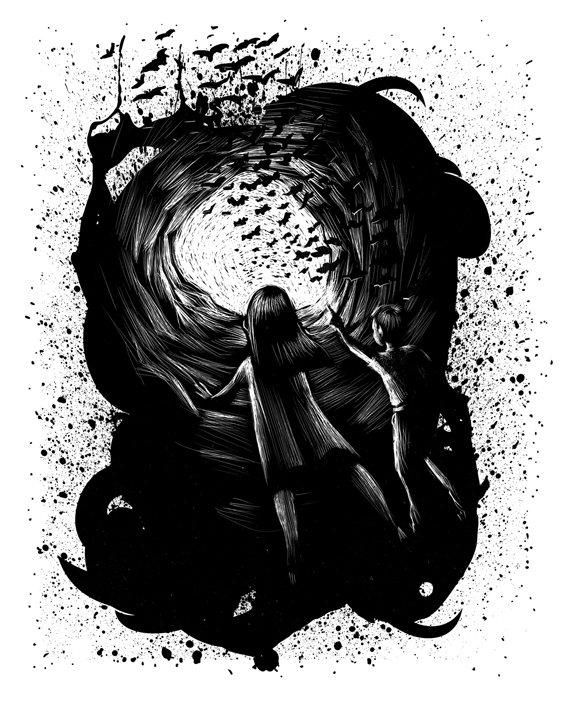
At about the middle of the story, after all hell has broken loose, two characters, Samantha and Andy, find themselves hiding in a cave. The way out was blocked. They had to explore the cave to find a new means of escape. Which gave me an idea — bats!

Here’s the scene from the manuscript:

The tight passageway opened up to a large cavern, with a ceiling at least fifteen feet high. “Wow,” Sam said. “Look at this place.”

Andy looked, as requested.

“But what’s that disgusting smell?” Sam complained.

She moved the beam to the rock floor. It was covered in some kind of thick, greenish slime. It smelled rank. Sam worked hard not to gag.

A steady trickle of droplets hit the rock floor. Plink, plink, plink. “Do you hear that?” Sam asked. “Could it be water falling from a stalactite?”

“No, not water,” Andy said. “I think it is called ‘guano.'”

“‘Guano’?’

“Bat droppings.”

Sam gulped. Bats. She hated bats.

Sam aimed the flashlight at the ceiling and stepped back in horror. The ceiling was alive. The roof of the cave was writhing, squirming, crawling with hundreds — no, thousands upon thousands — of bats. The bodies of mice, with human faces. Sam felt woozy, on the edge of panic.

This was worse than homework.

Way worse.

Oh, I should say another thing about my writing process here. When I realized that I was going to include bats in the story, I remembered that classic scene when Indiana Jones remarks, “Snakes, why did it have to be snakes?”

Part of the genius behind that scene was the script had previously established Indy’s fear of snakes. We learned it early in the movie and promptly put it away. So when he confronts the snakes, we know this isn’t just another obstacle for our hero. He’s facing one of his deepest fears.

Now, admittedly, my little book is operating on a simpler level. And I want to be careful about how scary to make this for my readers. So I went back to the first chapter and, while talking about Sam’s bravery (in the context of a thrill ride in an adventure park), I planted a seed:

Nothing frightened Sam Carver. Nothing, that is, except for dentists, bats, and homework. The usual things. Dentists, of course, with their fat fingers fumbling in your mouth. But bats creeped Sam out the most, with their leathery wings and tiny teeth and weird human faces.

I’m sure ideas for the cave scenes came from the light research I did on the topic. And, look, “research” is far too strong a word, implying more rigor than I applied. It was more a matter of casting about for inspiration by sorting through source material. I read about cave explorations and the bats of Bracken Cave in Texas, and tried to learn a little about bats in general. I even wandered over to Youtube, which can often be a spectacular research tool. This short, one-minute video really inspired me. BTW, pause on the video at 0:35, then look at the illustration below. I wonder if Bruno watched the same Youtube clip?

You need to a flashplayer enabled browser to view this YouTube video


After their first bat discovery, Sam and Andy had to overcome their fears to figure out a way that the bats could help them escape the cave. They wake ’em up. Which led to this short paragraph:

It was amazing. Even beautiful, in a way. The bats flapped and flew to the far end of the cavern and spiraled up, and up, through a shaft of light.

I found another video that I particularly liked, this one a bit longer, which offered more information. I decided that Andy would be the character who knew something about bats. He was an expert, the way many boys his age can reel off facts about baseball, or trains, or most anything that’s captured their imagination. They absorb like sponges. After that, I had what I needed to write those brief scenes in the cave with Sam and Andy lost in the dark . . . with all those bats.

Gosh, I hope readers find these books.

You need to a flashplayer enabled browser to view this YouTube video

SCARY TALES #2: I Scream, You Scream

It’s exciting to see a series come together. It’s this long process that involves a lot of different folks all pulling on the same oar. But, like, we’re on different boats. Or something like that.

I just got my first peek at the rough cover for book #2, I Scream, You Scream. This is not final art; it’s basically a very tight sketch with all the design elements in place. First, let’s look at the covers for the first two books together — that’s a eureka moment right there, when finally you see that it’s a series.

……………….

The art and design are critically important for these books because we made a decision that each book would be completely different. New characters, new setting, and sometimes new genre. Over time, if we are lucky enough to find readers, this series could include not only “horror,” but also science fiction, thrillers, historic fiction, and more. We’re trying to paint on a very large canvas, rather than limit ourselves to a rigid formula. Each book its own unique story. And yet, they are held together by certain qualities: for starters, each book delivers a dependable kind of reading experience, a twist, an elevated heart rate. Some storytelling techniques will be consistent from book to book, the use of the intro and outro, the length, the illustrations. I believe the brilliant work of illustrator Iacopo Bruno truly holds the series together. And it’s awesome, too.

Here’s a larger shot of the rough cover, designed by Rich Deas, where you can really see the unfinished quality. Below you’ll find the one-page introduction. Can you hear that I’m channeling my inner Rod Serling?

Fun, isn’t it?

Enter the world of Samantha Carver. An ordinary kid who loves amusement parks, the smell of popcorn, and the joyful terror of a heart-pounding ride.

Sam’s got a ticket in her pocket for a very special ride. Soon this ticket, ripped in half, will signal the beginning of a most unusual adventure –- and leave Sam, along with a boy named Andy, screaming for their lives.

So, come along. Take a seat. Buckle up, nice and tight. It’s sure to be bumpy ride. And if you need anything –- anything at all — just scream.

The intro page will look something like this:

Pay No Attention to That Man Behind the Curtain

When I started this blog, one of my guiding concepts was to pull back the curtain . . .

. . . .to show some of the inner workings of the writing process. It’s not all gazing into the luminous sky, folks; more often, you’re digging in the muck, shifting dirt around.

On Monday, I got a quick note from Holly, an editor who was working on Book #1, Home Sweet Horror, in my new SCARY TALES series (July, 2013). I think this offers a glimpse into the issues that demand a writer’s attention — even after the manuscript has been read, copy-edited, approved, and “final” (a word that must always appear in quotes, alas, until the book is printed).

That is, the illustrations finally arrive from the artist and there might be minor problems, tweaks, oddities, etc. So, thus . . .

Holly wrote:

Hey,

We have been going over the second pass of Home Sweet Horror (which looks amazing!) and:

On pg. 28, the lead in to chapter 4, the artist has drawn a great picture featuring a creepy old-fashioned rotary phone (see attached for the rough image).  It’s really got the right tone and will look fabulous in the book, but we are afraid that it might throw readers off a little bit. Would it be possible for you to add a quick description of the creepy old phone to the chapter so that we can keep the image?

Holly’s right: cool illustration. I reviewed the text, which read:

An hour later, Kelly came down and planted herself on the living room couch. Her nose was in a book, a tender love story about killer zombies.

“Do you think there’s anything creepy about this house?” Liam asked.

Kelly rolled her eyes. “Creepy? Yeah, you.”

“Can a house be . . . alive?” Liam ventured. “Like with, I don’t know, a spirit or something?”

“Oh, please, just shoot me now,” Kelly groaned. She turned her attention back to the book.

The phone rang.

And rang.

“Get it,” Kelly snapped.

“I’m not your slave. You answer it,” Liam replied.

No one moved.

After the fifth ring, the machine picked up.

Fourteen minutes later, I wrote back to Holly with my suggestions (amended text in red):

Does this work for you? If length is issue, could cut out “Dad says” and “Kelly laughed” lines. I’m open about this kind of thing, whatever you need. Cuts, additions, etc.

JP

“Do you think there’s anything creepy about this house?” Liam asked.

Kelly rolled her eyes. “Creepy? Yeah, you.”

Liam frowned. “You know what I mean.”

Kelly set down the book. “There’s lots of things that are creepy about this house, Liam. Everything is so old and musty and gross. Even the phone is like a million years old. A rotary phone? Really? What’s up with that?”

“Dad says it’s a fixer-upper,” Liam countered.

Kelly laughed scornfully. “Ha!”

“Can a house be . . .

NOTE: Now, of course, there’s the small issue of “the machine” picking up. When I wrote the book, I imagined a contemporary household, not rotary phones. So maybe that’s a new level of concerns. Or maybe, more than likely, we’ll decide that it’s perfectly fine and no biggie and we’re tired and let’s move forward. After doing 40 Jigsaw Jones books, also illustrated, I’m familiar with triage. In defense of the artist — the incredible Iacopo Bruno from Italy! — there’s a great tradition in horror to set stories in slightly olden times. By removing the contemporary sheen, you invite the timeless. So his instincts feel right to me.

NOTE #2: I’m tripping over my revision suggestions. Maybe change “Liam frowned . . .” line to “Come on, Kelly. You know what I mean.” [No attribution, but implied.] And also, change “Kelly laughed . . .” to “Ha!” Kelly laughed. Kelly scoffed?  [Drop the adverb, transpose the quote & attribution.] Gosh, all these little puzzlements and small worries. I’ll never get it right. Help, Holly!

We are publishing four books this year, working carefully, but also with pace. It’s fun to work this way, and it suits me. Part of that is the fast turn-around, the go-go-go, and the fine art of letting go. Because after a while, you’ve turned “the phone” into this Big Deal Thing, when all the reader wants to do is move forward without a glitch. In the end, that’s what we’re trying to do here: remove the glitch, anything that might slow the reader down.

We are focusing on the phone, briefly, so the focus won’t be on the phone, oddly.

Another random thought about “scary stories” and the various permutations: I’m conscious of writing within established cliches, variations on familiar themes, following a long and powerful tradition. You have to, I think, embrace the cliches while at the same time endeavor to punch something new into each story. For me, that’s usually character. Who is in the scary house. Who is being chased by wraiths. And so on. The relationships, the dialogue. Because I’m not sure I’ll ever write a sentence that’s as good as, “The doorknob slowly, slowly turned.” And it’s hard to top a cabin in the words. Or the idea of someone being watched, or worked on by unseen forces, or . . . you get the idea.

I’m loving these books, and I think kids are going to love them, too. I’m shooting for Big Entertainment. (And I don’t say that about everything I do.)

So. Much. Fun.

Thanks, Holly!