Tag Archive for Fan Mail Wednesday

FAN MAIL WEDNESDAY #295: When Joseph Basically Asks Me to Do His Homework


It happens often enough that just about every middle grade and YA author has experienced it. The ever-so-brief fan mail from a student that turns out to be an indirect request to do their homework. On one level: Resourceful! On another: Hey, you’re not fooling me, I see what you are doing, think for yourself

Over the years I’ve responded differently, depending on my mood. For this one, I felt chatty and gave an honest answer. Yes, I wanted a good grade! When I received Joseph’s response, I realized I probably let him down. Oh well! You’ll see.  

Here’s the first note from Joseph:

Hello, James. I am a fellow student who’s in high school in my sophomore year, I was curious to ask some questions about your book, THE FALL. I wanted to know what type of rhetoric device fits well in this story?

Thank you!

Joseph


I replied: 

Ha, Joseph, I am so glad I’m not in high school anymore. I would have failed this assignment!

There are a lot of different rhetorical devices in the world, most of them I’m not ever consciously employing. Asterismos and eutrepismus, hypophora and parallelism, procatalepsis and tmesis.

Oh boy, good times.

Can you tell I had to look all those up? I mean, I’m pretty sure I’ve used them at different points in my career, but not quite knowingly.

I think a lot of what we do as writers becomes instinctive, based on years and years of reading. You kind of eat it. Digest it. Absorb it and internalize all those storytelling strategies. So when you are telling your own story — trying to communicate — you just reach for whatever tool seems handy at the time.

The biggest conceit to The Fall, the Big Device, is that it’s presented as if it were Sam’s journal entries. He’s recounting the events to himself as a way to understand this really big and terrible thing that happened. He’s processing and, in turn, owning responsibility for his role in Morgan’s tragedy. As readers, we are looking over Sam’s shoulder, going through that experience with him.

Another device that comes to mind, which I used in one spot of the book, the “Not Me” chapter, is that Sam writes as if he’s on trial, addressing the jury. And you, the reader, of course, are on that jury. I didn’t carry that device throughout the book — I think it would have felt forced — but it seemed right at the time. And as readers, we are making those judgments of each character. Sam is acutely aware of being on trial.

Sam includes a few of his own poems, the way someone like Sam might. Maybe there’s a name for that, maybe it’s a rhetorical device, I don’t know. I just wanted to show Sam’s depth of feeling, how this stuff was pouring out of him, how he thought and felt, and the simple poems, again, seemed right for this journal format. It’s what I did as a kid in my journals, anyway.

Hey, Joseph: You forgot to tell me how much you loved the book! Don’t you know that’s how you are supposed to begin these letters? It’s a rhetorical device called “blowing smoke up someone’s butt.” Writers love that stuff. It gets our attention! And we immediately think, “What a smart young fellow!”

Next time: 1) Begin with a compliment; then 2) Ask me to do your homework!

(By the way, the above numbering technique is an example of eutrepismus, separating speech into numbered parts. We all do it, but 99% of us have never heard the name before. That’s writing, I think.)

All good things,

James Preller

Joseph politely replied the next day:

Thank you so much! So sorry, but this book was inspiring though haha! Its just I had include one Rhetorical Devices. those are 1. Repetition 2. Parallelism 3. Slogan and saws 4. Rhetorical questions

I had to choose one of them and explain why I chose it and how you used it in this book.

Oh well, I tried!

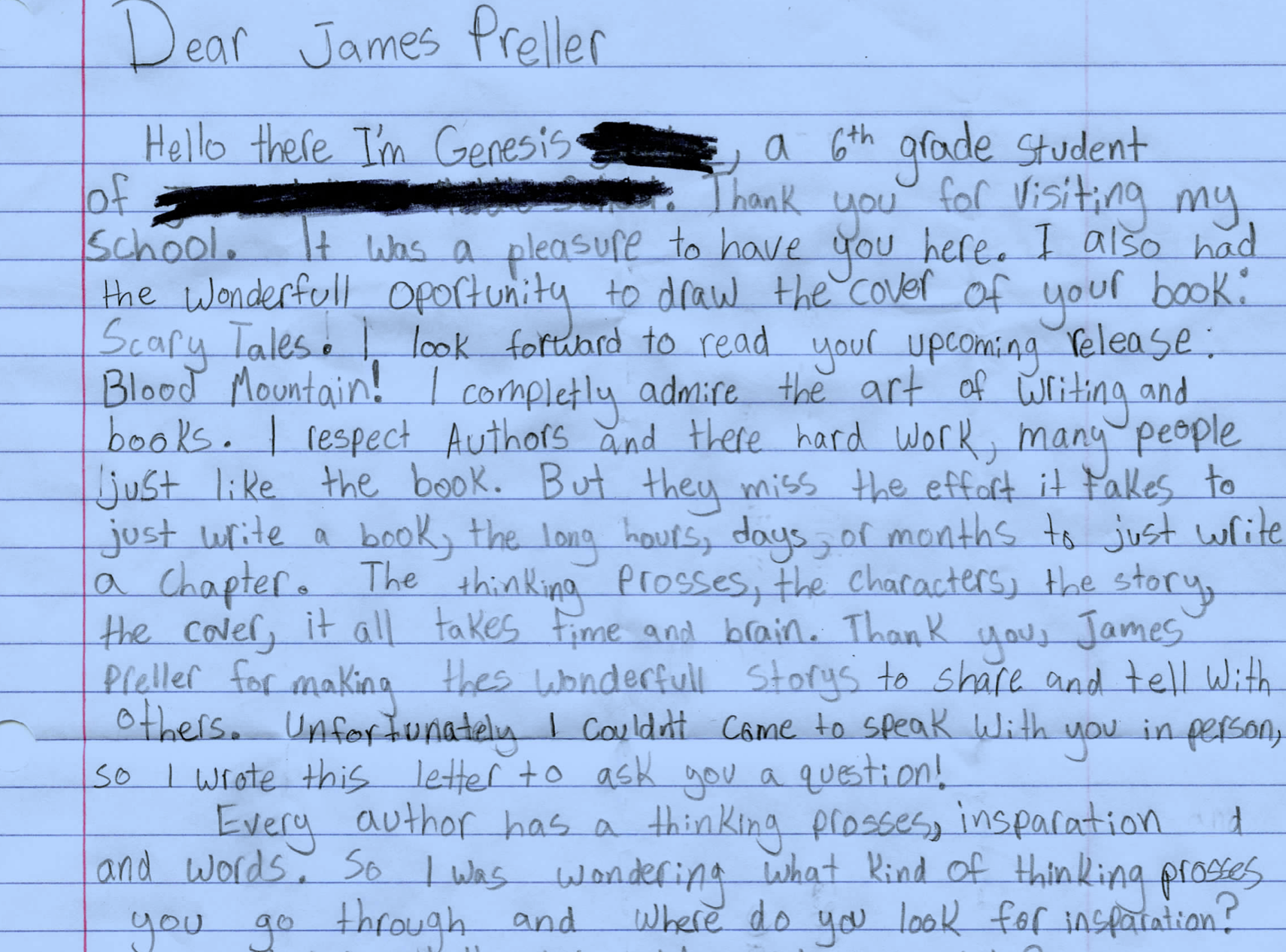
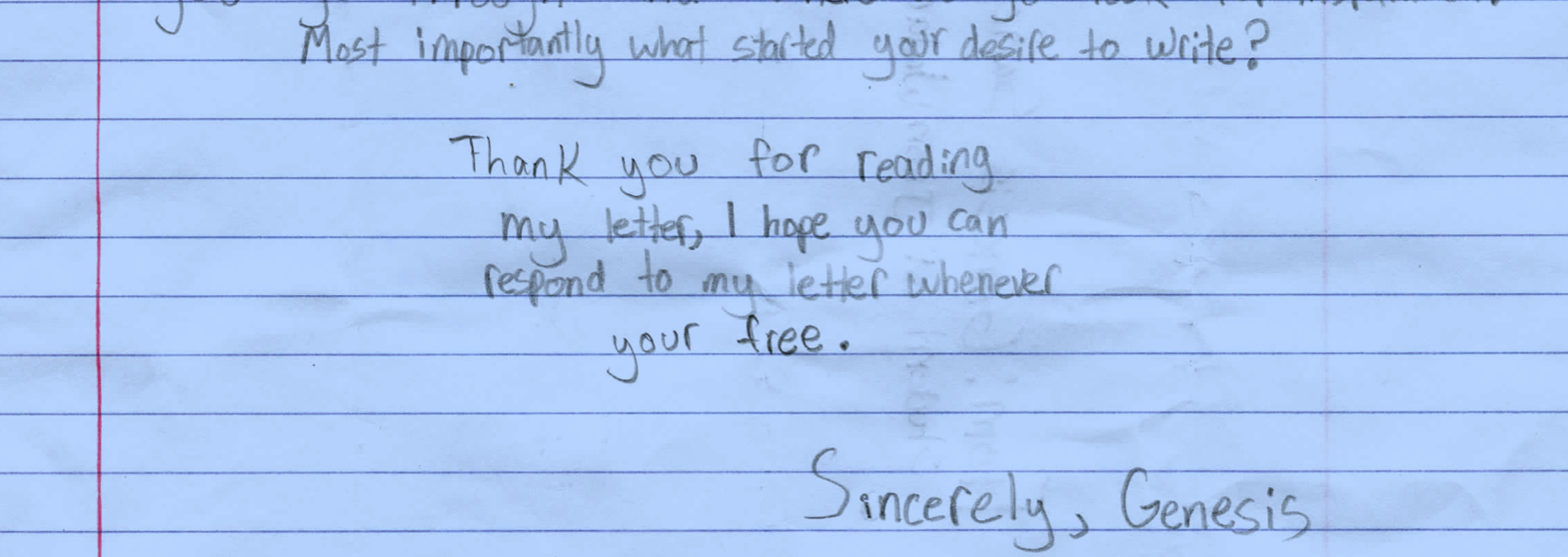
FAN MAIL WEDNESDAY #293: from Genesis to Revelation!

This letter was mysteriously left on a table, near my things, on the day of a school visit to Somewhere, CT. 

I replied . . . 

Dear Genesis,

My apologies for not responding sooner. In my haste, I stuffed your letter into my bag and, well, basically spaced it out. Hopefully my reply will arrive as a nice surprise, sometime after you’ve given up hope.

I must say that you wrote kind of a brilliant letter, Genesis. You are obviously a reader, but more than that, you are a deep reader, someone who seems to have natural insight into the fact that there’s an actual person who wrote the book. Doing research, getting inspired, making choices. You recognize the creative process that informs the book.

When asked to give advice to young writers, that’s often what I tell them: read like a writer, try to think like a writer as you read. So you are correct. Most people just want to happily enjoy the entertainment. Like you said, “they just like the book, but they miss the effort it takes to write a book, the long hours, days, or months to just write a chapter.”

You asked about my thinking process and inspiration. I don’t have an easy answer. When I’m at my best, I think of my brain as particularly “spongy.” I absorb things, receive the signals (like an antenna), maybe with a heightened sense of insight into others: how they feel, how they think. There’s no shortage of inspiration out in the world. The key is to be open. Eyes, ears, heart, brain. Seeing, hearing, feeling, thinking. Then giving yourself time –- and a blank page — to sort it out.

Today I had an idea about the character that I’m writing about, Mary from Bystander. I decided she could have a tarot card reading. I’m not sure why that popped into my brain today. I met a woman over the summer, at the dog park, who gives tarot readings. We’ve talked about it a little. I’m not sure I believe in any of that, but I do find it interesting. For me to write the scene, I’d need to talk again to her, maybe go out for coffee, ask questions, take notes. Or perhaps I should go for my own tarot card reading? Experience it for myself.

The important thing is that the idea appeals to me. It sounds like fun, learning that stuff, writing it. What does Mary discover in the reading? Does she believe it? Does she become upset? Who gives the reading? So many questions to answer. I think, maybe, it could be a friend’s older sister. Somebody just learning about the cards, fooling around with them a little bit. Maybe during a sleepover.

I don’t know, Genesis! The thing is, I’ll work it around in my brain, chew it over, talk to my expert, see if I can fit it into my story. I may ditch it -– or it might become a crucial scene, a pivot point in the story.

As for my desire to write, ha, it comes and goes. This is a tough business, filled with disappointments and great satisfactions. Up and down and up and down and up and down. Endlessly. Like most writers, I’m a reader. And I am perfectly okay with being alone. That’s important. I have the right disposition for the job. I know writers who are very disciplined. They sit in a chair and refuse to rise until they churn out 500 words. That kind of thing. For me, I need to have a certain feeling of fullness. Like, I don’t know, I’m ready. I can’t force it or fake it. Some days, I wish I could.

Thanks for your terrific letter. And thank you for expressing interest in my new book, Blood Mountain. If you do read it, please write back. I’d love to hear what a smart, thoughtful reader like you makes of it.

My best,

James Preller


Fan Mail Wednesday #292: On Jigsaw Jones, Ghosts, and Treehouses


Here’s one from a mystery lover in Indiana . . . 


Dear James Preller,

I really like your book, The Case of the Spooky Sleepover, because it makes me laugh. I like it because it talks about the treehouse. I think treehouses are cool. Who built the treehouse in the story? My favorite part of your book is the treehouse, I want a treehouse, I like the joke Justin played on his brother too. When he tried to scare him and his brother friends, it made me laugh. Do you believe in ghosts? Thank you for writing this book. I really enjoy reading your book.

Sincerely,

Alexander

I replied . . .

Alexander,

Oh, what a nice email! It always makes me glad to hear from a real, live reader.
I’m especially fond of The Case of the Spooky Sleepover, there’s a lot of nice moments in that book. Peeled grapes do feel a lot like eyeballs, don’t you think? Of course, I haven’t felt very many eyeballs, I’m happy to report. 

Illustration by R.W. Alley from THE CASE FROM OUTER SPACE.

As a little boy, I always wanted a treehouse. It just seemed so cool. A house — in a tree! What could be better than that? Unfortunately, my father was not one of those “handy” guys with a hammer and a saw. I never got that treehouse. When I started writing Jigsaw Jones, I remembered that childhood feeling. I wanted Jigsaw to have an office of some kind. You know, a classic detective, meeting clients, looking at clues. So I decided to give Jigsaw the treehouse that I never got. Who built it? I guess I did! However, you might notice that his treehouse isn’t anything fancy. It’s pretty basic. But that’s Jigsaw — he’s just a regular guy.

Do I believe in ghosts? Not in the daytime, no. But when it gets dark, very late at night, I’m less sure.
Keep reading, Alexander, and have a happy halloween. Boo!
Your friend, 
James Preller
NOTE: The newest Jigsaw Jones book, The Case of the Hat Burglar, just came out this August! Somebody has been stealing items from the school’s “Lost and Found.” Who’s the burglar? And what in the world is he doing with all those hats?!

FAN MAIL WEDNESDAY #291: From New Zealand, Via GoodReads

This one came to me in a roundabout way, via GoodReads, where I’m not a member. In fact, I tremble in fear at the very thought of GoodReads, imagining only cruel reviews. I’m not cut out for that. But somebody there did me a solid by going to the trouble of forwarding this message to me, and I’m grateful for that kindness. Thank you, Maria Fernanda. Here’s Graham (my reply is below):


Just like to let you lot at GoodReads that James Preller is a very good book writer. I have started to collect his Jigsaw Jones book here in New Zealand. I have rated 2 books in your website. So I hope that it’ll become helpful.

Please let James Preller know that his books are being read in New Zealand and by a person of his current age.

All the best to you lot at GoodReads. Thank You.

Graham.


I replied:


Graham, 

Thank you for the kind words about my Jigsaw Jones books. That’s awfully nice of you.
The Irish have an expression, “Flowers for the living.”
The idea is that you don’t have to wait for someone to die before you say something good about him. Funny, right? And maybe sad in some ways. In the rush of our days, we don’t often stop to say “thank you” to the people we love, or even “I see you” to the good, decent people in our lives. Parents, friends, teachers, neighbors. Even writers.
You read my book and went to the trouble of saying something positive. You put that out into the world. I really appreciate it.

Illustration by R.W. Alley from THE CASE OF THE HAT BURGLAR.

True story: I despair a lot about my career, especially lately, the many disappointments and shortcomings. It can be awfully hard sometimes. The rejection and, far worse, the indifference. I sometimes wonder if any of it really matters, if maybe I’m in the wrong business. Too late now!

So a note like yours, out of the blue, from New Zealand, well, that’s something to lift the spirits.
Peace to you — and keep reading, it’s good for the soul!
My best,
James Preller

Fan Mail Wednesday #289: About That “Happy/Sad” Thing


I enjoyed this letter from Sasha, who does things, like margins (for example) a little bit differently — which is a good thing, btw.

Why are some of us drawn to sadness?

Note: I mistakenly wrote on the back of Sasha’s letter, so some blue marker shows through. Go ahead, sue me.


I replied . . .


Dear Sasha,

Thank you for your spirited letter — so much of your personality came pouring out, like rain through a screen window. My favorite line: “I legit loved the book!” 

The happy/sad feeling? Oh yeah, I know that one very well. I’ve always been drawn to so-called “sad” things. In music, film, art, whatever. It might be my Irish ancestry, I don’t know. People will say, “Oh, I only want to see happy movies.” But to me, a lot of those “happy” movies just strike me as, yawn, really fake and superficial. I get bored. One thing about sadness: like laughter, it’s a true emotion –- and when we share a truth, any truth, it connects us as human beings. And that makes me happy. So, yeah, the happy/sad thing.

I’ve been hearing a lot lately about the idea of books as mirrors and/or windows. It’s an interesting way of looking at literature and how it functions in our lives, building self-perception and empathy. Some books reflect back upon us –- we see ourselves, perhaps in a new light -– while others help us see into new worlds. I like it.

The beautiful, haunting cover of the Japanese translation of my book, THE FALL.

Another happy/sad book of mine you might like is The Fall. It takes the issue of bullying to a darker place than Bystander, and ends up as a meditation, of sorts, on forgiveness. It’s told from the point of view of a boy, writing in his journal, after a girl’s death. The book won a YALSA award and, strangely, was nominated for some big award in Japan. I suspect they have a misfit/bully problem over there, too. I also have a new book coming out in October, Blood Mountain, a wilderness survival story with a brother, sister, and dog lost in the mountains. Super fast-paced adventure with some good writing, too.

I loved your letter, Sasha. All good things,

James Preller