Tag Archive for Bystander Preller

Fan Mail Wednesday #173: Sally from South Korea Asks About “BYSTANDER”

Here we go, folks. Since this letter essentially consisted of questions, I broke format and inserted my answers directly beneath each question. For your reading pleasure!

This is South Korean student reading your book, Bystander. I really enjoyed reading your book. Your book is even used in debate topic in S.K’s book debate. I am little confused with some parts. And I hope you answer my questions. Thanks.

1. Why did Hallenback hate Eric so much? Eric wanted to help Hallenback.

I don’t have all the answers on this, and by that I mean that your insights are just as valid as mine. For me, I think you need to go back to the opening scene of the book. Hallenback has just been terrorized. He is covered with ketchup, scared and humiliated. Who does he run into but Eric Hayes.  At that first meeting, Eric witnesses David in his time of shame. Utterly degraded. In Eric’s eyes, David Hallenback would always be that bullied kid, covered in ketchup, and Hallenback instinctively knew it.

Later on we learn that David desperately wanted to belong to Griffin’s group. He would have been a lot better off if that was not the case. David resented how the new kid in school, Eric, could quickly be accepted in Griffin’s group of friends. I think when Eric tried to show sympathy to David in the hallway, David perceived it as pity, that Eric was “feeling sorry” for him. So that angered David, too. Remember, when David is hurt or rejected or humiliated, he feels anger — but he doesn’t want to direct it at Griffin. That anger needs a different outlet. Later when Griffin whispers into David ear, asks a favor, David is only too glad to accept. Finally he’ll have a seat at the table.

2. Why did Hallenback try to be friends with Griff?

Oops, I sort of answered that above. For a variety of reasons, Griffin held a certain appeal for David. Griffin was smart, handsome, popular, all the things David wished he could be.

3. What did Eric help directly to Hallenback? He just advised him that don’t let Griff to treat himself with sneer. He just said he understand Hallenback. What help did Eric give to Hallenback?

Foremost, I think Eric was basically decent to Hallenback. Not friends, but civil, respectful, tolerant, compassionate. One time (chapter 19), Eric even tried to reach out to Hallenback a little bit, advise him against Griffin. It only made David angry. In the end, Eric tries to show David another small kindness by offering him a seat at the lunch table, a show of acceptance, but David rejects the offer. Oh well.

4. When Cody got angry with ‘Weasel’ and fought, why did Eric smile in the end? He even thinks ‘Hallenback found out the way to be in Griff’s group’ Is this mean Eric understand Hallenback betraying him, and kicking him? Is he that kind?

No, he’s not that kind. Though maybe he has a twisted sense of humor. The smile and laugh came when Eric was on the ground, bleeding and beaten, and he understood at that moment why Hallenback had betrayed him in the cemetery. David had gotten his unfortunate wish. The smile also signaled to the reader that Eric would be okay.

5. Is Hallenback changed in the end? If he does, how??

I don’t think he’s changed at all, actually. He’s still the same guy. But we’ve seen changes in the people around him. Eric has gained in understanding. Mary changed a lot; so did Cody. We also saw that the police had their eye on Griffin, who had been stealing from parked cars. The future does not look bright for Griffin Connelly. I think in some ways that is what is different about the book. Usually we see how the “bully” is transformed in some positive way. He turns into a nice guy, realizes the error of his ways, everybody becomes friends, etc. I didn’t want to write that kind of book. My focus was on the bystanders, the vast majority, the place where I thought the most meaningful change could occur. I’ll leave you with a quote by Martin Luther King: “The ultimate tragedy is not the oppression and cruelty by the bad people but the silence over that by the good people.”

I have so many questions on this. I am so curious about these to know. I hope you would answer these. Thanks~

You are very welcome!

JP

RE-POST: Imaging the Character of Griffin Connelly in BYSTANDER

I just enjoyed a terrific visit to Virginia, three nights, visiting Matoaca Middle School and Davis Middle School. I stayed in Richmond, was treated like a conquering hero, and all I can do is express my heartfelt gratitude one more time. Thank you to three librarians, Mrs. Masters, Mrs. Green, and Miss Warshen (I hope that’s how you spell it). Most singularly: The trip would not have been possible without the near-heroic efforts of Amanda Brata — and all the teachers/administrators who decided to make Bystander a school-wide read for their students. That’s an amazing honor I don’t take lightly.

SIDENOTE: I know I’m forgetting the name of someone who took me around to classrooms on Monday, and it’s killing me. It’ll come to me, promise!

Over three days, I gave eight (fabulous) large-group presentations. I was also offered the opportunity to enjoy several brief classroom visits. One perceptive student asked about how my intentions when it came to creating the character of Griffin Connelly. It was thoughtful question that I tried to answer as best I could. The truth is, I suspect that I write better — clearer — than I talk. So while I was fumbling for an answer, I referenced this blog post about Griffin’s two-faced quality.

Here’s an excerpt of that old post.

——-

Let’s talk about smiles . . .

I began my work on the book that would become Bystander by hanging out in the local library with a composition notebook. At the top of the first page of that notebook I see that I copied a line from Michael Connelly’s  Echo Park: “What is the bad guy up to?” I was excited. After writing 30-plus Jigsaw Jones mysteries for younger readers, I finally had a bad guy. It wasn’t going to be all benign misunderstandings and well-intentioned foul-ups; here, I had a character with potential for real darkness.

I see that I was reading Savage Spawn: Reflections on Violent Children, by Jonathan Kellerman. A powerful, disturbing book that looks at antisocial youth, from aggressive bullies to cold-hearted killers.

And right there on that first notebook page I started a list of potential “bully” characteristics. I wrote:

Smart, charismatic, charming, popular, superior, tortures animal?, trouble with police?, lights fires, COLD, raised by grandmother?, non-compliant, poor grades, not affected by discipline, causes fear, lucid, psychopathic?, free of angst, free of insecurities, (later, when caught, self-pity), preternaturally CALM.

I was in the first stages of character development — and for me, I’m at my best when character evolves into story, as opposed to plugging character into plot. That is: character first. With my focus exclusively on this “bad guy,” I even came up with a potential book title: Predator.

It became important to me that my main antagonist, Griffin Connelly, was divorced from the bully stereotypes we often see in books and movies. You know, the bully as gross coward, unlikeable lug, dim-witted brute, dirty, ugly, unpopular. It simply wasn’t realistic, and by turning bullies into  one-dimensional characters, we surrendered much of the complexity (and difficulty) of the topic (and story).

A quick plea: There’s a tendency to slot any topical book, such as this, into the bibliotherapy shelf. But Bystander is a story, a page-turner with thriller elements that a biased Jean Feiwel called, “Unputdownable.” It’s not a thesis paper. It’s a good, fast read. I hope boys find it.

Whew. I see that I’m letting this post get away from me, because I’m trying to talk about too much. So I’ll get specific:

I wanted Griffin Connelly to be  a great-looking kid, with charm and verbal dexterity and a great smile. He would be, in every sense of the word, attractive. All the surfaces would shine. The ugliness concealed.

His smile was one of the keys to his character. But what is  a smile if not a baring of teeth? The smile beams beatifically, but also represents a flashing of fangs. A threat. The wolfish grin. There’s menace under the surface.

Griffin Connelly was the kind of person who would smile at you while he stuck a knife in your back. And maybe, for pleasure, gave the blade a twist. The toothy smile was the mask he wore, this master of the mixed message.

Page 7, when Eric first meets Griffin:

The shaggy-haired boy in the lead pulled up right in the middle of the court, halfway between the foul line and the basket. He stayed on his bicycle seat, balanced on one leg, cool as a breeze. The boy looked at Eric. And Eric watched him look.

His hair fell around his eyes and below his ears, wavy and uncombed. He had soft features with thick lips and long eyelashes. The boy appeared to be around Eric’s age, maybe a year older, and looked, well, pretty. It was the word that leaped into Eric’s mind, and for no other reason than because it was true.

Some random examples now . . .

Page 11:

Words came easily to Griffin, his smile was bright and winning.

Page 18:

Griffin flashed a smile, that hundred-dollar smile he could turn on in an instant. He reached out his fist. “Are we cool, buddy

Page 50:

“Mrs. Chavez!” Griffin exclaimed, smiling cheerfully. “Please let me help you with that . . .”

Page 68:

There was no way Eric could tell Griffin Connelly that story. So he told bits and pieces and white lies. Eric wondered if Griffin sensed it, the whole truth, if somehow Griffin already knew, saw into Eric’s secret heart and smiled.

Page 78:

“You want to hang out, don’t you?” Griffin asked. He smiled, put an arm around Hallenback’s shoulder.

Page 130:

Griffin winked at Eric. Then gave that big Hollywood smile, and swept the hair from his eyes.

Page 130:

“What are you going to do? Punch me?” Griffin taunted, grinning.

Page 131:

“I’ll be seeing you around, Eric,” Griffin said. His smile was like a pure beam of distilled sunlight. His long lashes blinked, his cheeks pinkened. He wore a perfect mask of kindness and light.

Page 165:

Griffin smiled wide, folded his hands together, and said in a soft voice, “We’ll see about that.”

Page 186:

Griffin grinned through the insults.

——-

Presented in this way, it may seem a little much. But  in the context of the story, I suspect it’s unnoticed. The accumulated effect, I hope, is creepiness. Here’s a guy you can’t trust. Every threat comes with a smile. White teeth gleaming in the sunlight, fangs bared.

“My Grandma, what big teeth you’ve got?”

Don’t let that smile fool you.

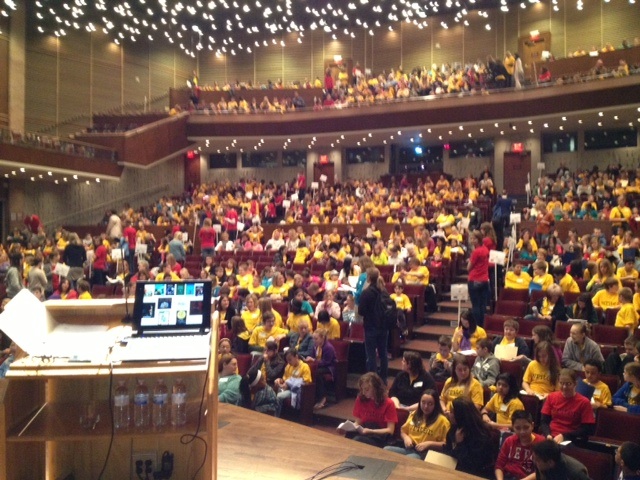
KINDNESS: My Trip to the 2013 Youth Writing Festival at Calvin College

I just returned from a wonderful, two-night trip to Grand Rapids, Michigan, where I was invited (by Gary Schmidt!) to participate in the 2013 Youth Writing Festival at Calvin College.

At one point it looked exactly like this:

As my Nation of Readers is well aware, I do many visits — particularly at this time of year. It’s fun, it’s beautiful to meet those children, and it’s work. Most visits are great, a few decidedly less so (oh, the stories I could tell), and every once in a while the entirety of a visit feels like a blessing.

Like I’m the luckiest guy in town.

That’s how I felt for my entire trip at Calvin. I was surrounded by caring, dedicated teachers and volunteers  who could not have possibly treated me with more kindness.

These folks did it right every step of the way, and I am grateful to all of them (Gary, Judy, Don, Kristin, Nancy, Debbie . . . far, far too many folks to name, from the President of the College who invited us into his home to the student volunteers who assisted us in countless ways).

For example, in the hotel room, I found a basket of treats and this sweet letter:

I certainly don’t need to be treated like a big deal, and it’s not anything I’ll ever actually believe, but it’s awfully nice when it happens.

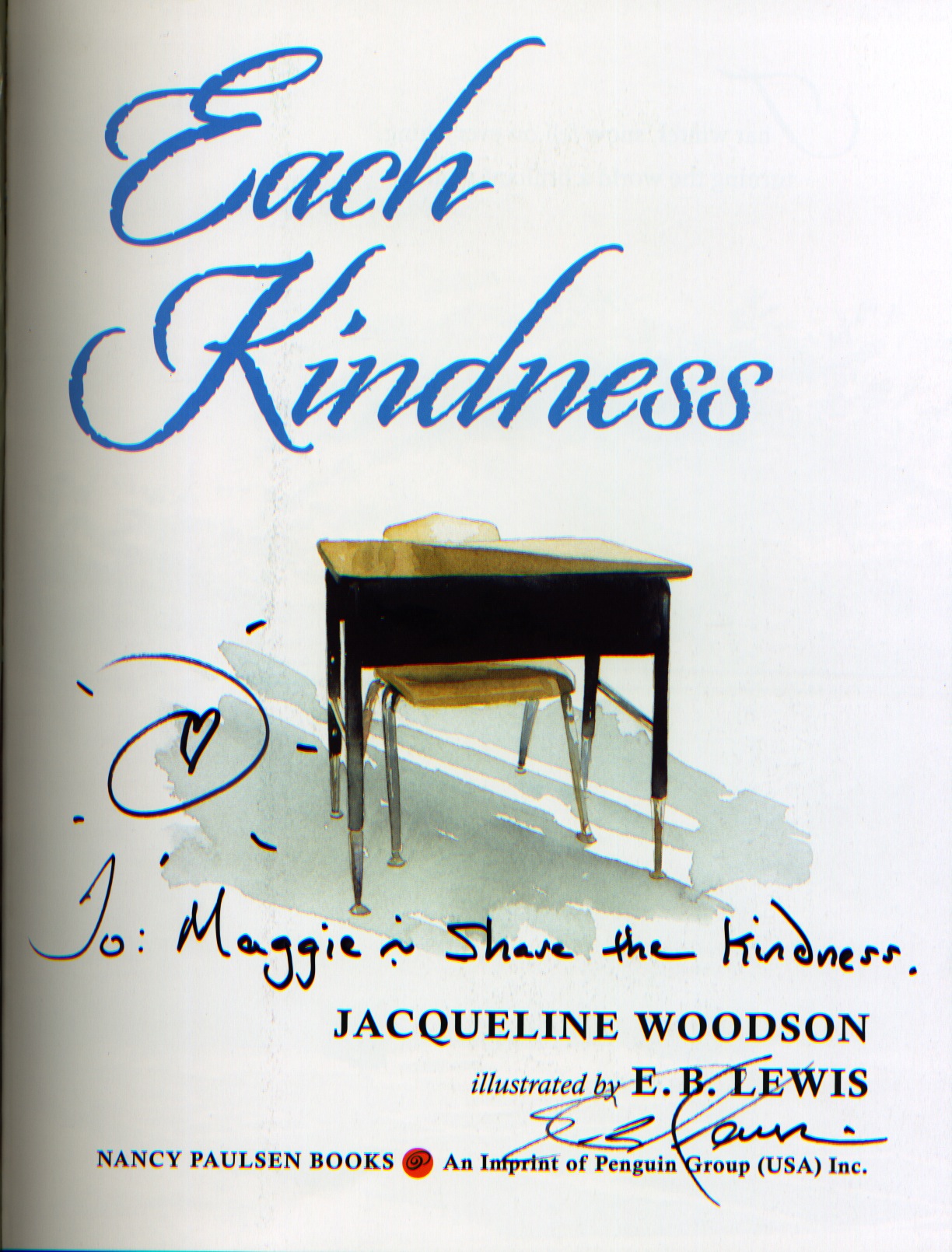
As an added bonus, I had the pleasure of meeting artist E.B. Lewis, a dignified man of talent, character, and intelligence. I picked up a copy of his latest book, Each Kindness, written by the great Jacqueline Woodson.

I love this book’s focus on kindness.

And, yes, that sad ending of lost opportunity hits me dang in the heart, hard.

Illustration by E.B. Lewis.

Since I first published Bystander in 2009, I’ve all seen a massive shift in focus on the issue of bullying in the media and in our schools. To the point where it almost feels . . . not over-stated, that’s the wrong word, but somehow . . . misguided at times. Students, especially, seem wary of being talked down to, lectured at, scolded. Hit over the head with the topic, turned off. You have to find a way to bring them to the core values, I think, and I believe that A GOOD STORY is far more effective at building empathy than a list of do’s and don’ts.

I suppose my radar has been, perhaps, more finely attuned to the issue over the past few years. I don’t really believe in talking about “bullying,” per say, since I don’t think that should be the main subject. I believe it’s  more basic than that, for “bullying” is just a sub-set of more significant themes for our children to encounter, consider, and embrace. One trend that I really like (see R.J. Palacio’s Wonder as a prime example) is a renewed focus on the simple things at the heart of the matter: how we should treat each other.

Words like empathy, decency, tolerance, compassion, and kindness.

Basic human kindness. Being a good person.

Do unto others.

Or questions like: How do you think it feels? How would you like to be treated?

This book powerfully expresses those ideas (and ideals).

We learn by meeting characters, by stepping in their shoes, by imagining their feelings, the rumblings in their hearts. We learn through the power of story — that essential human art form that’s been with us since cave dwellers gathered around the fire.

I highly, highly recommend the book, Each Kindness.

I even got a signed copy for my daughter.

Thanks, E.B.

And thank you, everyone at Calvin College, for a trip I’ll long remember.

One Reason Why I Titled the Book “Bystander”

Comments Section, re: BYSTANDER (a couple of highlights)

Oftentimes folks comment on past blog entries, no longer the current thread. So my sense is that My Nation of Readers does not ever see these comments.

And how sad is that?

So here’s two from today that I had to share. The first one made me laugh . . .

From Dakota:

I was reading your book called BYSTANDER. In the chapter called ” repairs”. I was reading page 198 and It said “Cody pulled a dirty bandanna from his back pocket to wipe the grease from his hands.” I thought it said cody pulled a dirty banana out of his back pocket. I was reading it in a group and every one laughed when i said ” dirty banana” instead of “dirty bandanna.”

From Makayla:

I read your book BYSTANDER and to be honest it was outstanding! You really know how to use all types of figurative language. Like when you described the buses as being “enormous Twinkies.” It really made our class laugh out loud. I liked how you titled the chapters, like how you made them important in that section of the book. You are a truly talented author and I look forward to reading more of your books. Thank you for your time Mr. Preller.