Tag Archive for Before You Go Preller

BEFORE YOU GO: The Imaginary Soundtrack to My Young Adult Novel, Part 1

No blogging for at least a week until I beat a deadline into submission, literally. So ’til then . . .

I’ve concocted an imaginary soundtrack that plays during the imaginary movie that’s based on my (real!) upcoming Young Adult novel, Before You Go (July 17, 2012) I didn’t sweat the details, such as, oh, there’s no movie and even if there was, we couldn’t afford many of these bands. Not going to worry about that. These are the songs I hear in my head as I move through the book, the songs that helped me as a writer.

Setup: For those who don’t know, the story opens with four unnamed teenagers driving on a dark road. The car spins out of control, hits a tree. One passenger dies. Next page, we rewind six weeks into the past, and gradually meet all the characters. The reader does not know who is going to be in the car, or who will die. The book catches up to the accident about 2/3 of the way through. So the book is in two sections: “Before” and “After.”

For purposes of length, and to avoid disclosing any key spoilers, I’ve limited today’s post to Part One, “Before.”

And away we go, chapter to chapter . . .

THE ACCIDENT

Tom Petty, “Here Comes My Girl”

You need to a flashplayer enabled browser to view this YouTube video

Probably not the hippest selection in the world, and surely classic rock isn’t the right note to start off with, but I always heard this Tom Petty tune blasting from the radio as the car races through the fogged, misty night. Anyway. Key lyric: “You know, sometimes, I don’t know why, but this old town just seems so hopeless.”

PART ONE: BEFORE

ONE

The Cure, “Pictures of You”

You need to a flashplayer enabled browser to view this YouTube video

This is Jude’s recent obsession as a guitar player, this exact tune, and the music plays when he shoves in the ear buds while riding the bus to his first-ever summer job. I see him staring out the bus window, crossing the bridges, the summer morning, the traffic and the water and the gulls.

TWO & THREE

The Head and the Heart, “Lost In My Mind”

You need to a flashplayer enabled browser to view this YouTube video

This doesn’t precisely connect to the material, but somehow reflects interior Jude, going through the motions at his new job, punching the clock, meeting the new boss, putting on the paper hat. It’s a mood thing. Key lyric: “‘Cause there are stars/Up above/We can start/Moving forward.” And also, “Put your dreams away for now/I won’t see you for some time/I am lost in my mind/I get lost in my mind.”

FOUR

Toro Y Moi, “Still Sound”

You need to a flashplayer enabled browser to view this YouTube video

Full on beach mode, Jude working hard now, the sun-burnt throng, great-looking girls in bikinis — and he sees Becka for the first time.

FIVE

Arcade Fire, “Suburban War”

You need to a flashplayer enabled browser to view this YouTube video

I see Jude returning home from work, walking the suburban streets, seeing his father out front, opening the door, going inside. Key lyric: “This town’s so strange/They built it to change/And while we’re sleeping all the streets, they rearrange.” There’s also a foreshadowing in a later line: “In the suburbs, I learned to drive/People told me we would never survive.

SIX

Big Star, “I’m In Love with a Girl”

You need to a flashplayer enabled browser to view this YouTube video

One of the all-time favorite songs, all that teenage vulnerability and yearning. We’ve got to find a place for it somewhere in the imaginary movie soundtrack, so we’ll squeeze it in here.

Ben Folds, “Not the Same”

You need to a flashplayer enabled browser to view this YouTube video

Jude and his best friend Corey climb the roof of his house, overlooking their suburban world. About the homemade fan video, above, made by two brothers, I love the vibe they created. Good, clean fun. Nice job, guys.

SEVEN & EIGHT

Charlotte Gainsbourg, “Me and Jane Doe”

You need to a flashplayer enabled browser to view this YouTube video

Cool tune, seems to be a conversation of sorts, and I wanted a female voice entering the soundtrack. I hear this with Jude and Becka outside on the bench in the open air, feeling each other out. Leads to this miraculous version of “Hey Jude” by Wilson Pickett and Duane Allman. All the lyrics to this song work for this character, “And anytime you feel the pain, hey Jude, refrain/Don’t carry the world upon your shoulders.” Or this: “And don’t you know that it’s just you, hey Jude, you’ll do/The movement you need is on your shoulder.

Wilson Pickett, “Hey, Jude”

You need to a flashplayer enabled browser to view this YouTube video

NINE

Teenage Fanclub, “Sometimes I Don’t Need to Believe in Anything”

You need to a flashplayer enabled browser to view this YouTube video

Fits with the feeling of time on the boardwalk, putt-putt golf, and talk about guitars. Sunny and happy, Becka and Jude. And I worship Teenage Fanclub.

TEN

Stornoway, “Fuel Up”

You need to a flashplayer enabled browser to view this YouTube video

The car imagery again, the youthful reflection, the open road — but not in the way that Springsteen writes about it, or even Kerouac, but here with a mixture of innocence lost and trepidation. Key lyric: “And your head’s on the window, your eyes are just closed/There’s a voice in the front and a hush on the road/You’re a passenger but your mind is travelling on.” Again with Jude, there’s this insular sense, lost in his mind almost regardless of circumstances. So many times he’s not fully there.

ELEVEN

Yuck, “Get Away”

You need to a flashplayer enabled browser to view this YouTube video

Just the right sound as the pace picks up, four boys in the car kicking back. But at the same time, a part of Jude will always, always, remain separate. He’s texting with Becka, thinking of her. Key lyric: “Summer sun says get out more/I need you, I want you/But I can’t get this feeling off my mind/I want you, I need you.//Oh, I can’t get away, Oh, I can’t get away . . .

12

Laura Marling, “Rambling Man”

You need to a flashplayer enabled browser to view this YouTube video

I kind of associate Becka with Laura Marling. I can imagine Becka owning some Marling on vinyl, spinning it in a candle-lit bedroom. Marling appears on this soundtrack in my head — lawyers be damned. This little scene between Jude & Becka at the beach has, like so many scenes with Jude, that underpinning of sadness to it. Key lyric: “Oh, naive little me/Asking what things you have seen/You’re vulnerable in your head/You’ll scream and you’ll wait till you’re dead.”

13

Rosewood Thieves, “Los Angeles”

You need to a flashplayer enabled browser to view this YouTube video

This song just brings the hip, cool vibe I needed to hear. But it also reflects absence and longing, Jude’s little sister, Lily, gone forever. Key lyric: “It’s been so long since I’ve seen her around here/I can’t remember if she’s real/Summer days spent walking around/And up all night yeah/Trying to remember if she’s real.”

14

M83, “Midnight City”

You need to a flashplayer enabled browser to view this YouTube video

Let’s party like it’s 2012. Good times, hanging out, knocking down the pins, drinking smuggled-in rum & coke. If this song plays when I’m bowling, hey, maybe I finally crack 150 if it’s cranked up LOUD enough.

15 & 16

Beirut, “The Rip Tide”

You need to a flashplayer enabled browser to view this YouTube video

Sun Kil Moon, “Floating”

You need to a flashplayer enabled browser to view this YouTube video

Joni Mitchell, “All I Want”

You need to a flashplayer enabled browser to view this YouTube video

There’s the beach, the sadness of their conversation, and then together entering the water, floating, faces turned to the sun, and liquid desire. These songs are those feelings.

17

Wilco, “You and I”

You need to a flashplayer enabled browser to view this YouTube video

Jude and Becka swapping songs on guitar, hanging out on a blanket, falling in love, together. If you don’t know this song, or the greatness of Feist, listen up!

18

Foo Fighters, “Home”

You need to a flashplayer enabled browser to view this YouTube video

A stunning and sensitive performance by Dave Grohl. At the end of this chapter, Becka wipes a tear from Jude’s face and tells him, “When you cry, I taste salt.”

19

The War on Drugs, “Brothers”

You need to a flashplayer enabled browser to view this YouTube video

Good times, Corey and Jude, gaming in the basement. Great friends, waiting for their ride, ready to hit that party at Gilgo Beach. As they are about to leave, four teenagers in a car, Jude’s father calls out, “Hey, before you go . . .”

20

Lana Del Rey, “It’s the End of the World

The original version of this song, by the great Skeeter Davis, ran through my head all through the writing of this book. I don’t think Lana Del Ray nails this version, by any means, but I like the idea of a hip update, sans strings, so submit that notion here. This is the chapter of the accident: “Don’t they know, it’s the end of the world? It ended when you said goodbye.”

Anyway, here’s the Skeeter Davis version — now imagine a more contemporary, stripped down take, without the syrupy excesses of the classic arrangement. Not criticizing Skeeter, btw, the original song is perfect. Just that for my movie, and for this song to reach a new audience, it needs a different take. IMO.

You need to a flashplayer enabled browser to view this YouTube video

Fan Mail Wednesday #157: Author Advice, Before You Go . . .

Dear Mr.Preller,

I am a big fan of your books.  I am in seventh grade this year, and two years ago, in fifth grade, you visited my school.  You talked about a book you were writing, about four teenagers/young adults, and they were in a car crash, and one of them died.  I was trying to find the book, but I don’t remember the title, and I was wondering if you just haven’t published it yet, and what the title is.
Also, when I am older, I hope to become an author.  So I was wondering if you have any helpful hints to writing a book, or publishing one.
Thanks so much, and please write back!
Sincerely,
A huge fan!
I replied:
Megan,

What a sweet note, thanks for remembering that I exist.

For remembering, that is, during your busy life, that oh, somewhere on this planet there’s a guy who came to my school two years ago.

The book is titled BEFORE YOU GO, and will be available on July 17th.

Helpful hints? Oh gosh. You know, the disappointing thing is that there’s nothing really new or profound to tell you. And it’s not like I’ve got it all figured out, by any stretch of the imagination. But #1, you’ve got to read. Widely, deeply. And pay attention as you read. By that I mean, sure, it’s fun to escape into a story, to get lost in a book. But I think writers also read on a different level, with more awareness about the craft. Such as, “Wow, I’m really scared right now, I can’t turn the pages fast enough.” Ask yourself, how did the author do that? If an author paints a vivid picture in your mind, if you can really see something, go back and reread that section. Notice the language.

In other words, think like a writer.

The other tip, I think, is there are no shortcuts. If you want to write, then you really should have a journal. And give yourself time to be alone, to be quiet with your thoughts, and put some of those words on the page. You don’t have to start to write your own amazing 400-page novel (unless, of course, that’s what you really want to do). Mostly, read and write, watch and live. Enjoy life, enjoy people. See them, try to notice things, imagine how you might describe someone you know, the way a friend maybe crosses her arms & squeezes the skin of her elbows when she’s nervous . . .

Hey, I’ve got to run. Sorry if this is a little disorganized, I’m feeling rushed today. Take care, Megan, and good luck!

JP

Brief Excerpt from BEFORE YOU GO, featuring “Pictures of You” by the Cure

I received a note today from a friend who read an advance copy of Before You Go (July, 2012).

She wrote, in part:

Dear Jim,

I just want to thank you for sending the advance reader’s copy of  Before You Go.  From the start I found the book simultaneously compelling and anxiety provoking, since it was clear one of the main characters would wind up dying in the shotgun seat.  But I read on, and along the way enjoyed seeing the world through Jude’s eyes.

Although the protagonist is a boy, I think Before You Go will especially resonate with girls, since much of it is about the complex interrelationships between the characters. But both boys and girls are nicely drawn.

Thanks again for sharing Before You Go — with this book,  Bystander, and Jigsaw Jones, I’m becoming quite a fan!

Susan

P.S.  I must confess I’d never heard of The Cure (what can I say? I think I missed most of the 80’s), but I’ve since listened to Disintegration.  You’re broadening my horizons!

A word of explanation: In an early scene to Before You Go, we meet the main character, Jude, as he rides a bus to Jones Beach for his first day of work. Jude plugs in the ear buds and listens to this song . . .

You need to a flashplayer enabled browser to view this YouTube video

The song became, for this book, and for me, the song. Somehow a guiding light, a sonic north star, the interior soundtrack of Jude’s heart and spirit. Thank you, Robert Smith and The Cure, awesome song. I can absolutely see my character sitting on that bus, head leaning against the pane, staring at the boats out on the water.

A paragraph from the book:

The bus came and everybody shuffled on board, feet dragging. Jude grabbed a seat toward the back, stuffed in ear buds, found The Cure on his iPod, gazed out the window for the ride south on Wantagh Parkway. Jude had been obsessing over the Cure lately, especially the best tunes off “Disintegration.” As a band, they peaked in early 90’s, but Jude liked them anyway. Music was music, it didn’t matter if a song was made fifty years ago in Liverpool, England, or behind some guy’s woodshed five minutes ago. The good tunes stuck and the rest dropped away. Some days Jude could listen to “Pictures of You” on an endless repeat cycle, losing himself in the interplay of guitar, synthesizer and bass. That the Cure’s songs were often dark, brooding and melancholy only made it all the better.  Jude had played guitar for eight years now, practicing four, five times a week. Guitar was his retreat. It was a door closing, shutting the world out, and a window opening, connecting him to something other, a rift in space through which he escaped for hours at a time. Jude felt, not without reason, that music had saved his life. But hey, music made everything better –- even bus rides to a particular version of sucks called My First Day on the Job.

Comment: Looking at this now, I realize that I’m such a music guy. As a reader, I’m often bored by passages about furniture and Sally Mae’s wardrobe. The parts that, as Elmore Leonard famously described it, readers tended to skip. It just wasn’t important to me. But the music a character listened to? The tunes on his mix-tape? Those are telling details, things I want to know. I feel that way at the gym. I want to tap an ear bud-wearing stranger on the shoulder, ask, “What are you listening to? What sounds are you putting into your skull right now? Who are you?”

“Pictures of You,” lyrics

I’ve been looking so long at these pictures of you
That I almost believe that they’re real

I’ve been living so long with my pictures of you
That I almost believe that the pictures are
All I can feel

Remembering
You standing quiet in the rain
As I ran to your heart to be near
And we kissed as the sky fell in
Holding you close
How I always held close in your fear
Remembering
You running soft through the night
You were bigger and brighter and wider than snow
And screamed at the make-believe
Screamed at the sky
And you finally found all your courage
To let it all go

Remembering
You fallen into my arms
Crying for the death of your heart
You were stone white
So delicate
Lost in the cold
You were always so lost in the dark
Remembering
You how you used to be
Slow drowned
You were angels
So much more than everything
Hold for the last time then slip away quietly
Open my eyes
But I never see anything

If only I’d thought of the right words
I could have held on to your heart
If only I’d thought of the right words
I wouldn’t be breaking apart
All my pictures of you

Looking so long at these pictures of you
But I never hold on to your heart
Looking so long for the words to be true
But always just breaking apart
My pictures of you

There was nothing in the world
That I ever wanted more
Than to feel you deep in my heart
There was nothing in the world
That I ever wanted more
Than to never feel the breaking apart
All my pictures of you

Photo: Curl Up to a Good Book

A librarian friend sent me this photo.

Proof that cats, like mothers, have great taste when it comes to 2012 YA debut novels.

“My Life’s Sentences” by Jhumpa Lahiri (on the art and craft of writing — and reading!)

I have to share this brilliant piece from The New York Times Sunday Review, March 18, 2012, written by the Pulitzer Prize-winning author, Jhumpa Lahiri. I powerfully identified with it.

In it, she expresses her love of sentences. Everything about this piece confirms, echoes, and expands upon my own feelings as a writer and a reader. Though we’re told that Lahiri’s piece is part of a series about “the art and craft of writing,” it is just as much about reading. Perhaps more so. Teachers, librarians, editors, readers, please check out it.

Art by Jeffrey Fisher.

Here’s the opening . . .

In college, I used to underline sentences that struck me, that made me look up from the page. They were not necessarily the same sentences the professors pointed out, which would turn up for further explication on an exam. I noted them for their clarity, their rhythm, their beauty and their enchantment. For surely it is a magical thing for a handful of words, artfully arranged, to stop time. To conjure a place, a person, a situation, in all its specificity and dimensions. To affect us and alter us, as profoundly as real people and things do.

I remember reading a sentence by Joyce, in the short story “Araby.” It appears toward the beginning. “The cold air stung us and we played till our bodies glowed.” I have never forgotten it. This seems to me as perfect as a sentence can be.

As I’ve said before on this blog, that’s how I read — pen in hand, underlining sentences, making marks, asterisks and exclamation points, my beloved marginalia. But the thought that really had me nodding in agreement was how the best sentences made me stop reading. I looked up from the page, thinking, feeling, dreaming. It’s counter-intuitive. We want readers to keep turning the pages, right? To devour the book, consume it. Well, maybe not. Maybe we want them to slow down, or stop altogether.

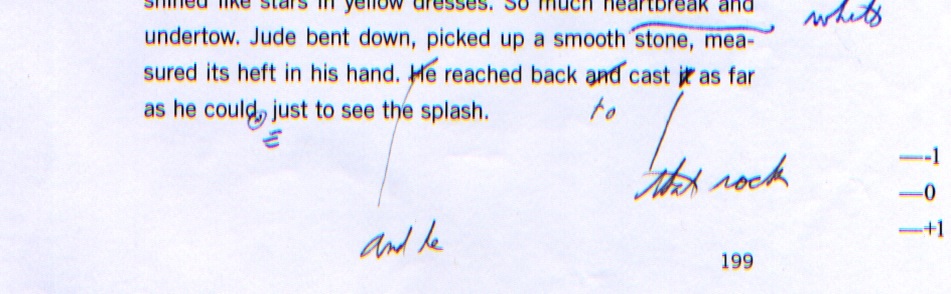
From my copy of Let the Great World Spin, by Colum McCann.

That’s why, I think, that I’m so often uncomfortable when I encounter the counters and the tickers, the well-meaning folks who inform us how they read exactly 214 books this year and so on. I don’t mean to insult anyone, but I’m so tired of the idea of quantity.

Pause and reflection, that’s reading too.

Of course, there are different kinds of reading. Librarians, for example, tend to read with an ultimate user in mind. So he burns through a Percy Jackson book (doesn’t that kill you when folks use that language, burning through a book), wanting to be familiar with it, but mostly thinking, “I can’t wait to give this book to about twelve boys I know.” That’s an altogether different reading experience — and probably a topic for another day.

Speaking of sentences, here’s a sturdy one:

The best sentences orient us, like stars in the sky, like landmarks on a trail.

And in the next paragraph:

They remain the test, whether or not to read something. The most compelling narrative, expressed in sentences with which I have no chemical reaction, or an adverse one, leaves me cold.

This is exactly why I could not continue reading Twilight, for example. For me, there was no spark in the sentences, no electric connection between writer and reader. I couldn’t even get past them to story.

Sentences are the bricks as well as the mortar, the motor as well as the fuel. They are the cells, the individual stitches. Their nature is at once solitary and social. Sentences establish tone, and set the pace. One in front of the other marks the way.

Another sentence to underline:

My work accrues sentence by sentence.

So true, could it be any other way? Bird by bird, sentence by sentence, brick by brick.

I hear sentences as I’m staring out the window, or chopping vegetables, or waiting on a subway platform alone. They are pieces of a jigsaw puzzle, handed to me in no particular order, with no discernible logic. I only sense that they are part of the thing.

I talk to students about this in a different way, more about ideas than sentences. Those times when you are thinking that you are not thinking. That’s often when the ideas come, when the sentences, unbidden, line up inside your skull. I know a book is going well when sentences come to me in the shower.

Last  thought — and please, go to the original piece, read it in full — I also connected with Ms. Lahiri’s concept of revision:

All the revision I do — and this process begins immediately, accompanying the gestation — occurs on a sentence level. It is by fussing with sentences that a character becomes clear to me, that a plot unfolds. To work on them so compulsively, perhaps prematurely, is to see the trees before the forest. And yet I am incapable of conceiving the forest any other way.

Students are taught the writing process in school, the five steps, brainstorming and so on, that it’s easy to imagine each as isolated, distinct from the other. In fact, many experts advise writers to “just write” in the beginning, get the words on the page, don’t worry about mistakes. And while I understand that point of view, that’s never been how I do it. Revision begins instantaneously, inextricably linked to the writing impulse. In this age of trumpeting daily word counts on status updates — “1,687 words today!” — it’s nice to read that maybe I haven’t been doing it completely wrong after all.

When something is in proofs I sit in solitary confinement with them. Each is confronted, inspected, turned inside out. Each is sentenced, literally, to be part of the text, or not. Such close scrutiny can lead to blindness. At times — and these times terrify — they cease to make sense. When a book is finally out of my hands I feel bereft. It is the absence of all those sentences that had circulated through me for a period of my life. A complex root system, extracted.

I have just been through this with my upcoming book, Before You Go (Macmillan, July 2012).

And though all my favorite writers are great sentence-makers, with this novel I came closest to that ideal. This book has my best sentences. Each confronted, inspected, turned inside out. Yes, the sentences are vehicles for ideas, feelings; they carry story on their shoulders. But story itself consists solely of sentences, sounds, rhythms, meanings. And  now that my book is at the printer — hey, before you go! — too late, too late! — I too feel a bit bereft.

The only way out of that hole is to write a new story. Sentence by sentence.

Go here to learn more about Jhumpa Lahiri.