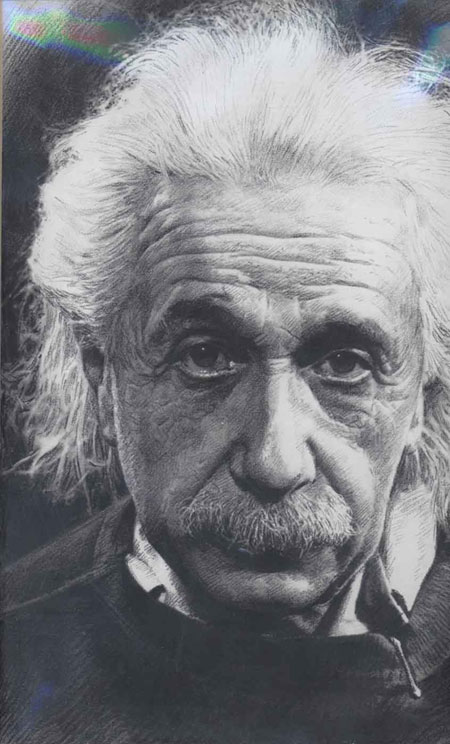
Last night I came across a chilling story behind a famous photograph of Albert Einstein.
The portrait was taken by Philippe Halsman, a photographer who had escaped Nazi Germany with Einstein’s help. Meeting together in 1947, Halsman held a camera while he chatted with Einstein. He asked Einstein if he believed there could ever be a lasting peace.
Einstein answered with weary resignation,
“No, as long as there will be man, there will be war.”
“At that moment Halsman clicked his shutter and captured Einstein’s sadly knowing eyes for what became a famous portrait.”
Here’s the Halsman photograph. You can almost see the thought lingering behind his eyes.
While I surfed that up, I also caught another wave — a copy of the first page of the letter that Albert Einstein wrote to President Franklin D. Roosevelt, alerting him about the potential of “extremely powerful bombs of a new type.” This was the letter that set the Manhattan Project into motion. As a side note, though this was a matter of utmost urgency, it required two months for the letter to be finally delivered into the President’s hands.
I’ve been reading Walter Isaacson’s warm, affectionate biography,Einstein: His Life and Universe. I purchased a copy when the book first came out, but it sat on my shelf for a few years before I tackled it. Einstein’s popularity was, and remains, rather astonishing. He was, after all, a scientist. Before reading the book, I don’t think I fully appreciated how this man, this thinker, captured the public imagination. He became a bona-fide celebrity, a media darling who was often hounded by paparazzi. Think about that. These days, we’ve got Snooki and Charlie Sheen.
One of the things about fascinating people is that the more you know . . . the more you want to know. I feel that way about Bob Dylan, Charles Lindbergh, John D. Rockefeller, Ted Williams, Temple Grandin, Patti Smith. The list goes on. With most celebrities today, it feels like the exact opposite. The more we learn, the less we care to know. As Yoda might say, “To the shower rushing we go.”
The book includes many photographs and, again, Einstein is simply one of those guys who never took a boring photograph. He’s like Keith Richards that way. Any picture with Einstein is interesting. Here’s one of my favorites, Einstein on the beach. Somebody should turn it into an opera. Oh, wait. He loved sailing, did you know that? Charming tales of him taking out the sailboat, drifting along all day, lost in reverie; more than once they had to send out the coast guard looking for him.
After college, I worked in Washington, D.C., for a year. No, not as a state senator — I was a waiter at Beefsteak Charlie’s on K Street. I think my favorite spot in the city was Einstein’s Memorial, a quiet spot missed by most tourists, not far from the Vietnam Veterans Memorial. The statue by Robert Berks is bronze, over 12 feet, and weighs more than 4 tons. I tried to lift it, but no go. Usually I just sat by his knee, enjoying the great man’s near company.
But the best photo of Einstein does not even include him. Einstein is absent, and yet wholly present. It’s the classic shot of his office in Princeton, New Jersey, taken by Ralph Morse for LIFE magazine on April 18, 1955, the day of Einstein’s death at age 76. Take a gander.
What a glorious, cluttered, creative mess. A great mind at work. Don’t you feel better now?
I should also comment that in the biography Isaacson does a marvelous job in giving us the whole man, not just the rumpled genius. Yet in rendering the whole man, Isaacson includes the science — in as straightforward and relatable way as possible. Still over my head, but when I jumped, I could almost touch Einstein’s stars.
For your listening pleasure, here’s a clip from the Philip Glass opera, “Einstein On the Beach.”
Tom Waits reads “Nirvana,” a great poem by an imperfect man, Charles Bukowski.
the young man
thought, I’ll just sit
here, I’ll just stay
here.
but then
he rose and followed
the others into the
bus
I really enjoyed this fan video, created by somebody out there and shared on Youtube. Great job, brother. Hits the mood exactly right.
Nirvana, a poem by Charles Bukowski
not much chance,
completely cut loose from
purpose,
he was a young man
riding a bus
through North Carolina
on the way to somewhere
and it began to snow
and the bus stopped
at a little cafe
in the hills
and the passengers
entered.
he sat at the counter
with the others,
he ordered and the
food arived.
the meal was
particularly
good
and the
coffee.
the waitress was
unlike the women
he had
known.
she was unaffected,
there was a natural
humor which came
from her.
the fry cook said
crazy things.
the dishwasher.
in back,
laughed, a good
clean
pleasant
laugh.
the young man watched
the snow through the
windows.
he wanted to stay
in that cafe
forever.
the curious feeling
swam through him
that everything
was
beautiful
there,
that it would always
stay beautiful
there.
then the bus driver
told the passengers
that it was time
to board.
the young man
thought, I’ll just sit
here, I’ll just stay
here.
but then
he rose and followed
the others into the
bus.
he found his seat
and looked at the cafe
through the bus
window.
then the bus moved
off, down a curve,
downward, out of
the hills.
the young man
looked straight
foreward.
he heard the other
passengers
speaking
of other things,
or they were
reading
or
attempting to
sleep.
they had not
noticed
the
magic.
the young man
put his head to
one side,
closed his
eyes,
pretended to
sleep.
there was nothing
else to do-
just to listen to the
sound of the
engine,
the sound of the
tires
in the
snow.
“What we need to understand is that books weren’t written so that young people could write essays about them, but so that they could read them if they really wanted to.” — Daniel Pennoc.
–
A note from my pal, Lewis Buzbee, alerted me to a book he figured was right up my alley.
Here’s the summary from Indiebound:
First published in 1992 and even more relevant now, Daniel Pennac’s quirky ode to reading has sold more than a million copies in his native France. Drawing on his experiences as a child, a parent, and an inner-city teacher in Paris, the author reflects on the power of story and reminds us of our right to read anything, anywhere, anytime, so long as we are enjoying ourselves. In a new translation with a foreword and illustrations by Quentin Blake, here is a guide to reading unlike any other: fresh, sympathetic, and never didactic, it is a work of literature in its own right.
It was one of those reading experiences I took slow. A book, translated by Sarah Adams and marvelously illustrated by the great Quentin Blake, that could be polished off in a single sitting — There! Did it! What’s next?! — but one I stretched out across several weeks, better to let it sink, like a stone slowly settling in thick liquid. My copy a mess, filled with marginal notes, underlines, stars, circles, asterisks.
The chapters are short, poetic, slowly building upon a thesis the way sedimentary rock accumulates over time. You almost don’t notice that it’s headed in any particular direction. The concerns of the book are straightforward: We love to read as children, we love to be read to, and yet over time that love for many of us seems to fall away. We stop reading, fatigued by it all. Why?
What is it that we do, as a society, as educators, as parents, to suck the pleasure out of reading?
Pennac takes us through the life stages of a reader, from infancy (when we associate reading with intimacy, warmth, love) to high school (when reading matters, it becomes important, dogged, unhappy — and there will be a test!). Yes, Pennac (and Blake) have issues with the withering effect of accountability, the administrative need to measure and test.
Blake writes about education — standards and craven accountability — in the book’s introduction. And I think he nails it right here:
The French version of this is a rather dry respect for arts and letters. In the U.K., and, as I understand it, in the U.S. as well, one senses not so much a respect for the subject as an urge to convert an elusive entity into something that can be tested. Am I just imagining it, or is there, behind all the tests and targets, a sort of fear of the rich, fluid diversity of the material — a fear, perhaps, among those who want to be in control at many levels of art and educational administration, that they cannot actually see or feel the substance they have put themselves in charge of? How satisfying, by contrast, the reassurance of a well-checked box.
Also by contrast, here’s Chapter Eleven in its entirety:
The book isn’t prescriptive, beyond a reminder of the importance of reading aloud, reading for pleasure. Instead, it’s a good read for anyone interested in books, and reading, and education. Anyone who cares about children, who believes in the value of reading. It’s a book that asks questions, challenges old assertions, and makes you think.
I recently finished reading the Keith Richards biography, Life, which I largely enjoyed. It’s not a great book, huge gaps, not particularly well organized or written, and it suffers from a classic case of the unreliable narrator (this is Keith Richards, after all), but entertaining nonetheless. For me, born in 1961, the youngest of seven, those great Rolling Stones albums are woven into my earliest memories. My brothers had the original, gate-fold 3D cover of Satanic Majesty’s Last Request, the actual zipper cover for Sticky Fingers, and so on. I shared a bedroom wall with my brother, Neal, twelve years my senior, and I can vividly recall his two favorites seeping into my sleep: Dylan and the Stones, endlessly. I grew up listening to Keith and all these years later still find new things to appreciate.
The best outcome from reading Life was that it inspired me to pull out the old disks, and in particular, search out the rare songs when Keith sang lead. There aren’t that many, and I missed some of them, because I skipped much of their post-1983 output. But in doing so, bypassed some gems.
These past weeks I’m obsessed with Keith as a lead singer, on minor songs like “This Place Is Empty,” “The Worst,” “Slipping Away,” and “How Can I Stop,” not to mention classics like “Happy,” “Little T&A,” “Before They Make Me Run,” and my personal favorite, “You Got the Silver.” Despite its limitations, I respond to a quality in his voice, the looseness of his delivery, the bittersweet delicacy, the soul, the undeniable fact that it’s Keith in all his low-slung glory, guitar practically at his knees. It’s so uncommercial, such an American Idol fail. Say what you want about the man, the drugs and the stupidity, but he’s always been the genuine article, committed to the music. As much as it’s possible to say about any one man, you can say it about Keith Richards: He is rock and roll. Seriously, who else in the history of rock embodies the authentic spirit more than Keith? Nobody, that’s who.
So I made a mix of Rolling Stones tunes where Keith sang lead vocals, and added in a select few from his first solo disk, Talk Is Cheap. Keith’s second solo effort, Main Offender, also features some great songwriting, but to my ears it’s marred by a regrettable, monotonous, and headache-inducing drum sound. The mix:
1) “All About You,” Emotional Rescue (1980)
This is from around the time I began to lose interest in the Rolling Stones. Or more accurately, stopped expecting greatness from their new albums. Bands like the Clash and the Talking Heads, to name just two, sounded much more vital. The Stones’ time had passed, the incredible run from Beggars Banquet, Let It Bleed, Sticky Fingers, to Exile on Main St, 1968-72, as good a run as any band ever had. However . . . there are gems on every disk. “All About You,” the album’s melancholy closing track, is certainly one of them. On the recording, that’s Bobby Keys on saxophone, Charlie Watts on drums. Reportedly Keith played everything else himself, bass, guitar, piano.
2) “The Worst,” Voodoo Lounge (1994)
Lyric: “Well I said from the first/ I am the worst kind of guy/ for you to be around.” There’s a beautiful fiddle part by Frankie Gavin on the original recording.
3) “Slipping Away,” Steel Wheels/Stripped (1989)
Another slow ballad from Keith in heartfelt mode, this one off the “Steel Wheels” disc. I prefer the relaxed, natural version from the Stripped CD.
4) “You Don’t Have to Mean It,” Bridges to Babylon (1997)
Great line: “You don’t have to mean it/ You just got to say it to me, baby.” A reggae-inflected tune with a rock-steady shuffle, surely reflecting Keith’s years hanging out in Jamaica, jamming with the local talent.
5) “Little T&A,” Tattoo You (1981)
Again, as we often find when Keith sings, this was largely a Richards composition. The lyrics, the vibe: pure Keef.
6) “Locked Away,” Talk Is Cheap (1988)
This great song comes from Keith’s 1988 solo album, Talk Is Cheap, which many reviewers correctly called the best Rolling Stones album in years. Love Keith’s outro here, the short chord slashes, signature and beautiful.
7) “Hurricane,” CD Single (2005)
A rare treat, dug out from the vaults and polished a bit, to benefit the Hurricane Katrina relief effort.
8) “How Can I Stop,” Bridges to Babylon (1997)
From the Bridges disk, remarkable as a CD because it includes (over Mick’s initial protests) three tunes sung by Keith. He wrote with such affection about this song in Life, I had to search it out. Toward the end, the tune morphs into pure jazz, with Charlie Watts providing drum flourishes in conversation with saxophone runs by legend Wayne Shorter. You can hear the band improvising, not quite willing to let the song end. An unusual moment in the Stones discography, nice to hear them stretch in a different direction, with no interest whatsoever in making arena rock. This tune closes the disk.
9) “This Place Is Empty,” A Bigger Bang (2005)
This is pure Keith, nothing particularly great, supposedly written on his couch while at home in his empty house in Connecticut. That’s right: Keith in Connecticut. The mind boggles. That’s Don Was on piano on the original recording. Sings Keith to his wife, Patti Hansen: “Come on, simmer down/ And treat me sweet and cool/ At least by now you have learned/ How to love a fool.”
10) “You Got the Silver,” Let It Bleed (1969)
This song represents the first time Keith had solo vocal chores (though he previously shared lead with Mick on a couple of other tracks, “Salt of the Earth,” “Something Happened to Me Yesterday,” and “Connection”). Checking my iPod, this is the Stones song I’ve listened to the most over the past five years. It just kills me, I can’t explain it, beyond the pure authenticity I feel in Keith’s delivery: “Hey babe, you got my soul/ You the silver, you got the gold.” The guitar playing, of course, is understated and perfect. Nice accompaniment from Ronnie Wood in this live version, almost 40 years later.
11) “Before They Make Me Run,” Some Girls (1978)
If Keith has a theme song, this might be it. Off Some Girls in 1978, the last, hands-down great Rolling Stones disk. The Stones effortlessly absorbed the punk attitude — perhaps because they helped invent it — and you can hear it in songs like “Shattered” and “When the Whip Comes Down.” As usual, it seems that Keith gets the vocal nod when the lyrics speak directly to his life, or closely reflect his experiences; that is, lyrics that just don’t fit Mick. Impressively, these punk-inspired songs sit comfortably beside disco (“Miss You”), country (“Far Away Eyes”), or the roughed-up cover of the Temptations soul classic, “Imagination.” At a time when classic rock bands were widely considered no longer relevant, this disk proved that some dinosaurs still lived.
12) “Losing My Touch,” Forty Licks (2002)
Keith seems to specialize in album-closing tracks, and this one concluded the 40-song retrospective, Forty Licks, which included four new tracks: “Losing My Touch,” “Stealing My Heart,” “Keys to Your Heart,” and “Don’t Stop.” After 1985 or so, the Stones tended to be at their absolute worst when they were shooting for the next big radio hit — all bluster and desperation — and those were never, ever Keith songs. This one wasn’t aimed for the airwaves, just the heart.
13) “You Don’t Move Me,” Talk Is Cheap (1988)
A ton has been written about this song, viewed as Keith’s response to Mick’s efforts to distance himself from the band. At the time, Mick was attempting to launch a solo career, and had refused to tour for the Dirty Work CD. So an outraged Keith made his own solo album, featuring this song, which included these killer couplets aimed at Mick: “It’s no longer funny/ It’s bigger than money,” and “You lost the feeling/ Not so appealing.”
14) “Coming Down Again,” Goats Head Soup (1973).
A Keith song about the early days of his messy relationship with Anita Pallenberg, who had been living with bandmate Brian Jones: “Slipped my tongue into someone else’s pie,” or so the song goes. That’s the great, great Nicky Hopkins on piano, really an unsung hero from Exile days, and a great musician. It’s notable that Keith uses the Wah-Wah Pedal on this track, because typically he’s not a guitarist who used many effects. Generally for him, it’s about chords and rhythm and riffs, no frivolity, no blistering heroics, no studio trickery, and sound is almost always a function of plugging the right guitar into the right amplifier. Reportedly this song has never been played live on a Stones tour.
15) “Rockawhile,” Talk Is Cheap (1988)
Keith keeps the lyrics simple and direct, as usual — he’s not a complicated man, really — and gets help here from the founding members of a couple of legendary bands, Joey Spampinato (bass, NRBQ), and Bernie Worrell (clavinet, Parliament-Funkadelic). Pretty sure that’s Patti Scialfa on backing vocals.
16) “Salt of the Earth,” Beggars Banquet (1968)
This one is almost a cheat, since Keith sings only the first verse, but it’s such a great song: “Let’s drink to the hardworking people, let’s drink to the lonely of birth, let’s drink to the good not the evil, let’s drink to the salt of the earth.”
17) “Happy,” Exile on Main St. (1972)
“Happy” grew out of the chaotic, drug-fueled recording sessions for Exile on Main St., recorded in France at the villa Nellcote. From what I recall from previous reading, Keith just sort of did this one on his own. Mick Jagger wasn’t around at the time, so Keith grabbed producer Jimmy Miller who sat in on drums, sax player Bobby Keys, and laid down the tracks for bass, guitar, and vocals himself. The band tinkered with the tune later, adding musical contributions by Nicky Hopkins, Jim Price, and backing vocals by Mick.
18) “The Nearness of You,” Live Licks (2004)
Written in 1938 by Hoagy Carmichael and Ned Washington, this standard has been recorded by the Glen Miller Orchestra, Dinah Shore, Frank Sinatra, Willie Nelson, Norah Jones, Paul Anka, Barbara Streisand, and many others. It’s a treat to hear Keith get his crooner on. Brilliant and charming. Exceptionally sweet guitar outro on this one, and a great way to end the mix. Thanks for listening, folks. Hope you found a new treasure or two.
Other released Stones songs with Keith on lead vocals not mentioned above:
“Something Happened to Me Yesterday,” alternates with Mick Jagger; “Connection” (co-lead with Jagger), from Beneath the Buttons.
“Memory Motel,” alternates with Jagger, Black and Blue.
“Wanna Hold You,” Undercover.
“Too Rude,” “Sleep Tonight,” Dirty Work.
“Can’t Be Seen,” Steel Wheels.
“Thru and Thru,” Voodoo Lounge.
“Thief in the Night,” Bridges to Babylon.
“Infamy,” A Bigger Bang.
————-
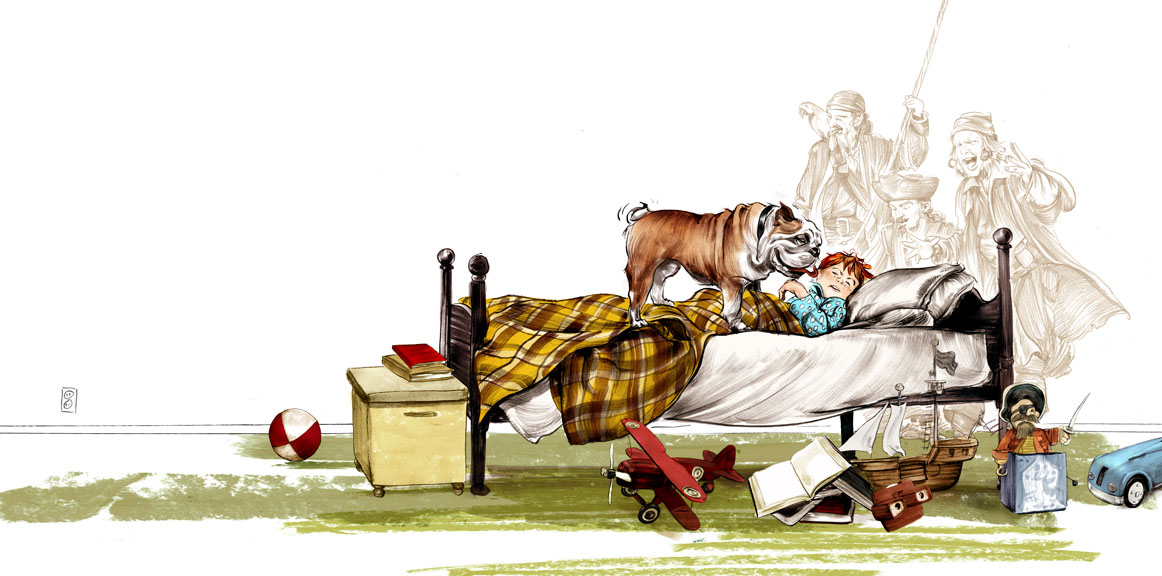
James Preller is a children’s book author of Bystander, Six Innings, the Jigsaw Jones mystery series, and many more books. He likes to imagine Keith Richards reading one of books aloud to his grandchildren. So Keith, if you’re reading this — and I’m sure you are — I’d love to send you a signed copy of A Pirate’s Guide to First Grade, illustrated by Greg Ruth.Call me crazy, butI think you’d like it.
“Arrr! Shiver me timbers, what a slobberin’ moist mornin’!
Me great scurvy dog slurped me kisser when I was tryin’ t’ get me winks!”