Archive for In the Classroom

“Teaching Is Believing” — My Short Essay over at THE NERDY BOOK CLUB


12418040_10208943236163396_1070494708685066319_n

I’m a big fan of Donalyn Miller.

Do you know her? As a classroom teacher, Donalyn made a splash with her book, The Book Whisperer. I met Donalyn during a trip to a reading conference in Dublin, Ohio, where I had the opportunity to hear her present to a large audience. She was impressive and her message was inspiring.

If you are an educator, you should read this book.

If you are an educator, you should read this book.

Long story short: Donalyn has made a deep impact bringing books and young readers together, and she does it without ego or self-aggrandising motives. There’s nothing phony about Donalyn. She’s simply a positive force in the world of children’s reading. My kind of people.

Several years back she started The Nerdy Book Club with, I believe, Colby Sharp. It’s an active, inspirational resource/blog for teachers and librarians who care about children’s literature. I recommend it. Over the past couple of years, Donalyn has allowed me to contribute a few essays, and I’m always grateful to reach that specific audience, and to participate in that grand conversation.

I’m happy with my recent essay and I invite you please check it out (link below). The idea came as the result of a few things going on in my life, particularly the end of my baseball coaching experiences. I reflected on what I had learned from those times coaching young people, and I connected those lessons to teaching and writing. But don’t go by me. Judge for yourself.

Here’s the opening:

I’m at loose ends.

For the first time in 16 years, I find myself not coaching a baseball team. During those seasons, I’ve coached a men’s hardball team, and all three of my children at various stages of Little League, including All-Stars and competitive Travel teams.

Now it’s over.

All I’m left with are memories, some friendships, and my accumulated wisdom, which can be reduced to a single, short sentence. So I’m passing this along to the readers of the Nerdy Book Club because I think it connects to teaching. And writing. And maybe to everything else under the sun.

When I started coaching, my head was exploding with knowledge. I knew all this great stuff! Boy, was I eager to share it. I had an almost mystical awareness of the game: tips and strategies, insights and helpful hints. Baseball-wise, I knew about the hip turn and burying the shoulder, how to straddle the bag and slap down a tag. The proper way to run the bases, turn a double play, and line up a relay throw. As coach, I simply had to pour this information into my players –- empty vessels all –- and watch them thrive.

But something happened across the years. I found myself talking less and less about how to play. Fewer tips, less advice. It seemed like I mostly confused them. The learning was in the doing.

I became convinced that the most important thing I could do was believe.

< snip >

Please click here to read the whole enchilada.

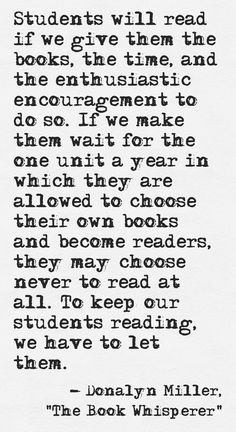
But before you go, here’s a nice quote from Donalyn that I figured I’d share.

Truth!
54ca57e70638ad712813f27288f92057

Give Student Writers the Freedom to Embrace Their Inner Zombies


1621704_667566729951571_1638043617_nNote
: A variation of this essay first appeared a while back over at the fabulous Nerdy Book Club, founded by Donalyn “The Book Whisperer” Miller, Colby Sharp (the man, not the cheese), and possibly several other folks. The history is not entirely clear to me. Nonetheless! You can follow all their nerdy, book-loving, classroom-centered hijinks on Facebook, Twitter, and various other social platforms, I’m sure. 


These days, young people are crazy about zombies. That’s just a plain fact. Not every kid, of course, but a lot of them.

And I’m here to say: Use that as an advantage in your classroom. Seize the day zombie! Particularly when it comes to student writing. Some girls want to team up to conjure a story about a zombie apocalypse? Here’s a pen and paper. Go for it, ladies.

photo-12

Many students, as young as third grade and on up into high school, are watching THE WALKING DEAD. The secret that quite of few of them don’t realize is that the hit television show is not about zombies at all. It’s about people surviving zombies. The zombies themselves are boring, without personality, almost irrelevant. They could be switched out for deadly fog, or World War II, a forest fire, or a tsunami. The zombies are simply a device to propel forward a character-driven story. It’s the engine that drives plot — all those pistons churning — and gives each moment heightened meaning.

That’s my point here. Any zombie story is almost entirely about character.

zombie-3-comingWhat we need to recognize is that, counter-intuitively, the zombie plot device perfectly lends itself to character-centered story. In the case of THE WALKING DEAD, it could even be argued that it’s about family, blended, modern, unconventional, or traditional.

With, okay, some (really) gross parts thrown in. Warning: Some characters in this story may get eaten. Hold the hot sauce. Ha! And why not, if that’s what it takes? If a little bit of the old blood and guts is the hook you need to lure in those writers, embrace it.

You can’t write a good zombie story without creating an assortment of interesting characters. Then you place those diverse characters in danger, you bring them into conflict with each other, you get them screaming, and talking, and caring about each other.

As, okay, they are chased by a bunch of zombies.

There’s no drama unless the writer makes us care about his or her characters. Your student writers will be challenged to make those characters come alive, become vivid and real. We have to care that they live or, perhaps, really kind of hope they get eaten alive in the most hideous way possible by a crazed zombie mob. Screaming, hopefully.

Don’t be turned off by that. Remember, it’s really all about character development, keep your focus to that. Dear teacher, I am saying this: embrace your inner zombie –- and turn those students loose. We can’t all write about dinner parties and visits from Aunt Gweneth.

What they will be writing will be no different than your typical Jane Austin novel. Except for, you know, all those bloody entrails.

——

There are currently five books available in my “Scary Tales” series.

OneEyedDoll_cvr_lorez     nightmareland_cvr_lorez     9781250018915_p0_v1_s260x420     iscreamyouscream_cvr_highrez-198x300

homesweethorror_cvr_highrez


Donalyn Miller’s “The Book Whisperer” Reaches Cultural Icon Status

I met Donalyn Miller at a Literacy Conference in Ohio. She was the keynote speaker and I came away impressed, inspired, and determined to read her book, THE BOOK WHISPERER: Awakening the Inner Reader in Every Child.

I started reading it yesterday, frustrated over my own 9th-grade son’s brutal, book-hating experience in advanced, 9th-grade English.

I underlined this passage from Donalyn’s book, page 18:

Reading changes your life. Reading unlocks worlds unknown or forgotten, taking travelers around the world and through time. Reading helps you escape the confines of school and pursue your own education. Through characters — the saints and sinners, real or imagined — reading shows you how to be a better human being.

The book is filled with passages that make you want to stand up and cheer.

Anyway, this morning Donalyn Miller shared her enthusiasm over this fun bit of pop culture stardom:

Good for Donalyn Miller, good for Jeopardy.

It’s funny, isn’t it? That’s a real touchstone in America today. An undeniable sign that you’ve arrived and made your mark. You become a clue on Jeopardy!

Donalyn is also a founding member of the Nerdy Book Club, which you should definitely follow. Seriously, I insist.

The Problem with Math Problems, Common Core, Standard Tests, etc.

I’ve been meaning to write an epic post recounting my visits to schools this past year. The things I’ve seen, the things I’ve learned, but gosh, I keep watching it slide down my list of things to do.

In short:

* It’s INSANE that elementary schools don’t have full-time librarians. Crazy, backwards, tragic, stupid, ill-conceived.

* Writing that above bullet point, I know that I should try to do more.

* April used to be the first month that filled up with school visits. It was the perfect time of year for it. Nowadays all I hear after we take out the calendars, “=April is out — that’s for testing.” Okay, I’ll admit that I have a bias, but what we are saying is, “In April, there’s no time to celebrate literacy and inspire a love of reading and thinking and writing — we’ve got to give hours upon hours of lousy tests instead.”

* When educators rally around the state capitol in Albany and chant, “Let us teach, let us teach, let us teach!” that’s just a really sad thing. I wish that we would, you know, listen to them.

Some links:

* An ALA-supported education bill that aims to help support school libraries: “For too long, research has shown that students have a better chance of succeeding academically when they attend schools with strong library programs,” said Emily Sheketoff, executive director of the American Library Association’s Washington Office. “This bill will ensure that students will have access to professionals who can help them make connections between subject areas, retrieve information, and think independently.”

* I’m so sorry I missed this important public statement, but was off coaching a ballgame. A sincere “thank you” to everybody who showed up to fight the good fight.

* NY Principals: Why new Common Core Tests failed.

We New York City and Metropolitan Area Principals hold ourselves accountable to ensuring that all of our students make consistent and meaningful academic progress. Although we are skeptical of the ability of high stakes tests alone to accurately capture students’ growth, we understand a system’s need for efficiently establishing and measuring milestones of learning.

KINDNESS: My Trip to the 2013 Youth Writing Festival at Calvin College

I just returned from a wonderful, two-night trip to Grand Rapids, Michigan, where I was invited (by Gary Schmidt!) to participate in the 2013 Youth Writing Festival at Calvin College.

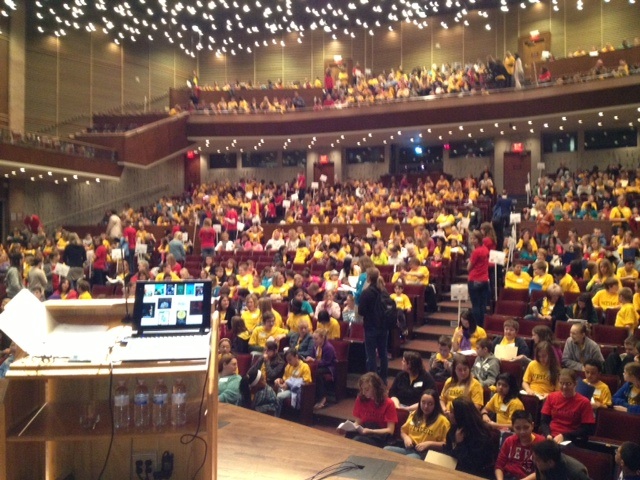
At one point it looked exactly like this:

As my Nation of Readers is well aware, I do many visits — particularly at this time of year. It’s fun, it’s beautiful to meet those children, and it’s work. Most visits are great, a few decidedly less so (oh, the stories I could tell), and every once in a while the entirety of a visit feels like a blessing.

Like I’m the luckiest guy in town.

That’s how I felt for my entire trip at Calvin. I was surrounded by caring, dedicated teachers and volunteers  who could not have possibly treated me with more kindness.

These folks did it right every step of the way, and I am grateful to all of them (Gary, Judy, Don, Kristin, Nancy, Debbie . . . far, far too many folks to name, from the President of the College who invited us into his home to the student volunteers who assisted us in countless ways).

For example, in the hotel room, I found a basket of treats and this sweet letter:

I certainly don’t need to be treated like a big deal, and it’s not anything I’ll ever actually believe, but it’s awfully nice when it happens.

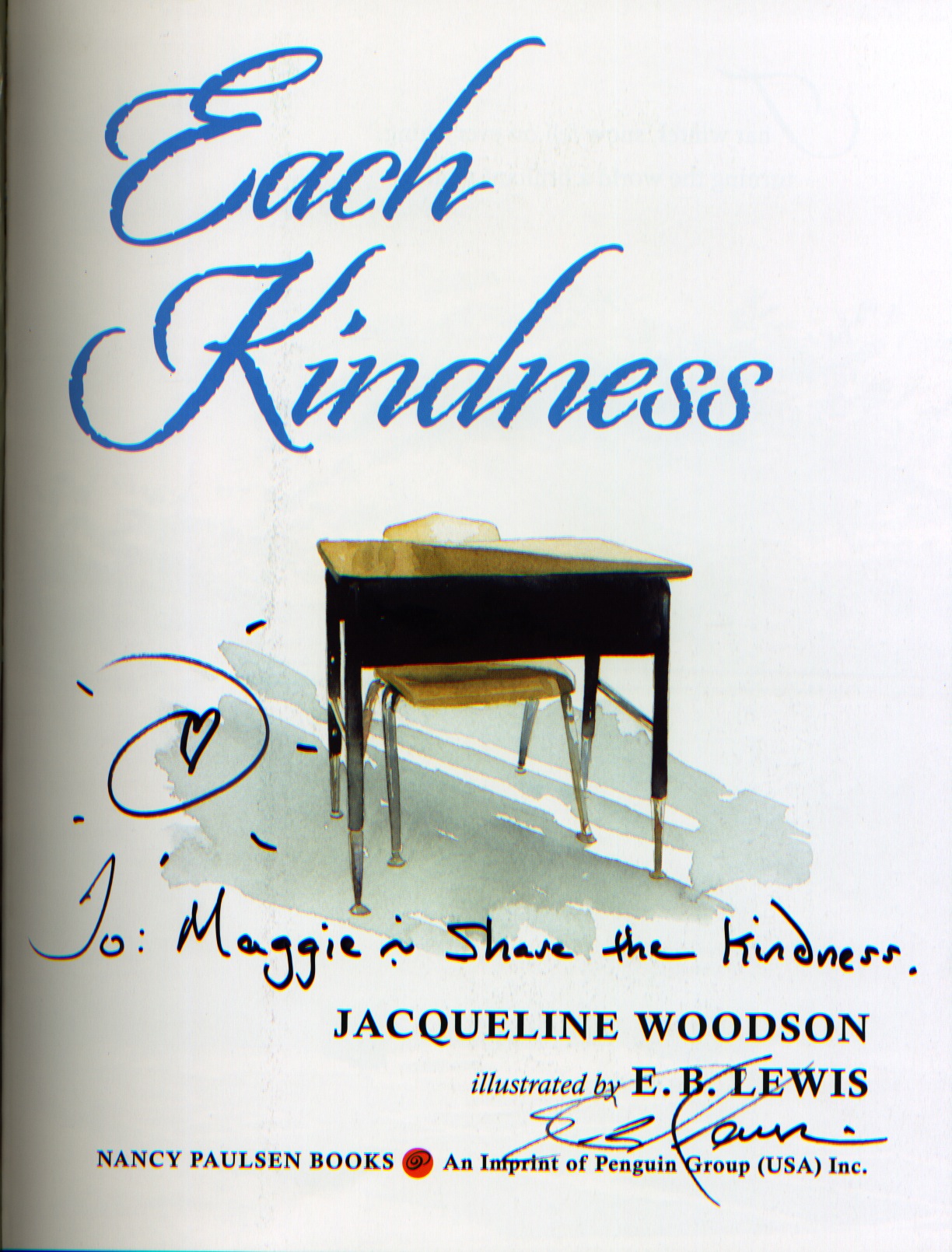
As an added bonus, I had the pleasure of meeting artist E.B. Lewis, a dignified man of talent, character, and intelligence. I picked up a copy of his latest book, Each Kindness, written by the great Jacqueline Woodson.

I love this book’s focus on kindness.

And, yes, that sad ending of lost opportunity hits me dang in the heart, hard.

Illustration by E.B. Lewis.

Since I first published Bystander in 2009, I’ve all seen a massive shift in focus on the issue of bullying in the media and in our schools. To the point where it almost feels . . . not over-stated, that’s the wrong word, but somehow . . . misguided at times. Students, especially, seem wary of being talked down to, lectured at, scolded. Hit over the head with the topic, turned off. You have to find a way to bring them to the core values, I think, and I believe that A GOOD STORY is far more effective at building empathy than a list of do’s and don’ts.

I suppose my radar has been, perhaps, more finely attuned to the issue over the past few years. I don’t really believe in talking about “bullying,” per say, since I don’t think that should be the main subject. I believe it’s  more basic than that, for “bullying” is just a sub-set of more significant themes for our children to encounter, consider, and embrace. One trend that I really like (see R.J. Palacio’s Wonder as a prime example) is a renewed focus on the simple things at the heart of the matter: how we should treat each other.

Words like empathy, decency, tolerance, compassion, and kindness.

Basic human kindness. Being a good person.

Do unto others.

Or questions like: How do you think it feels? How would you like to be treated?

This book powerfully expresses those ideas (and ideals).

We learn by meeting characters, by stepping in their shoes, by imagining their feelings, the rumblings in their hearts. We learn through the power of story — that essential human art form that’s been with us since cave dwellers gathered around the fire.

I highly, highly recommend the book, Each Kindness.

I even got a signed copy for my daughter.

Thanks, E.B.

And thank you, everyone at Calvin College, for a trip I’ll long remember.