Archive for Bystander

Fan Mail Wednesday #113: Skype & Teaching in the 21st Century

Preamble: My friend, talented author/illustrator Matt McElligott, is a frequent presenter at schools. I saw him when he came to my local elementary school and he was spectacular. A total pro, funny, informative, and kind. For info on his author visits, read this. See what I mean about being a pro? He makes me feel like a dirtbag, a rank amateur getting by on shaggy charm. I learn things from Matt every time we speak (twice a year if I’m lucky).

The Point: Matt recently told a good story. A few days after a visit, a librarian called Matt to convey a conversation she had just had with the mother of a young child in the school.

The Joke: The girl came home and said, “Mom, guess what!? We had an author visit our school . . . AND HE WAS ALIVE!”

Maybe you’d find that funnier if, like me, you’d been introduced as a “real, live” author dozens of times over the years. Or maybe you find it hysterical already. I don’t know how you feel. What am I? A mind-reader??!! So just . . . BACK UP, PEOPLE. BACK — IT — UP!

Ah, so. This morning I did a couple of Skype visits. I’m relatively new to Skype and still figuring it out. It’s like we’re in the first few dates of our relationship, where I’m still dressing nice and pretending that hey, no, I actually love Julia Roberts movies. The first visit this AM was with an 8th-grade class from Duxbury, MA. They had all read Bystander as part of an anti-bullying initiative and had a lot of insightful questions. It was a cool way to connect directly with readers without putting on socks and shoes. And come to think of it, that might be the right word for it: Skyping is cool.

I got the nicest note shortly thereafter . . .

Dear James,

Thank you so much for the skype session this morning. It was a great experience for me and for my students to virtually talk to a real author. We all found your answers interesting and personal. The kids said they were surprised that you were “so normal and such a regular guy.” You were so personable, honest and down to earth with them. A few students wanted to ask some other questions and I said maybe they could send you an email sometime??? It was such a great example to the kids about teaching and learning in the 21st century.

Thanks again, Martha.

I replied:

The invoice is in the mail. Please remit within 30 days.

No, kidding!

I actually replied:

Thanks, Martha. When I first started author visits, back in the way back, I was a little uncomfortable with the star treatment. Sometimes I’d get put on a pedestal, the famous author! Well, that wasn’t me; I couldn’t live up to it. I soon realized that if I had anything of value to share, maybe that was it — that I was a (relatively) normal, average, everyday guy who happened to write books for a living. I was no more special than the neighborhood architect, doctor, midwife, lawyer, or . . . um, wait, actually I am more special than lawyers. But anyway!

The Irish have an expression, “Flowers for the living.” (Meaning: You don’t have to wait until someone dies to say something nice about them.) I appreciate your kind words. And I had a good time visiting with your bright, lively students. I’d be happy to answer their email.

My best,

JP

——

NOTE: I realize that I’ve been bad, bad, bad when it comes to Fan Mail Wednesday. I’ve got a huge backlog and I’m seriously in trouble. I’m going to start digging out asap. I mean it.
Notes to Myself: Writing BYSTANDER

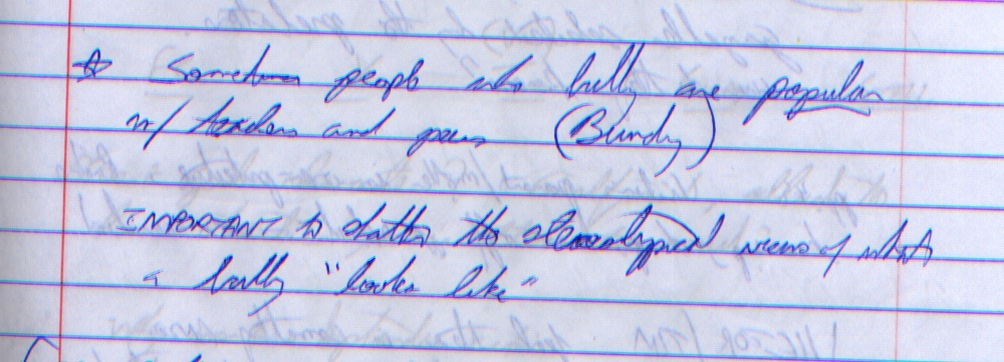
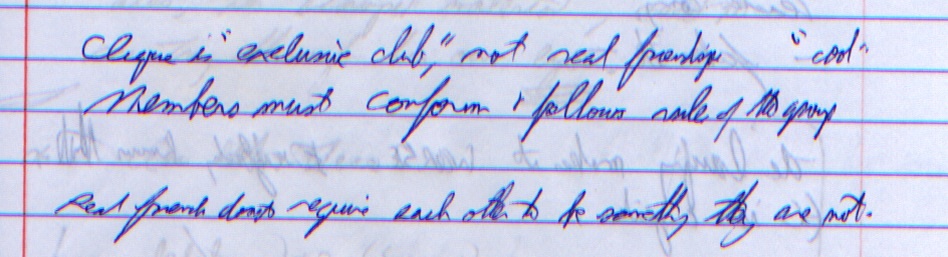
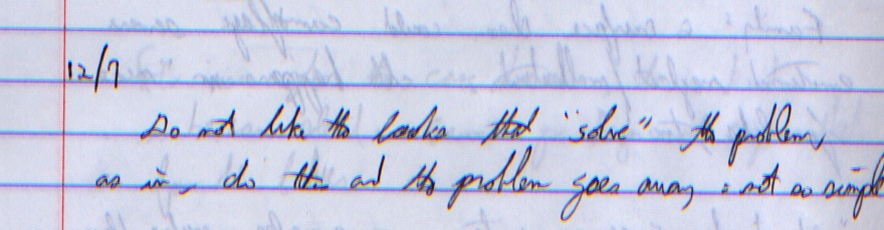
I’d guess that all writers do it, but I can only speak for myself. During the course of brainstorming for a book, which for me usually involves a composition notebook and random observations, snatches of dialogue, character traits, ideas for scenes, etc., I’ll often write brief notes to myself. These notes that I’m referring to are general guidelines for the book I’m writing — about tone, intention, theme. They serve as signposts, clarifying my intent for that specific book. I’m not talking about notes to address specific scenes in the story, but more global thoughts about the book I’m hoping to write, what I’m trying to achieve.

Below, here’s a few notes taken from a larger notebook that I filled during the research phase for my middle grade novel, Bystander. This might come across as naval gazing, I suppose, but I hope the notes shed light on my writing process and in doing so help readers and writers with their own creative work.

Don’t worry, I’ll translate these into English for those unfamiliar with the dialect of Southpaw Scrawl: “Do not like the books that ‘solve’ the problem, as in, do this and the problem goes away: not so simple.”

“Sometimes people who bully are popular w/ teachers and peers (Bundy)

Important to shatter the stereotypical views of what a bully ‘looks like.'”

“It becomes important to realize/understand what real friendship means.”

“Clique is ‘exclusive club’ not real friendship. ‘Cool’ members must conform & follow rules of group.

Real friends don’t require each other to be something they are not.”

“Children go to great lengths to hide the fact that they are victims of a bully.”

“Bully/victim is more dangerous, because acts out of anger, revenge.”

“Bystander” Named to Ballot of 2012 Charlotte Award Nominees

This is amazing good news. Great news, in fact. I’m happy and proud to say that my book, Bystander, is included on the ballot for the 2012 New York State Reading Association Charlotte Award.

To learn more about the award, and to download a ballot or bookmark, please click here.

The voting is broken down into four categories and includes forty books. Bystander is in the “Grades 6-8/Middle School” category. Really, it’s staggering. There are ten books in this category out of literally an infinity of titles published each year. You do the math, people.

For more background stories on Bystander — that cool “insider info” you can only find on the interwebs! — please click here (bully memory) and here (my brother John) and here (Nixon’s dog, Checkers) and here (the tyranny of silence).

Below please find all the books on the ballot — congratulations, authors & illustrators! I’m honored to be in your company.

–

GRADES pre K-2/PRIMARY

Bubble Trouble . . . Margaret Mahy/Polly Dunbar

City Dog, Country Frog . . . Mo Willems/Jon J Muth

Clever Jack Takes the Cake . . . Candace Fleming/G. Brian Karas

Lousy Rotten Stinkin’ Grapes . . . Margie Palatini/Barry Moser

Memoirs of a Goldfish . . . Devin Scillian/Tim Bower

Otis . . . Loren Long

Stars Above Us . . . Geoffrey Norman/E.B. Lewis

That Cat Can’t Stay . . . Thad Krasnesky/David Parkins

Turtle, Turtle, Watch Out! . . . April Pulley Sayre/Annie Patterson

We Planted a Tree . . . Diane Muldrow/Bob Staake

–

GRADES 3-5/INTERMEDIATE

The Can Man . . . Laura E. Williams/Craig Orback L

Emily’s Fortune . . . Phyllis Reynolds Naylor

Family Reminders . . . Julie Danneberg/John Shelley

Fly Free! . . . Roseann Thong/Eujin Kim Neilan

Jake . . . Audrey Couloumbis

Lizards . . . Nic Bishop

Lunch Lady and the Cyborg Substitute . . . Jarrett J. Krosoczka

Mirror Mirror: A Book of Reversible Verse . . . Marilyn Singer/Josee Massee

The Sandwich Swap . . . Queen Rania of Jordan & Kelly DiPucchio/Tricia Tusa

Sojourner Truth’s Step-Stomp Stride . . . Andrea Pinkney/Brian Pinkney

–

GRADES 6-8/MIDDLE SCHOOL

All the Broken Pieces . . . Ann E. Burg

Bystander . . . James Preller

The Brilliant Fall of Gianna Z. . . . Kate Messner

Candy Bomber . . . Michael Tunnell

Cleopatra Rules! . . . Vicky Alvear Shecter

How to Survive Middle School . . . Donna Gephart

January’s Sparrow . . . Patricia Polacco

The Secret Science Alliance and the Copycat Crook . . . Eleanor Davis

Slob . . . Ellen Potter

A Tale Dark & Grimm . . . Adam Gidwitz

–

GRADES 9-12/HIGH SCHOOL

Beautiful Creatures . . . Kami Garcia & Margaret Stohl

The Chosen One . . . Carol Lynch Williams

The Maze Runner . . . James Dashner

North of Beautiful . . . Justina Chen Headley

The Notorious Benedict Arnold . . . Steven Sheinkin

The Sweetheart of Prosper County . . . Jill S. Alexander

The Things a Brother Knows . . . Dana Reinhardt

Trash . . . Andy Mulligan

Truce . . . Jim Murphy

The Year of Goodbyes . . . Debbie Levy

–

By the way, who’s Charlotte?

Illustration: Garth Williams.

Too Much Awesome: Posters, Student Writing, etc.

I know, Dear Reader, I know.

You are getting tired of my slipshod approach, the endless excuses about how busy I am.

But!

Yesterday I coached two baseball practices, for two different teams. Threw batting practice to twenty-two different boys who are at a point, ages 11 and 12, where it’s no longer okay to just blob it over. They need the ball with a little heat. So my wing is sore.

Today I’m driving off to Geneseo with my oldest, Nick, for a second look-see. He’s a high school senior and we’re getting down to decision time for college. On Wednesday, my good wife Lisa flies down to Atlanta, where she’s going to learn how to perform minor surgery on a cervix — and frankly I do not want to know any more details than that. She comes home Sunday, the day I coach a doubleheader and drive down to Long Island for a week’s worth of school visits.

And, oh, yeah. There’s the job thing, too. Writing stuff.

So the blog suffers.

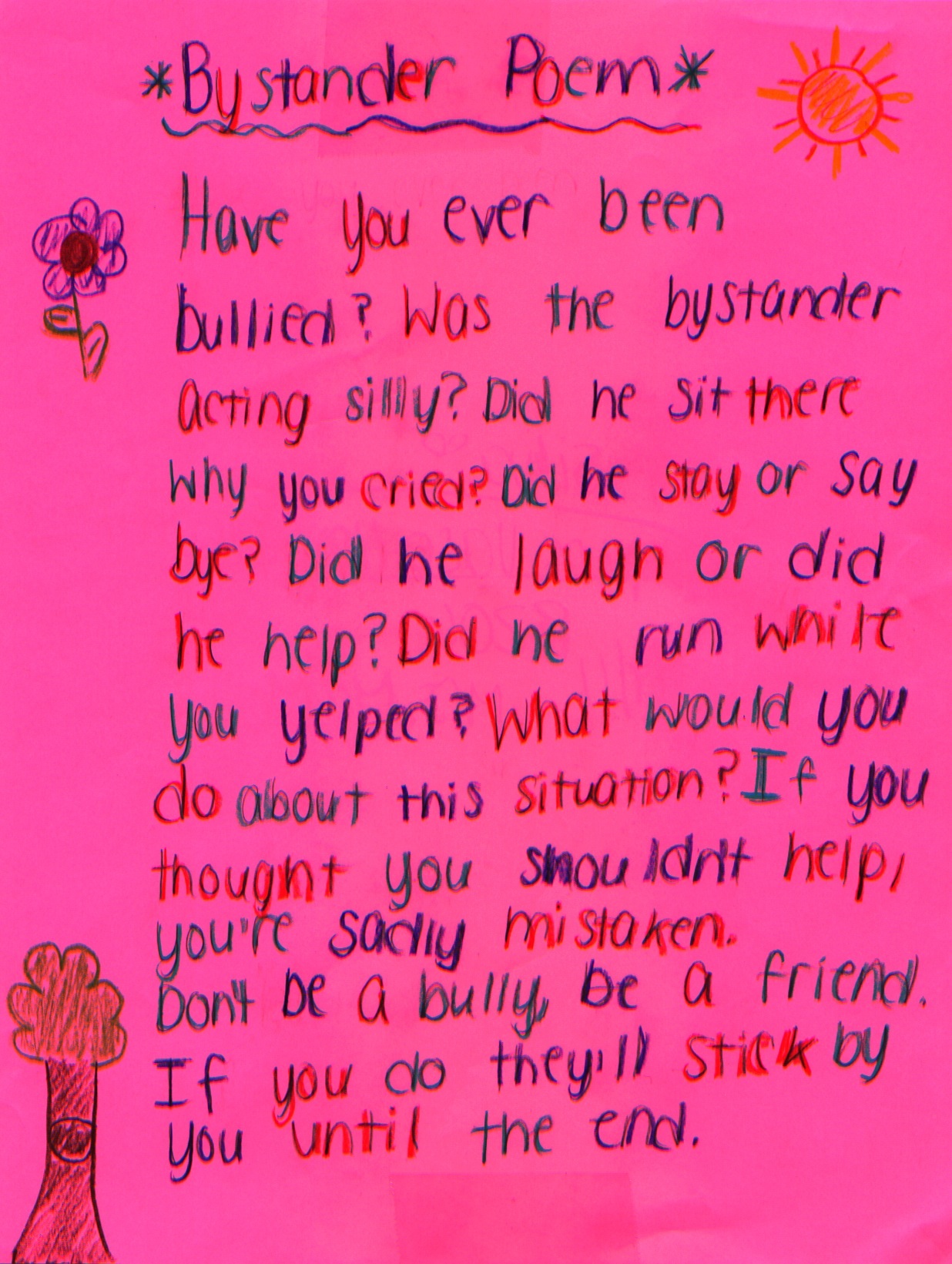
I wanted to share a few scans and photos. I recently visited a school down in Sicklerville, NJ, where the students filled the halls with creative responses to my book, Bystander.

There were posters and poems. Some students wrote journal entries from the perspective on a book character, and I thought those were particularly interesting and effective. Isn’t that the big lesson in To Kill a Mockingbird, when Scout stands on Boo Radley’s porch and sees the world from his perspective? When she stands in his shoes?

“You never really understand a person until you consider things from his point of view . . . until you climb into his skin and walk around in it.” — Harper Lee.

So after my presentations were done, and the books signed, we walked around the halls and filled a big box with incredible artwork, posters, etc. I can’t show it all to you, but here’s a few samples:

Most posters were too big to scan. I loved the tagline that one boy came up with . . .

“DON’T BE A BULLY . . . DO THE NICE!”

Fan Mail Wednesday #111 (Re: Book Titles)

–
Don’t you love the icon that I use for every Fan Mail Wednesday? A word of explanation for younger readers: It’s an illustration of something we used to call “a letter.” You see, long ago, we used to — and you’re not going to believe this — write words on actual paper (made from trees!) to our friends and relatives and business associates. Then we’d place the paper in a sealed envelope, called an ENVELOPE, and then . . .
–
Nevermind.
–
A girl sent this one via the interwebs. I removed her name for privacy:
–
Hi, I was at the school that you were at today at Vail Farm 3/30.  I was wondering how you come up with titles because I’m a writer too. I’m writing a book that is about a girl who gets picked on a lot just like the book bystander. But just so you know I didn’’t steal it from you.  But any way I can’t come up with a title for it so that’’s all I want to know.
Love,
X
–
I replied:
Hey, X. Thanks for writing. You must have been one of those students with your hand raised when we ran out of time. Sorry I didn’t call on you.
–
Titles are a tricky business. I can’t say that I’m an expert. With books like Six Innings and Bystander, I had those titles very early on. In fact, writers will often plug in a “working title” for a book in progress. It’s not the final title, or at least doesn’t seem to be, it’s just something handy to call the untitled book. For Six Innings, my working title was . . . Six Innings. That was always the concept for the book from the beginning, very clear in my mind. So when it came time to officially name the book, I used the working title.
–
With Bystander, my first title idea was Predator. That’s because I began by focusing my research and note-taking on the bully character, Griffin Connelly. But after a short while, I became convinced that the real story was with the bystanders. In life, there are a few bullies and some victims, and then there’s the rest of us, the overwhelming majority, the bystanders. We are often silent, yet hold all the real power. I knew it should be the focus of my book, and the title. Of course, there are all sorts of bystanders. The floaters and the enablers, the watchers and the cheerers and the ones who simply walk away — all with our own roles to play in the schoolyard drama. Few of us are purely innocent.
–
Speaking of bullies, have you ever noticed that they almost always need an audience? They don’t bully unless there’s somebody to watch it, to cheer them on, to laugh. Fights are the same way. It’s interesting when you think about it, isn’t it? What would happen if there was no audience? Do bullies need bystanders in order to exist? Are we their oxygen?
–
Back to titles: In many cases, writers don’t have a title until the book is finished. Editors have told me not to worry about the title, just write the story, worry about the title later on. It can be hard, because you do need a good title. I wanted my title for Justin Fisher Declares War to be Justin Fisher Declares War on Fifth Grade, but that was vetoed due to length. I never felt that we got that title right.
–
–
When I begin a book, I often purchase a composition notebook. My working title for Justin was Talent Show. Maybe I should have stuck with that.
–
–
Here’s the first page from that notebook. I wrote it in the Bethlehem Library in Delmar. I had this idea of Justin defacing a poster in school and it’s the first scene I wrote, event though it doesn’t happen until Chapter Four of the book.
–
Often writers will go back over a story and see if there’s a word or phrase in the text that somehow stands out. You’ll see that a lot when you read books, the book’s title buried somewhere deep in the pages of the book. I’d recommend that strategy for you. Reread your story. Does a character say something that could work as a title? Is there a symbol in the book that somehow represents a character or an idea?
–
With Jigsaw Jones, my publisher wanted a title from me before I even wrote the book or, in some cases, knew what it was about. It drove me crazy.
—
The other strategy is to ask for help. That’s what I do. I’ll have a reader — my editor, almost always — read the manuscript and we’ll talk about titles together. Sometimes it takes another person who has some distance from the story to see what it’s really about. And isn’t that nice, when someone can give you the title?
–
Lastly, brainstorm. I’ve created long lists of potential titles. Then you can review them, whittle them down, and maybe share them with other people. Maybe even people who haven’t read your story. Which titles appeal to them? Is there a title that gets them curious? Nowadays this is called “crowd-sourcing,” when you simply ask a bunch of random people for their opinions.
–
Anyway, sorry, long letter. Good luck with your story. It’s always nice to meet a young author.
–
JP