Archive for Bystander

Comments Section, re: BYSTANDER (a couple of highlights)

Oftentimes folks comment on past blog entries, no longer the current thread. So my sense is that My Nation of Readers does not ever see these comments.

And how sad is that?

So here’s two from today that I had to share. The first one made me laugh . . .

From Dakota:

I was reading your book called BYSTANDER. In the chapter called ” repairs”. I was reading page 198 and It said “Cody pulled a dirty bandanna from his back pocket to wipe the grease from his hands.” I thought it said cody pulled a dirty banana out of his back pocket. I was reading it in a group and every one laughed when i said ” dirty banana” instead of “dirty bandanna.”

From Makayla:

I read your book BYSTANDER and to be honest it was outstanding! You really know how to use all types of figurative language. Like when you described the buses as being “enormous Twinkies.” It really made our class laugh out loud. I liked how you titled the chapters, like how you made them important in that section of the book. You are a truly talented author and I look forward to reading more of your books. Thank you for your time Mr. Preller.

“BYSTANDER” Made VOYA’s Suggested Summer Reading List

My editor said, “Here’s to many more lists recommending Bystander.”

My agent said, “Huzzah!”

And I chanted, “Show me the money, show me the money, show me . . .”

I mean, er, “Well, goodness, this is certainly an honor.”

Click here for the full, annotated list, featuring categories that range from “Core Curriculum” (Little Women, The Time Machine, The Phantom Tollbooth) to “Anti-Bullying/Tolerance” (Bystander) to Social Studies (Amelia Lost, Chains) to Sci-Fi (The Maze Runner) to ALL SORTS OF OTHER STUFF.

Seriously, why make me work so hard? Get off my back and jump, instead, on the above link.

One title that captured my interest . . . Scrawl, by Mark Shulman.

It came with this annotation: “Enter the mind of a bully by reading his journal.”

Cool cover, don’t you think? Color me curious. I’m going to buy it right now.

Are Students Sick & Tired of Anti-Bullying Messages? And What About You?

I’ll admit it. Sometimes I have doubts. Not about bullying, exactly — I know it’s a serious issue, a matter of life and death — but I fret about the effectiveness of talking about it.

You could call it an occupational hazard.

Does anyone hear the message anymore?

Anti-bullying rhetoric seems everywhere these days. Trending hot on Twitter. Almost fadish. And I sometimes wonder if kids have tuned it out. In my travels, I’ve talked to many teachers who have expressed that worry.

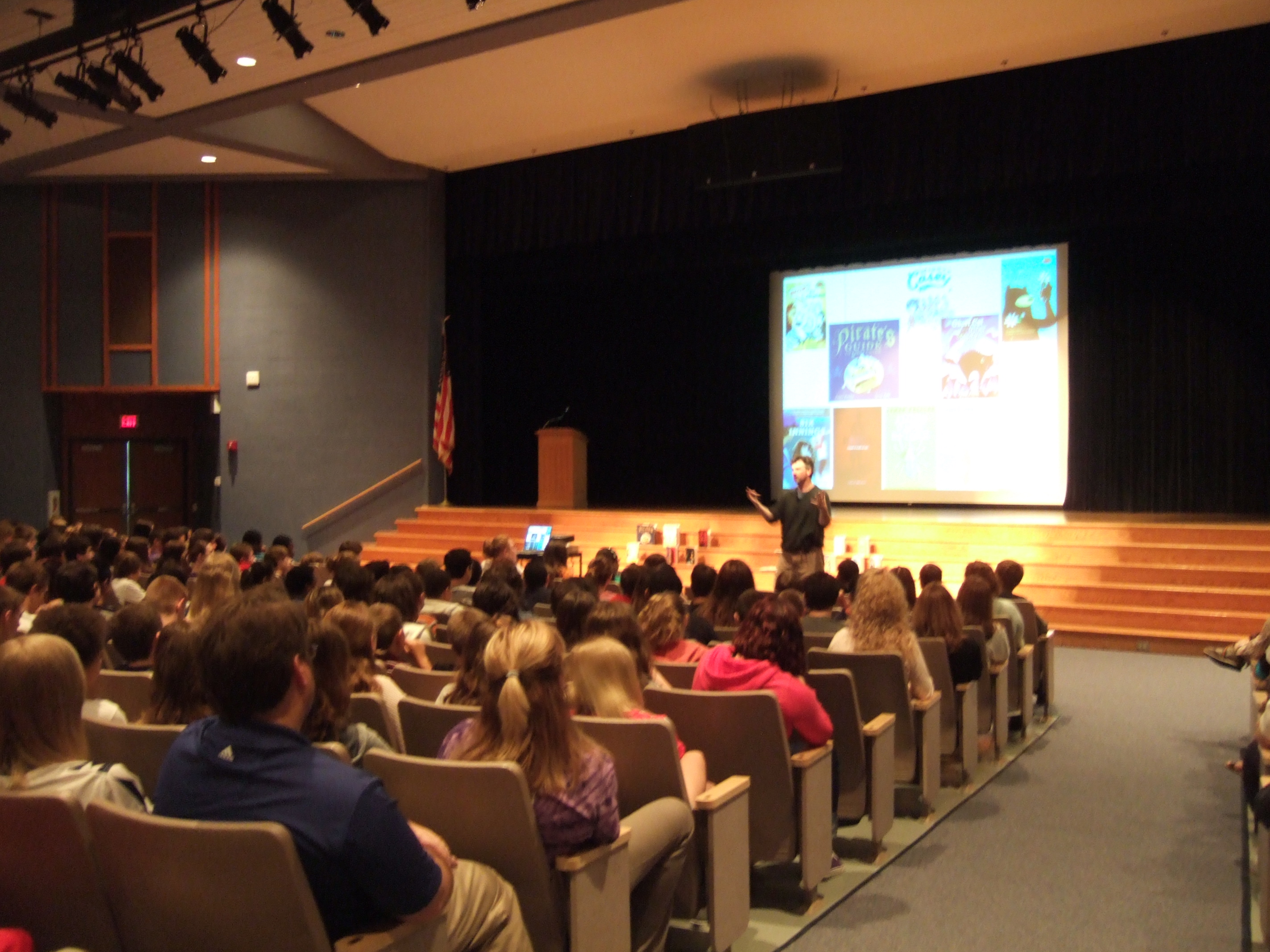
This year, I’ve visited schools in OH, MA, FLA, MI, NJ, NY, SC, PA, and CN — often because I wrote the book, Bystander. I’ll arrive at a school where all the middle schoolers, grades 6-8, have read and discussed my book. They’ve wrestled with the issues, hopefully identified with characters, felt compassion, empathy, anger. Or, I guess, some of them have just been bored by another book they didn’t get to select themselves. In most cases, my novel is only one small piece of a comprehensive anti-bullying agenda.
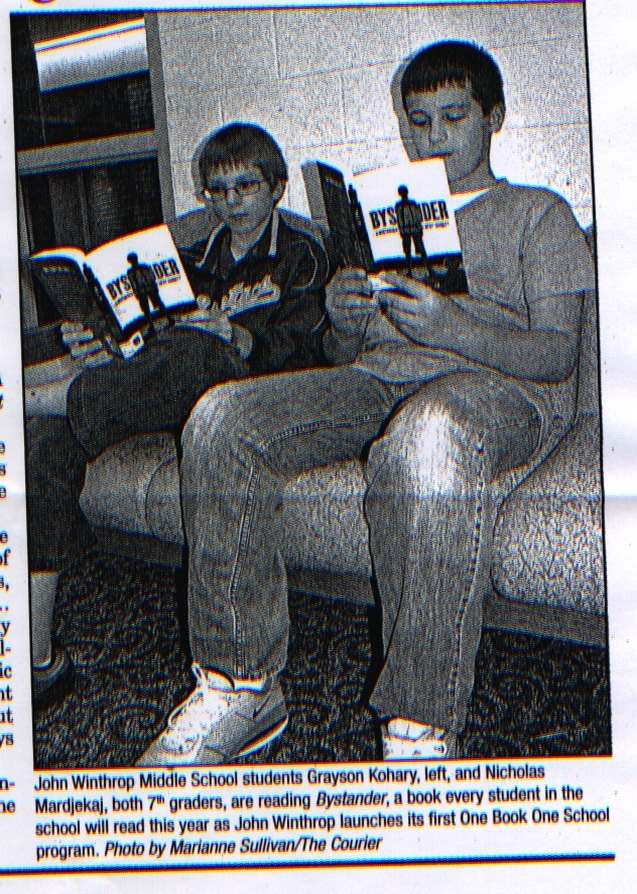
But as I’ve said before, I wrote a book. A story. Not a brochure on how to make your school a “bully-free zone.”

Despite the amazing letters I receive, I still wonder what I can say on a school visit that won’t come off as yet another lecture to this audience. What can I say that might make a difference. And if, perhaps, they simply can’t hear it anymore.

Is it worth beating on that same old drum?

Then I opened up The New York Times and read Nicholas D. Kristof’s op-ed piece from Thursday, May 17. And I’m reminded, yet again, why this matters so very much; and how real people — the children in our village — are powerfully effected every single day; and that anything we can do is far, far better than sad resignation.

As an author and father of three children, ages 11, 12, and 19, I believe that the core of this issue comes back to simple values. Do unto others. The importance of thinking to yourself, “How would that make me feel?” Identifying with others. Caring. Our fundamental humanity.

The issue of bullying is about the importance of compassion, tolerance, kindness, and empathy — at a time in life when empathy does not come easily to many middle schoolers. Stories can help. Like Wonder, by R. J. Palacio, to cite one recent, brilliant work of children’s literature. I read it recently and then pressed it into my 5th-grade daughter’s hands. You must read this, I said. I loved the way, like any great book, Wonder brought us into the hearts and minds of different characters. How we experienced forms of bullying, of painful isolation, from the inside out. I loved Palacio’s message of kindness and compassion.

Anyway, I digress.

Here’s an excerpt from Mr. Kristof’s op-ed piece:

Plenty of adults are skeptical about the fuss over bullying. “How come the thin-skinned kids nowadays can’t handle the bullying that made us better, stronger adults?” one man wrote to me on Twitter.

He should read what Madison Jaronski, 15, of New Hope, Pa., wrote:

“Tears have been flooding down my face; breathing is a task that now seems impossible. I draw my legs closer and closer into my chest as I try to transform the pressure into reassuring comfort. I begin to slowly rock myself, and by now my tears have colored my pillow black. …

“All of my accomplishments and enjoyable moments are overshadowed by the pain and harassment that was thrust upon me. Just looking at my surface, you would see a confident young woman, as sturdy as a rock. You would never think that I was broken, broken into a million pieces like shattered glass, all because of the work of a group of senior boys.”

You want to reach out to these kids and envelop them in a big warm hug and tell them that they are smart, sensitive human beings, a thousand times better than their tormenters.

——

To read the winning essays, go here. Just do it.

You will be blown away.

Here’s a brief sample from one winning essay, written by Lena Rawley, age 17, from Montclair, NJ:

Teenage girls are cruel super-humans from a distant galaxy sent here to destroy us all. They have the self entitlement of a celebrity heiress and the aggression of a Roman Gladiator. Like vampires they feed off the blood of the weak. They’re pubescent monsters. Adolescent boogeymen.

While my observations may be coming from a point of bias, that doesn’t mean they are faulty in accuracy. As a teenage girl myself, I think I know teenage girls quite well. Not only was I a former teenage mean girl, but I was tortured, tormented, isolated and socially maimed by them as well.

—–

Just came across this school that featured a booktalk about Bystander, way back in 2011. I appreciate that this kind of thing has been happening in many schools across the country, and sometimes on a schoolwide scale, but this one is especially sweet since I grew up in Nassau County, too. I just love the idea of parents and kids coming together and talking about this stuff — that this book, my book, offers a safe springboard for those conversations. Wow.

—–

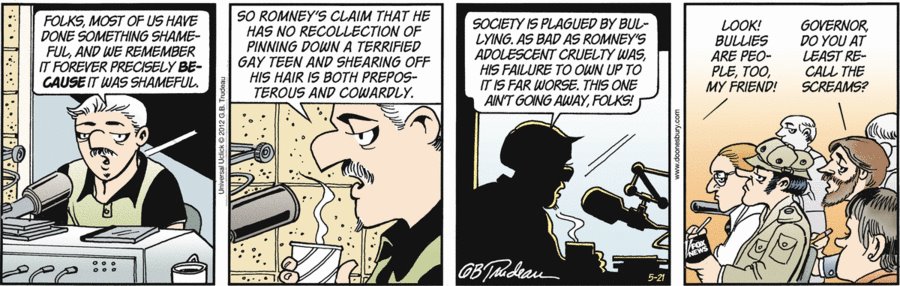
Lastly, here’s a recent Doonesbury . . . still kicking it after all these years.
Behind Every Harassed Child . . .

New York Times film critic A.O. Scott wrote a sensitive, perceptive review (3/29) of the new film, “Bully,” a much buzzed-about documentary by Lee Hirsch.

It’s worth reading in full. But here’s a paragraph to wet your whistle:

The feeling of aloneness is one of the most painful consequences of bullying. It is also, in some ways, a cause of it, since it is almost always socially isolated children (the new kid, the fat kid, the gay kid, the strange kid) who are singled out for mistreatment. For some reason — for any number of reasons that hover unspoken around the edges of Mr. Hirsch’s inquiry — adults often fail to protect their vulnerable charges.

I look forward to seeing this important film, while at the same time dreading it.

Here’s the trailer:

You need to a flashplayer enabled browser to view this YouTube video

There’s a scene in my book, BYSTANDER, when Eric speaks up to a group of peers. He asks, “The other day with Griffin and David. Why didn’t we do anything to stop it?”

And in that brief dialogue out on the playground, I wanted to quickly present, without editorial, some of the most common reasons cited for failing to stand up.

The mood of the group changed, grew quiet and uncomfortable. A few sets of eyes looked away, perhaps searching for Cody and Griffin.

“What about it, Hakeem?”

The thick-bodied, dark-skinned boy stared at Eric. He smiled, lifted up his hands. “My parents tell me to stay out of it,” he admitted. “I don’t want any trouble.”

“Hallenback is a loser,” Drew P. interjected. “You know how annoying he is, Eric. That kid deserves a little roughing up now and then. It’s like he asks for it.”

“Please, sir, may I have another?” Marshall Jenkins joked in a whiny voice.

Most of the boys laughed, nodding in agreement.

Eric noticed that Pat Daly wasn’t laughing.

“What about you, Pat?” Eric asked.

Pat swallowed, looked at the ground. “Even if, let’s say, maybe you saw something that seemed a little harsh,” he tentatively began. “What if you did say something? You’d get your butt kicked the next day.”

“It’s not worth it,” another commented.

“Besides, who are you going to tell?” Marshall asked. “The principal? Mrs. Morris can’t do anything.”

“What about Officer Goldsworthy?” Eric wondered.

“No way I’d ever rat someone out,” Sinjay stated. “Especially not to a rent-a-cop.”

“Eric, listen to me, okay? You’ve got to lighten up, dude,” Drew P. advised. “Why make a big deal out of it? Okay, a few little things have happened. There’s always going to be some guy who takes a pounding. That’s life. What do they call it in science? Natural selection,” he pronounced.

Fan Mail Wednesday #143-146: Some Recent Letters from Teachers about BYSTANDER

I’ve been getting a lot of mail from teachers who are using Bystander in their classrooms. From early on, that was my hope for this book — a talking book, a valuable conversation starter in the hands of a good teacher and a lively classroom. I’m happy to see that it’s been embraced in the 5th grade, as well some 4th-grade classrooms. Overall, most readers seem to be in grades 6-8.

Here’s a sampling of emails from teachers I’ve received over the past few weeks. As always, some personal info has been deleted to protect the innocent  . . .

Hi James,

I’m a 4th grade teacher in Iowa. Today I started reading Bystander aloud to the class. I think this is my 3rd year in a row reading the book and I LOVE IT!!! As the kids were listening their mouths were ajar. (I love that!)

Thanks for sharing your awesome talent –- with such an important message.

Cheers,
K

And from Hawaii . . .

Dear Mr Preller,

My name is ____ ______ and I am a 5th grade teacher on the island of Oahu, Hawaii. I am currently reading the book with my students and I have some students who would like to write you some “fan-mail” and replies to reading your book. On your web site you do not have an address in which we could mail you. Could you possibly email me your address?

Any help would be much appreciated. Thanks so much!

Love the book! My students cannot put it down!

Sincerely,

G

I replied: James Preller, 12 Brookside Drive, Delmar, NY 12054.

I also might have added something about being available for school visits. Aloha, baby.

Hi James!  I teach fifth grade and we read Bystander as a class.  They LOVED LOVED LOVED it.  You are a rock star.  One of my students took the initiative to write you a letter but I cannot find the address to send it.  He even included a self-addressed stamped envelope in the hopes of hearing from you.  Can you please send me the address?  I would really appreciate it.
V

And lastly, from the Windy City . . .

Mr. Preller,

I would like to inquire about having you come to visit our middle school in late August or early September of 2012 (the beginning of the next school year).

We have adopted your novel, Bystander, as an all-school summer reading novel for all students in our building, grades 6-8 (about 900 students).  Our School Climate Committee has been meeting this year to develop a more effective anti-bullying initiative in our school, and your novel is a perfect match for this project.

Please let me know your availability and fees.  We are located in _______, Illinois, a northwest suburb of Chicago.  Here is a link to our school’s web page linked to our district’s site if you would like to get a sense of our community.

Thank you,

M

I replied, in part . . .

M,

This sounds wonderful, though there are some obstacles in our path.

I live outside of Albany, NY, so there is travel to consider. Generally speaking, I prefer to have a minimum of three full days of work for any trip. Four is better. The best arrangements come when schools in a district coordinate their efforts — and share the expense of plane tickets — and I’m invited somewhere for 4-5 school days.  Is that enough to get you started?

Lastly, thank you. I’m very glad to hear about your efforts, and glad that my book might help in the process for cultivating a safe, happy community of learners.

My best,

JP