Archive for Bystander

My Interview at “Author Turf”

I was recently invited for an interview by Brittney Breakey over at AUTHOR TURF. Brittney has really accomplished a lot with her site. It’s worth checking out. She’s recently interviewed Holly Goldberg Sloan, Sally Nicholls, Gennifer Choldenko, Jo Knowles, Kathryn Erskine . . . and my great pal, Lewis Buzbee.

For me, that’s a double-edged sword. I’ll be honest, I’ve always hoped to be the kind of person who somebody wanted to interview. It’s an incredible compliment. And a true honor.

In my career, some of the first work I ever did was interviews of authors for promotional brochures. I think Ann McGovern was my first interview, back when I worked as a junior copywriter for Scholastic. Or it might have been Johanna Hurwitz. I don’t think I saved them. This would have been in 1985, I guess. Life went on and I’ve interviewed some talented authors and illustrators over the years.

You’d think I’d have learned some things along the line, but my basic feeling is usually one of disorientation, a sense that I have no idea what I’m doing, most likely saying the wrong things, awkwardly. Oh well.

I do have lucid moments, times when I think, “Okay, not terrible.” But in general I can’t read things like this without wincing, without twitching and blinking too often. I don’t know, it’s weird. I try to be honest, authentic, and hope for the best.

Below, you’ll find a brief excerpt of a much longer interview. Click here for the whole shebang.

What’s the worst thing you did as a kid?

It’s interesting you ask this, because I recently wrote about it in my journal. A theme that I’m exploring in the book I currently writing (or should be writing), which is a quasi-sequel to BYSTANDER. I have superstitions about talking about books before they are finished, but I’ll say this: In the summer between 7th and 8th grade, a girl in my homeroom died unexpectedly. I didn’t know her well, and wouldn’t call her a friend. When I first heard about Barbara’s death, I was with a bunch of friends –- I can picture it vividly, a bunch of us lounging around — and I said something dumb, snarky, immature. Of course, the death of a peer was completely new to me, a big deal, and I didn’t know how to react. I still feel a sense of shame about it, across these forty years, that one dumb thing I said that no one else even noticed. I’ve been reflecting a lot about identity lately, the idea of self not as a revelation, but as a made thing. Something you earn. Bryan Stevenson gave an incredible presentation for TED Talks -– everyone in America should Youtube it -– and he said, “I’ve come to understand and to believe that each of us is more than the worst thing we’ve ever done.” That’s a huge, complicated, controversial idea –- and it speaks directly to the topic of my next book. [NOTE: I’ve embedded Stevenson’s talk, below.]

Was there ever a time in your writing career where you wanted to seriously give up? If so, how did you find the motivation to continue?

Yes, I’ve wanted to quit. Absolutely. Mostly because it’s hard, and because I’ve felt (and still feel, though less so) insecure about my own ability –- that I was a pretender, a self-deceiver, a fake. Also, it’s a bunny-eat-bunny business that can crush your soul at times. As a husband and father, I’ve worried about my ability to provide for my family, to keep paying the bills. But that’s life, right? You have to keep getting up. You can’t just lie there on the canvas. That said: Every day I feel blessed that I can do this for a living. The hard is what makes the good.

What’s your favorite writing quote?

It’s not a quote, so much as an attitude about doing the work, a sort of blue collar distrust of pretentiousness. In a phrase, shut up, sit down, and write. Or not! But either way, shut up. It’s hard, writers are told that we need to promote ourselves, we need to “have a presence” on the web, we need to “get out there.” And I just keep thinking, we need to write great books. That’s all that matters.

Is there anything you find particularly challenging in writing? What comes easily?

The whole thing is a challenge. One thing about having published a bunch of things over a long period of time is that I’ve come to understand that each book is its own, self-contained thing. You write the story that’s in front of you. Then you write the next one. And the next. You don’t control what happens after that and, on good days, you accept that plain fact.
You need to a flashplayer enabled browser to view this YouTube video

REPOST: Thoughts On Bullying, Bystanders, and Middle Schoolers

Note: This was first posted over at The Nerdy Book Club, a great sight for fans of children’s books. Recommended.

EVERYBODY ELSE IS ALREADY TAKEN

“To be yourself in a world that is constantly trying to make you something else is the greatest accomplishment.” – Ralph Waldo Emerson.

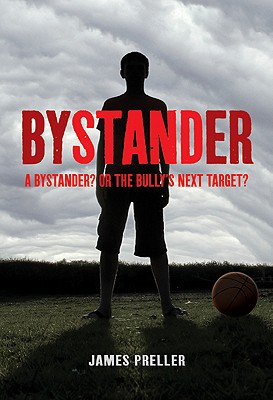
After I wrote the book BYSTANDER (Macmillan, 2009), I began to receive invitations to speak at middle schools. I was wary at first of being perceived as anybody’s “anti-bullying program.”

I wrote a book. Not a pamphlet, not a list of discussion questions, not a nonfiction guide to bullying. I could not offer a handy list of ten ways to make your school a bully-proof zone. I didn’t even believe in it.

I wrote a story –- that was the tool at my disposal.

Stories are essential to our lives. How could we live without them? We watch television, go to movies, tell tales to our friends and neighbors, conjure dreams at night, play complex video games, read books. Humans are storytelling creatures. We seem to need stories. Something inside us craves stories, we hunger for them, ravenous.

Why is that?

Stories function differently than nonfiction. The characters have a way of worming inside our souls. Robert McKee, in his book, STORY, claims that “Stories are equipment for living.”

Equipment for living.

Our lives race past us, a frantic blur, and we move from the next thing, to the next, to the next, with barely a moment’s reflection.

Stories give us pause. They give our lives form and shape. And time. We turn a page. We consider. We piece together the meaning of our days through the stories we hear.

And we ask of these stories the same question, over and over again: What is a good life? How are we to conduct ourselves here on this earth?

Well-told stories, as Harper Lee so beautifully demonstrated in TO KILL A MOCKINGBIRD, allow us to walk in someone’s else’s shoes. Remember that remarkable scene at the end of the book? When Scout walks Boo Radley home, climbs up to his porch, and for a moment turns and looks at the world from his perspective?

Scout concluded: “Atticus was right. One time he said you never really know a man until you stand in his shoes and walk around in them. Just standing on the Radley porch was enough.”

That’s story.

It’s also called empathy, understanding, compassion.

Here’s McKee again: “A culture cannot evolve without honest, powerful storytelling.”

Story isn’t an escape from reality. It is a light that shines upon the dark corners of our world, the secret places, the hidden fears and hopes and dreams.

It is why books matter, and why, I now know, some teachers have embraced BYSTANDER –- among other novels — as a way to explore this complex topic.

I’ve stood on a stage in auditoriums in front of 500, 600, 700 middle school-age children. Or as they refer to them in Ireland, “young people.” I like that. Young people. So much more intrinsically respectful than kids, little lambs eat ivy.

Despite my experience visiting places like Oklahoma and South Carolina, Illinois and Connecticut, Florida and Michigan, I’m still in the process of learning how to talk about bullying. Still growing into my own shoes. Still learning to speak above a whisper.

One of the central ideas embedded in the book – an idea I came to understand only through the passage of time – also happens to be one that’s incredibly difficult for me to directly convey to middle school students. So I don’t try to tell it, per say, so much as hope it leaks out over everything, like sunlight through the edges of a drawn blind. But I think it’s worth saying to you, here.

Research shows that bullying peaks in middle school. Why is that?

Let’s recall Emerson’s quote from up top, and agree that one of the greatest achievements in life is to become, simply, one’s true self. It sounds easy enough, but as we know, it is not. I’m a father, I have three children, including a 7th-grader and a 9th-grader. I watch their awkwardness and insecurities and struggles.

To be content in your own skin.

To not look to others for your cues.

To accept and trust who you are, to follow your own inner compass.

These are not easy things.

At no time in life is it tougher than in middle school, when peers begin to replace parents as prime influencers. How to dress, what to talk about, what to watch on television, how to act, where to sit, whom to befriend, whom to avoid. This is how we forge identity, hammering out our awareness of self (which is a created thing after all, the “self” we decide to become). At middle school, many of these daily details are powerfully influenced by the pack.

Yet a primary aspect to becoming a true individual is the casting off of those concerns. It’s a challenge for anybody to stand up against the crowd. For a middle schooler, it’s close to impossible. On a deep level, in terms of self-identity, they see themselves as the group. The group is them, the individual swallowed by the great whale. And we are all Pinocchio, trapped inside the dark belly, fumbling for a light, yearning to become a real boy.

This dynamic is how young people find their place in the world. We watch others to learn about ourselves. We tell stories. We listen. And then when it comes to bullying, the adults in their lives tell these young people to not worry what anybody else thinks.

“Who cares what anyone thinks!”

Well, they care. They care so much.

In my heart, I believe the lasting answer to bullying is to become a genuine, authentic, free-thinking, responsible individual. The best definition of responsibility I’ve heard is “the ability to respond,” to act according to the courage of your convictions.

People are good, I absolutely believe that. And the closer people hone into to their true selves, the better and more moral they become.

Be yourself. In doing so, we all become far more likely to allow others the freedom to be their selves.

Shakespeare: “This above all: To thine own self be true!”

Or, if you prefer, Oscar Wilde: “Be yourself. Everybody else is already taken.”

COMINGS & GOINGS: The Rochester Children’s Book Festival, November 16th

I’ve always heard great things about the Rochester Children’s Book Festival, but never got invited. I tried to weasel an invitation a few years back (clever Cynthia DeFelice reference), but that went nowhere. Finally, at last, I wore ’em down. Good thing, too, because I’m hoping to promote my SCARY TALES series as well as, you know, meet some kindred, book-loving spirits. So if you are near the area — a teacher, a librarian, or merely a stalker — please stop by and say hello.

Some of the many authors & illustrators who’ll be there: MJ & Herm Auch, Julie Berry, Michael Buckley, Peter Catalanotto, Bruce Coville, Cynthia DeFelice, Jeff Mack, Daniel Mahoney, Matt McElligott, Linda Sue Park, Matt Phelan, Robin Pulver, Jane Yolen, Paul O. Zelinsky, and more.

Holy crap! What a list of luminaries! My knees are sweating already. I better pack a clean shirt.

I’m looking forward to it, with thanks to my publisher, the kind folks at Macmillan, for putting me up with a family of Armenian immigrants at a nearby trailer park for the weekend. I just hope they remember to roll out the red carpet. Remember, I’ll only eat the blue M & M’s.

Happily, the event places me in close proximity to my oldest son, Nick, who attends Geneseo College. And by “attends” I mean, I certainly hope so!

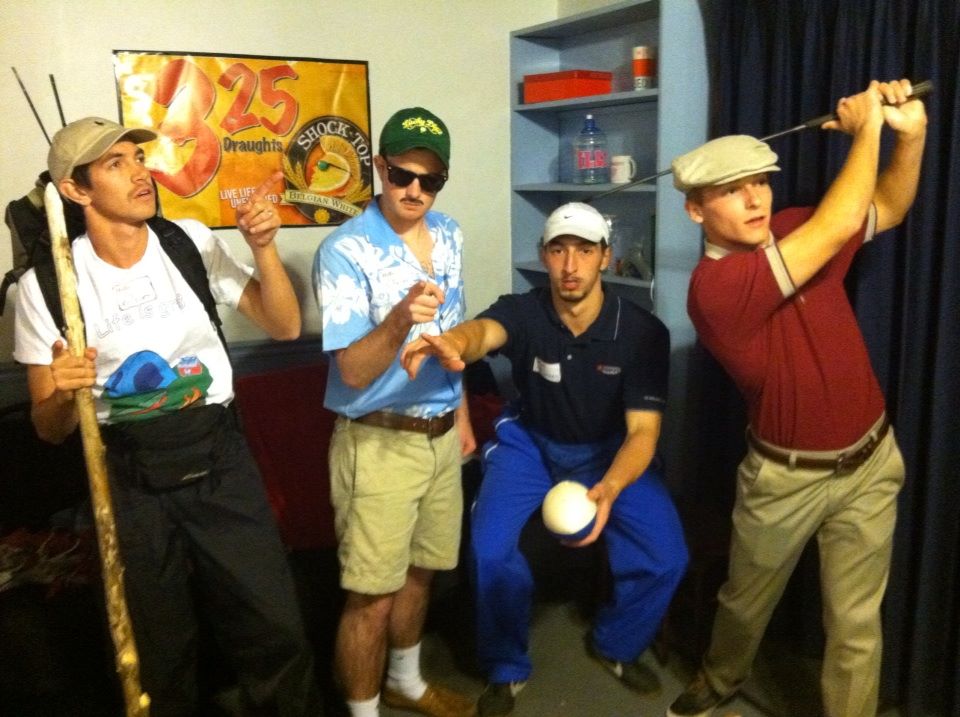
Over Halloween, he and some friends decided to go as “Dads.” I functioned in an advisory capacity, the content of which he politely ignored. My big idea was to get a Darth Vader helmet and cape, then pull on one of those t-shirts that reads: “WORLD’S GREATEST DAD!”

Because, you know, irony!

Anyway, check it out. Nick is the one in shorts, pulled up white socks, bad mustache, and “Lucky Dad” hat. Hysterical, right?

Lastly, hey, if you happen to be in Elmira, NY, on November 6th, or Richmond, VA, on November 13, you can catch a lively, fast-paced musical based on my book, Jigsaw Jones #12: The Case of the Class Clown.

I did get to see it a few years ago, with a knot of dread in my stomach, and came away relieved and impressed. Everyone involved did a great job and, to be honest, the story is sweet, too.

Here’s the info on Richmond, VA (where, coincidentally, I’ll be visiting middle schools in early December, mostly giving my patented “Bystander/Anti-Bullying/Author ” presentation. Anyway, the info I promised:

Families, elementary schools and preschools are encouraged to make reservations soon for performances of a children’s show.

A 55-minute performance of “Jigsaw Jones and the Case of the Class Clown” will be performed at 9 a.m. and 12:30 p.m. Nov. 13 at Civic Hall Performing Arts Center in Richmond.

The show is based on a children’s mystery series written by James Preller. Theodore “Jigsaw” Jones and his friend, Mila, are investigating who’s playing practical jokes. It includes music and humor.

“Jigsaw Jones” is presented by Arts Power, a professional theater company touring the nation.

Admission is $2 per student because a grant from the Stamm Koechlein Family Foundation is helping offset the cost for Civic Hall’s Proudly Presenting Series educational programming.

Teachers and chaperones are admitted free.

For Elmira, click here or call: 607-733-5639 x248 (and tell ’em Jimmy sent ya!)

Five Days, 14 Presentations, More than 6,000 Students, and a Cowboy Steak

On Friday the 20th, I traveled to Wolcott, Connecticut, where I spoke to 650 students, grades 6-8, at Tyrrell Middle School. They had all read Bystander as part of their summer reading program and, I’m sure, as part of their school-wide anti-bullying initiative. The feeling in that school was very impressive. Thank you for all your hard work to make this happen, Sara Tedesco. I’ve been wearing the shirt!

Wait. What shirt?

This one:

That’s the design on the back of the long sleeve shirt created and sold (I think) at the school. I was presented with one as a gift.  The design, created by the librarian, Sara Tedesco, was a variation of the Bystander book cover, with a more positive, local spin. Brilliant.

Come to think of it, those students said they read Bystander. But I’ll admit it, some of those kids looked pretty tan. When I see young people under these circumstances, I often apologize, explaining that in all my hopes and wild dreams, I never intended to become somebody’s homework.

On Sunday, I flew from Albany, NY, to Chicago, and then on to Oklahoma City for four full days of visits in the Yukon school district.

Maybe you’ve heard of it.

Garth Brooks was born and raised there.

The main school I visited — it had a big auditorium, so several neighboring schools bused their students to us — was located on Garth Brooks Drive, because of course it was.

My first morning I stopped into a 7-11, still groggy & desperate for caffeine. After I completed the purchase of one cold Starbucks Mocha something, the cashier asked:

“Would you like a sack with that?”

“Excuse me?”

“Would you like a sack?”

My brain was still fuzzy. The flight had been delayed. I had slept less than four hours. “A sock?”

(Yes, in my pre-caffinated state, I silently wondered if, perhaps, in Oklahoma cashiers offered people socks. Maybe this is what they do here? “Why, yes! I’ll take argyle!”)

(Next comes helpless staring, where wonderment meets bewilderment. At last a light bulb goes on.)

“A sack!” I say. “Like a bag!”

“Yes, sack, bag. I call ’em sacks.”

At that moment, I knew that I had fully arrived in Oklahoma. The land of sacks, not bags, far from the standard question of, “Paper or plastic?”

Across four days in the Sooner state, I gave thirteen presentations to 5,600 students, grades 2-8. And I can honestly say that they all loved me, every single one of them.

Actually, well, there was one kid . . .

The truth is, everyone treated me wonderfully throughout the visit. Respectfully, kindly. I felt blessed and fortunate. I can’t thank everyone enough, and won’t really try to here (I tried to there, in person).

Wednesday night I made it over to the Oklahoma City National Memorial & Museum.

The museum was incredibly moving, artistic and powerfully effective. I was, at times, a blubbering mess, but in a good way.

If you ever get the chance, by all means, yes, get yourself over to the museum — and prepare to feel the power of that experience right down to the soles of your shoes.

Then I walked over to Bricktown and treated myself to a “cowboy steak” at Mantle’s restaurant, just across from the ballpark. It was a peaceful, reflective, delicious meal, and I was happy to be exactly where I was.

Jenah Hamilton was the force of nature who helped make my visit possible.

Thank you, Yukon, OK. It was really terrific for me to gain a first-hand experience of Sooner Pride. To meet all those kids. And try, in my own limited way, to leave each school a slightly better place where together we value reading, thinking, and basic human kindness.

Most especially, thank you Jenah Hamilton, middle school librarian, the force of nature who made my visit possible.

(I owe you, big time.)

Short, Sweet Review of “BYSTANDER” by The Reading Junky

Came across a nice review of Bystander at the Reading Junky, a site written by a woman about to embark on her 36th year of teaching.

They give out Purple Hearts for that, don’t they?

Or just smile stickers?

Here’s the money quote:

Author James Preller deftly handles a current adolescent concern – bullying.  By breaking the stereotype of the rough, tough bully, and revealing a more devious variety, Preller’s story will make readers consider their own role in bullying situations.

For the full review, click here.

Thank you, Reading Junky!