Archive for Bullying

Fan Mail Wednesday #143-146: Some Recent Letters from Teachers about BYSTANDER

I’ve been getting a lot of mail from teachers who are using Bystander in their classrooms. From early on, that was my hope for this book — a talking book, a valuable conversation starter in the hands of a good teacher and a lively classroom. I’m happy to see that it’s been embraced in the 5th grade, as well some 4th-grade classrooms. Overall, most readers seem to be in grades 6-8.

Here’s a sampling of emails from teachers I’ve received over the past few weeks. As always, some personal info has been deleted to protect the innocent  . . .

Hi James,

I’m a 4th grade teacher in Iowa. Today I started reading Bystander aloud to the class. I think this is my 3rd year in a row reading the book and I LOVE IT!!! As the kids were listening their mouths were ajar. (I love that!)

Thanks for sharing your awesome talent –- with such an important message.

Cheers,
K

And from Hawaii . . .

Dear Mr Preller,

My name is ____ ______ and I am a 5th grade teacher on the island of Oahu, Hawaii. I am currently reading the book with my students and I have some students who would like to write you some “fan-mail” and replies to reading your book. On your web site you do not have an address in which we could mail you. Could you possibly email me your address?

Any help would be much appreciated. Thanks so much!

Love the book! My students cannot put it down!

Sincerely,

G

I replied: James Preller, 12 Brookside Drive, Delmar, NY 12054.

I also might have added something about being available for school visits. Aloha, baby.

Hi James!  I teach fifth grade and we read Bystander as a class.  They LOVED LOVED LOVED it.  You are a rock star.  One of my students took the initiative to write you a letter but I cannot find the address to send it.  He even included a self-addressed stamped envelope in the hopes of hearing from you.  Can you please send me the address?  I would really appreciate it.
V

And lastly, from the Windy City . . .

Mr. Preller,

I would like to inquire about having you come to visit our middle school in late August or early September of 2012 (the beginning of the next school year).

We have adopted your novel, Bystander, as an all-school summer reading novel for all students in our building, grades 6-8 (about 900 students).  Our School Climate Committee has been meeting this year to develop a more effective anti-bullying initiative in our school, and your novel is a perfect match for this project.

Please let me know your availability and fees.  We are located in _______, Illinois, a northwest suburb of Chicago.  Here is a link to our school’s web page linked to our district’s site if you would like to get a sense of our community.

Thank you,

M

I replied, in part . . .

M,

This sounds wonderful, though there are some obstacles in our path.

I live outside of Albany, NY, so there is travel to consider. Generally speaking, I prefer to have a minimum of three full days of work for any trip. Four is better. The best arrangements come when schools in a district coordinate their efforts — and share the expense of plane tickets — and I’m invited somewhere for 4-5 school days.  Is that enough to get you started?

Lastly, thank you. I’m very glad to hear about your efforts, and glad that my book might help in the process for cultivating a safe, happy community of learners.

My best,

JP

Fan Mail Wednesday #141 (Bystander)

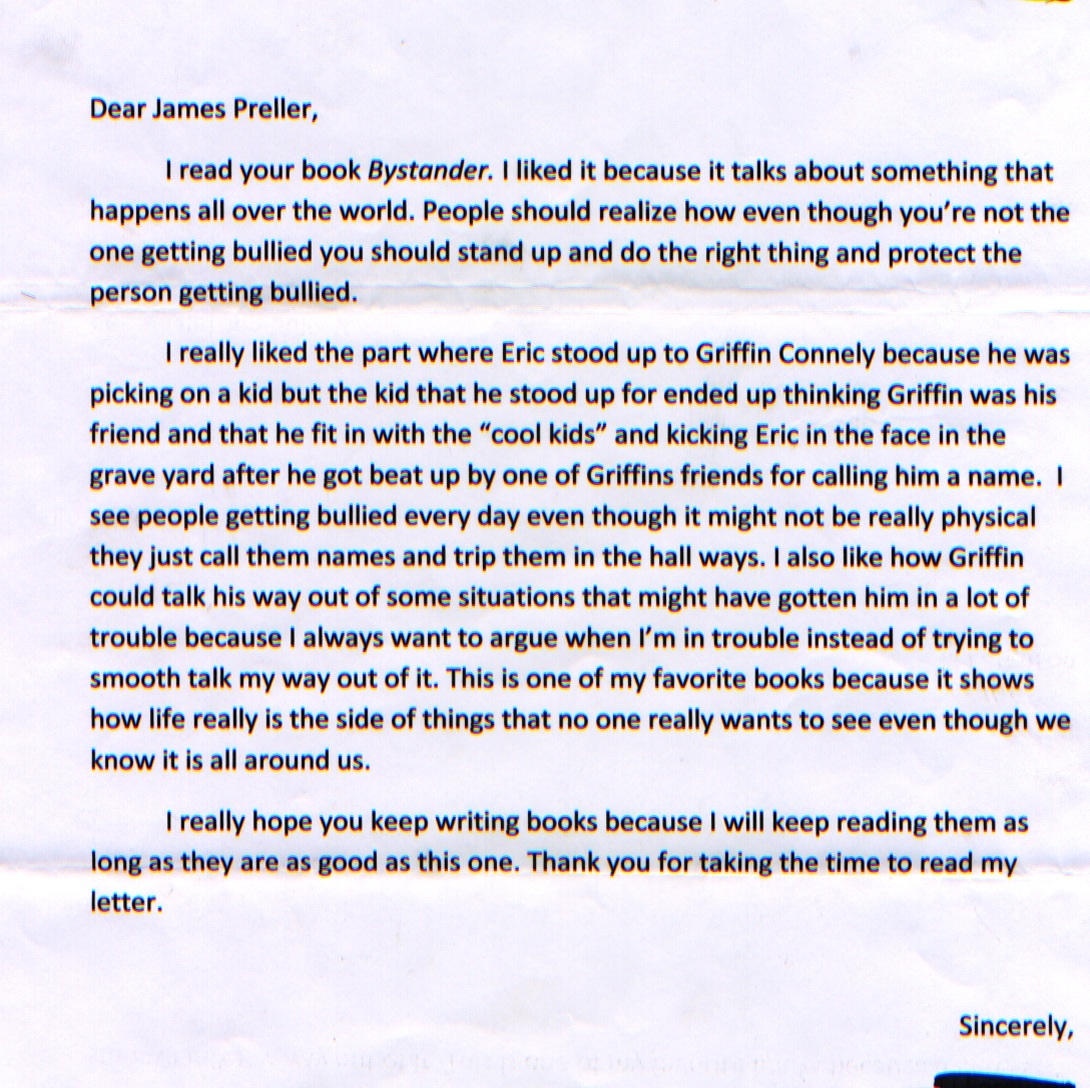
There’s a great line in the last paragraph of this letter: “I really hope you keep writing books because I will keep reading them as long as they are as good as this one.”

He didn’t add, because it was unnecessary, “But if they suck, no dice.”

I replied:

Dear ____:

Thanks for your great letter. I know you wrote it a long time ago –- you’ve probably forgotten about it by now – but I want you to know that I really, really appreciate that you took the time to read my book, BYSTANDER, and send along a typed letter.

I have a new book coming out in July, titled BEFORE YOU GO. It has a little bit of mild language in it, as they say, some alcohol, but not much. I guess it’s up to individuals as to where they draw the line on those issues. The main characters are ages 16, 17. Essentially the setup is this: Opening scene, four unnamed teenagers drive on a dark road. The car spins out of control, hits a tree. One passenger dies. Next page, we rewind six weeks into the past, and gradually meet all the characters. The reader doesn’t know who is going to be in the car, or who will die. The book catches up to the accident about 2/3 of the way through, so it is divided into two sections: “Before” and “After.”

I’m also in the middle of writing a crazy (and fun, and funny) book about about a 12-year-old zombie, but I don’t like to talk about books until I finish them.

Thanks for reading my book, and thinking about it. I loved your line, “This is one of my favorite books because it shows how life really is, the side of things that no one really wants to see even though we know it is all around us.

Smart guy, ______.

My best,

JP

Fan Mail Wednesday #139 (Bystander, Again)


I’m forwarding this out from the Crowne Plaza Hotel in Cherry Hill, NJ, on my 5th day of my 9-day barnstorming mission. So far, so great. Gotta run!


There’s no point sharing my reply here. I just tried to be gracious and thankful.

Fan Mail Wednesday #134: Audiobook Blues

Hello, I am an 8th gr. teacher in Ashtabula, Ohio and I am currently teaching the book Bystander.  I have searched high and low for an audio CD or cassette for this book to use in my classroom because I have a large amount of struggling readers that this would benefit.  Does this book have an audio accommodation?  I would greatly appreciate any information that you would give me.  By the way, I LOVED the book!!  Our school is currently beginning a Bully Week in school, and this is fitting in great with this activity.  I hope my students enjoy it as much as I did. Thanks, Nicole
I replied:
Nicole,
–
Thanks for your kind words. I have received quite a few requests similar to yours. Unfortunately, an audio component to BYSTANDER remains stuck in the discussion stage. Which I gather means: Nope, never gonna happen. I suspect the book’s timeliness took the audio folks by surprise. Believe me, I’m frustrated too. But to be kind, I don’t think the audio business is exactly booming these days, so they need to be very careful about what they produce and try to sell.
–
This pains me for the reason you mentioned. This is a book that’s being read in class and, in some cases, entire grades. It’s a novel, yes, but one that ties into and hopefully supports the anti-bullying work that’s being done around the country. Given the importance of this issue, I wish we had an audio companion to offer the students who struggle with the printed word.
–
I wonder if the new business model is that we (they) produce something inexpensively, and sell it for 99 cents (cheap!) or just give it away. Hmmm.
–
Ultimately, I’m just the writer, and these types of publishing decisions go over my head.
–
JP
–

Confession: I Finally Got Around to Reading “The Chocolate War” by Robert Cormier

–

And indeed there will be time

To wonder, “Do I dare?” and, “Do I dare?”

––

I’m not a ticker by nature. You know tickers, right, those bird-watchers who have the list in their back pockets, and are all too delighted at each new sighting to check another one off the list. Yellow warbler, good, that’s done.

I worry about those people. I sit up at night, fretting over the shallowness of that experience. Is that all they want, I agonize, just to check it off and be done with it?

I suspect that some readers are the same way. Read it, read it, read it. Done, done, done. What’s next?

Where’s the reflection? When did it become a race?

Better to read one book well, and deeply, than to race through a dozen.

That said, it felt good to finally get around to reading Robert Cormier’s The Chocolate War, the book that rekindles the question, “Do I dare disturb the universe?”

By the way, you know where that quote’s from, right? Only one of the greatest poems ever.

I thought The Chocolate War was brilliant, expertly written, full of youthful rebellion, combativeness, anger, sorrow, energy, brutality — and still timely today. A stunner, frankly. There are not many times when I feel I could have written someone else’s book, and it would be misguided and presumptuous for me to say that here, but I did feel a kinship with Cormier. I understood him down to my bones, recognized his choices, knew exactly what he was trying to achieve.

Cormier’s book is darkly beautiful, the characters vividly drawn, sharp and jagged. There’s the cold manipulation of Archie Costello, the puppet-master. Jerry’s confusion and inner conflict, his unresolved emotions, the way events took on a life of their own beyond any decision or intentionality. And all that catholic school stuff, yes, I remembered that,  too. The 70s were my era, and the tone of this book rang clear and true. Cormier got it all right. The novel’s themes are closely connected to my own book, Bystander, but Cormier goes deeper, darker, older. If Bystander is right for middle school — a somewhat gentle introduction to bullying, a story that peers over the precipice but never makes that leap into the void — then The Chocolate War goes a step or two beyond, grades 8/9-up. It takes you into the black. Where I stopped short, by design, Cormier plunges bravely onward.

Stop it, stop it. But nobody heard. His voice was lost in the thunder of screaming voices, voices calling for the kill . . . kill him, kill him. Goober watched helplessly as Jerry finally sank to the stage, bloody, opened mouth, sucking for air, eyes unfocused, flesh swollen. His body was poised for a moment like some wounded animal and then he collapsed like a hunk of meat cut loose from a butcher’s hook.

On a different note, in my upcoming book, Before You Go, the main character, Jude, is a runner. I had to think about that, and describe his running, here and there, nothing much. A metaphor, for sure, alluding to deeper themes, but also something as concrete and specific as sneakers on the sidewalk.

Well, here’s a paragraph from The Chocolate War. A quick description of a minor character, Goober, who likes to run. Want to read a great passage?

The Goober was beautiful when he ran. His long arms and legs moved flowingly and flawlessly, his body floating as if his feet weren’t touching the ground. When he ran, he forgot about his acne and his awkwardness and the shyness that paralyzed him when a girl looked his way. Even his thoughts became sharper, and things were simple and uncomplicated — he could solve math problems when he ran or memorize football play patterns. Often he rose early in the morning, before anyone else, and poured himself liquid through the sunrise streets, and everything seemed beautiful, everything in its proper orbit, nothing impossible, the entire world attainable.

All I can add to that is, wow. Just slack-jawed wow. Poured himself liquid through the sunrise streets. Liquid! The portrait of Goober  goes on for another remarkable paragraph, where Cormier turns the phrase, “The neighbors would see him waterfalling down High Street . . .”

Waterfalling! The noun as verb, the image startling and yet crystal clear, natural not forced. Waterfalling down High Street.

Run, Goober, run. See Goober run. Liquid, waterfalling.

Damn. That’s great writing.

ADDENDUM:

A librarian friend chimed in with this comment, via email:

Saw on your blog that you finally read The Chocolate War.  Amazing book, huh?  It gets banned EACH AND EVERY year, as you can probably imagine, for being – and I quote from some of the language in the bans and challenges – “pornographic,” for foul language, for its “portrayal of violence and degradation of schools and teachers,” for its “blasphemy” and because it is “ humanistic and destructive of religious and moral beliefs and of national spirit.”  One challenge, in a Georgia high school, cited “ I don’t see anything educational about that book.  If they ever send a book like that home with one of my daughters again I will personally burn it and throw the ashes on the principal’s desk.”  And my favorite, from someone who wanted to ban it because the ending was…get this…too pessimistic.

A book like that, you just HAVE to read.