Archive for A Pirates Guide (Series)

Guest Blogger at Mackids

I contributed to the cyber-clutter by posting over at the Mackids blog. Kathryn Hurley had asked me to write something about A Pirate’s Guide to First Grade. I mulled that over for a week or so, and came up with this, below.

Funny, in clipping it and pasting it here, I decided to ditch the first paragraph. That happens a lot with writing. You scribble and scribble, then realize that the story starts why down in the fourth paragraph. It would have been faster to start there in the first place, but I suppose you’ve got to go through the process of getting there . . .

I have vivid memories of playing alone as a little boy, the youngest of seven children. Inspired by “Batman” and “The Wild, Wild West,” I used to create epic battles in my living room. I’d fight imaginary villains, hurl myself headlong into the cushions, throw wild left hooks into the air, crash the bad guys’ heads together like coconuts. Likewise, I’d often go outside to pitch a rubber baseball against the shed behind my house. I’d imagine myself as a big league pitcher going up against the great hitters of my time: Willie Mays, Hank Aaron, Roberto Clemente and more.

And here’s the thing: There was always an internal narrative going on in my head.  “Two outs, bases loaded . . .” I’d mumble to myself, setting the scene. I didn’t realize it at the time, but I was telling myself stories, inhabiting an imaginary world, learning how to write. This made me, of course, no different from any other kid I’ve ever met. These days, I’ll look out the window and see my son out by the pool, waving his arms, lips moving, telling himself some kind of story. It seems like it’s a fundamental aspect of being a kid, living in that imaginary world of our own making. Maybe that’s why we dream, I don’t know. Maybe it’s necessary.

So when it came to writing A PIRATE’S GUIDE TO FIRST GRADE, I think I was drawing on those memories of being a boy, a head full of imaginings. The boy in the book thinks about pirates. They are alive to him, and as he goes through the day they remain vital in his mind. The narrative itself isn’t much, a fairly uneventful first day at school –- with story hour and lunch and recess and a trip to the library. But I like the creative core of this book, the hard truth of a boy’s imaginings, the story in his head.

For an author, it’s a magical experience when an illustrator breathes new life into the manuscript, adds color to that black-and-white page. I’m blessed that Greg Ruth did such an amazing job with this story. But then again, Greg was a kid once, and somehow he still has that map that allows him to return to that creative place of the mind, a boy making things up. Maybe that’s the treasure to this job after all, where X marks the spot and we find ourselves alone in a room, lips moving.

Another Starred Review for “A Pirate’s Guide”

This makes me happy. A Pirate’s Guide to First Grade earned a second starred review, this time from Publishers Weekly . . .

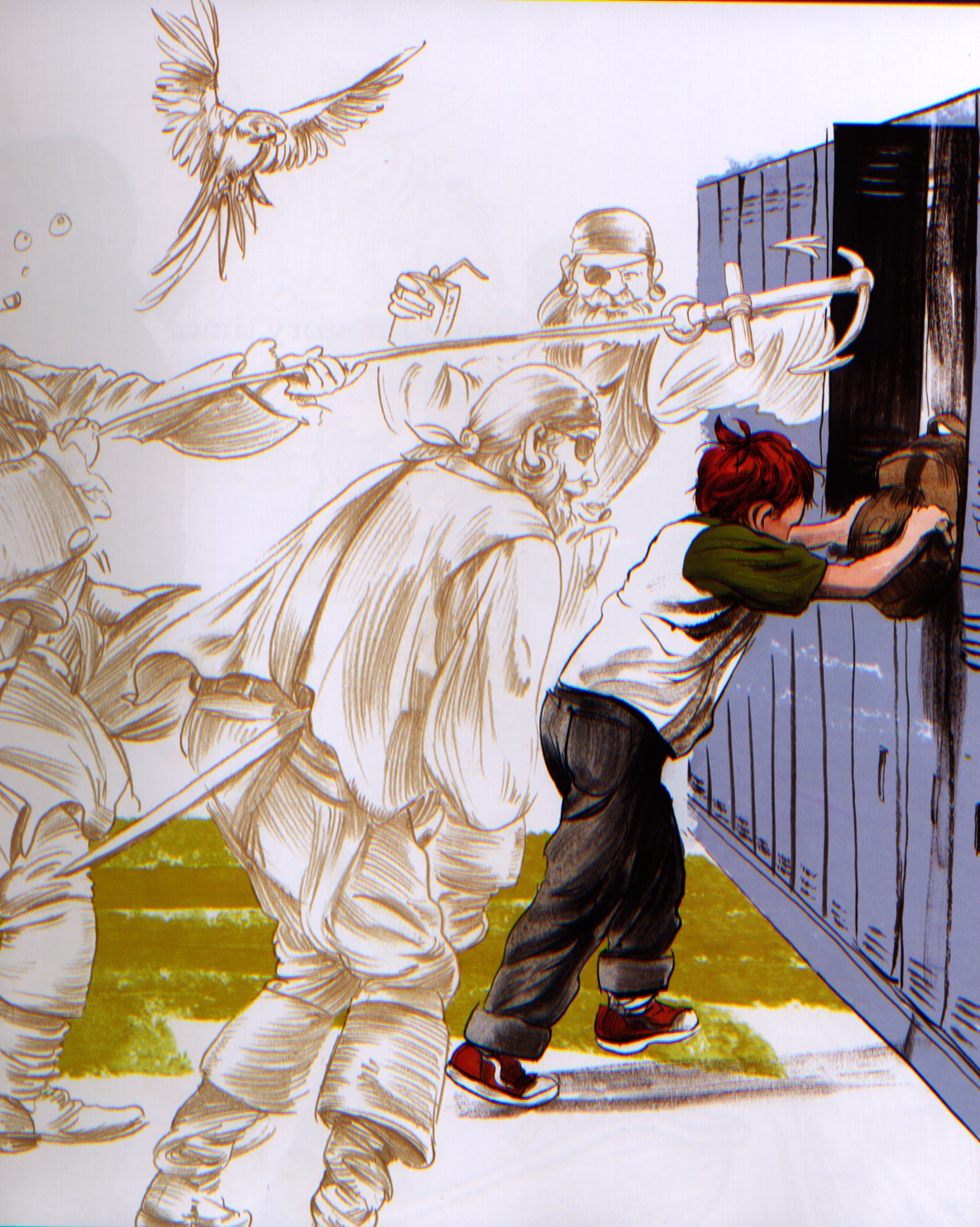
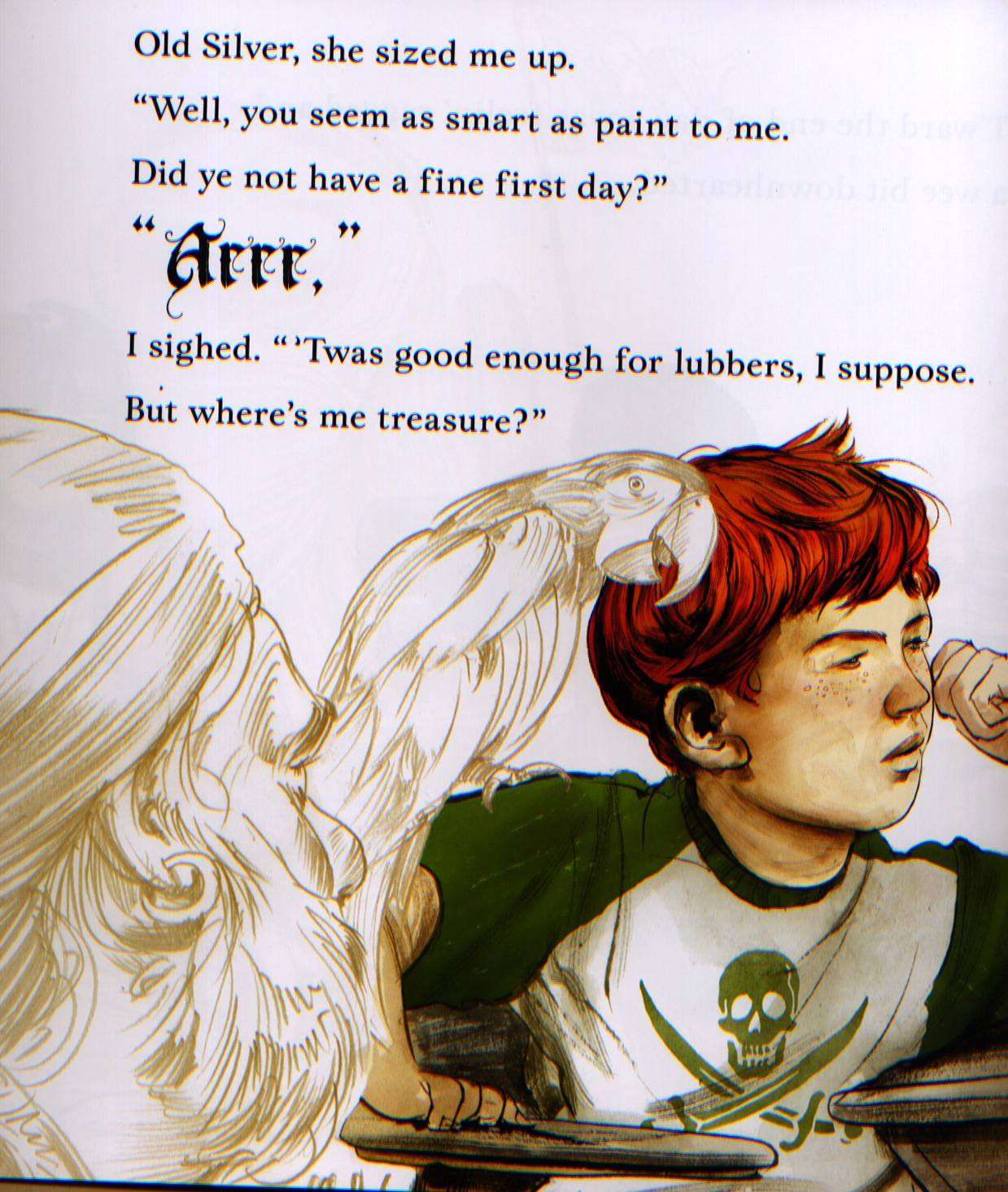
“This rambunctious first day tale is fit for any young buccaneer. Leading an imaginary crew who are drawn in pale pencil, the red-haired protagonist shines his “snappers” (brushes his teeth), breakfasts on grub and grog, and boards the “great, grand jolly boat” (also known as the school bus), journeying to meet his teacher: “Silver was her name, and a fine old salt was she!” The pirates are ever-present companions, sharing in the ups and downs of the day (“We counted and spelled ’till we nearly dropped, brain-addled and weary”). Preller’s buoyant pirate-inflected storytelling and Ruth’s illustrations, which have a decidedly vintage flair, form an exuberant tribute to imagination and a spirit of adventure.”

Starred Review from SLJ!

This Just In: The first mainstream review for my new picture book, A Pirate’s Guide to First Grade, illustrated by Greg Ruth. The review appears in the August issue of School Library Journal, and was written by Jasmine L. Precopio.

What does this mean for you, personally? Jeepers, do I really have to spell it out? Okay, since you asked: It means, good people, that it’s now officially safe for you to buy this book as soon as possible. Now in stock! Think of your future grandchildren!

Told entirely in pirate lingo, this story follows a boy and his entourage of ethereal salty dogs through the first day of school. “Me great scurvy dog slurped me kisser when I was tryin’ t’ get me winks!” The protagonist’s fruitful imagination turns ordinary routine into a high-seas adventure complete with a small, skirted buccaneer walking the plank during recess. In the end, where does X mark the spot? Treasure abounds in the library, with the chance to experience the adventure of the written word. The illustrations have a vintage feel, complete with boisterous grog-drinking, scabbard-waving, and bubble-pipe-smoking pirates. The combination of the muted tones of the pirates with the bold colors of the real world adds to the visual appeal. Despite the glossary, the text may prove a little challenging for the intended audience. However, it can serve as a tremendous read-aloud, especially on Talk Like a Pirate Day.

Kirkus Reviews “A Pirates Guide to First Grade”

“Good fun, me hearties!”Kirkus Reviews.

Ahoy, lubbers! Here’s the first review for A Pirate’s Guide for First Grade:

“A little boy with pirates on the brain navigates the first day of school. Narrating in a vigorous piratespeak, he takes readers through his day. “Then in the galley, I mashed me choppers on grub and drowned it with grog.” It may come as no surprise to learn that school comes as a bit of a letdown: “ ’Twas good enough for lubbers, I suppose. But where’s me treasure?’ ” he asks his teacher, “Cap’n” Silver,” at the end of the day, and she obliges. Ruth matches the narration with striking line-and-watercolor graphics, surrounding his hero (who sports a skull-and-bones athletic jersey) with sepia-and-white pencil renderings of pirates (and a parrot) who silently kibitz on his day. Pirate-addled readers will dance a jig; press-ganged kids will be happy for the glossary. Good fun, me hearties. (Picture book. 4-7)

I’m not sure about “press-ganged,” this might be an advance copy that hasn’t had the final proofread. Or maybe it’s just a word or phrase I don’t know.

That said, I agree. The book is good fun and Greg Ruth’s illustrations are great.

UPDATE: You know what they say, ignorance is Jimmy! Author Kurtis Scaletta explains the meaning of a “press gang” in the comments section. Arrr.

When That First Copy Arrives in the Mail: Shiver Me Timbers!

I don’t do happy dances. I’m not a fist-pumper, chest-thumper, or rump-bumper. It’s just an inward satisfaction, and pure pleasure; the culmination of something that’s been brewing for years. In the case of this book, A Pirate’s Guide to First Grade, illustrated by Greg Ruth, my pleasure is tripled by the gratefulness I feel to be so well published.

What does that mean, exactly? Well, for the most part, after you sell a manuscript your editor and publisher will make a hundred small decisions about the book. And each decision boils down to one thing: How much care are they going to put into it? Sometimes it’s money; mostly it’s attention to detail. For example, almost all picture books are 32 pages. But for this book, Feiwel & Friends gave illustrator Greg Ruth the freedom to stretch out the artwork across 48 pages. In doing so, they showed a commitment to story.

As an author, you can see it in the book, in the conversations you have about it, in all the myriad details of how it and you are treated. At times in my twisting, inglorious career I’ve been disappointed and disheartened. So clearly a B-lister.

That’s the most important thing, I think, with my editor Liz Szabla at Feiwel & Friends, the art director Rich Deas, publisher Jean Feiwel, and many others who work so hard there: Dave Barrett, Nicole “May I Buy a Vowel” Moulaison, and the entire “Fifth Ave” sales force (for talking like a pirate on all sales calls). What’s more, they all now bring parrots on all bookstore visits. That’s commitment, folks.

Collectively, they seem to care deeply about every book they publish. And for that I am enormously grateful and, yes, indebted.

The book hits the market for real on July 20, 2010 — just in time for the coming school year.