In keeping with our theme for the week, here’s cool cat Ben Sidran with a little advice.
“You’ve got to read! That’s what you need. Open the book, baby!”
Below, you might appreciate this brief Bo Diddley performance of the same song. Great fun when the background dancers appear, forty seconds into the tune. Got to love the roots of rock. Also: I keep wishing I could hear Jack White cover this tune.
Well, it’s been a wonderful week and I’ve really enjoyed having Lewis Buzbee as my co-host, trailing after me like a lost puppy . . .
Believe me, if I had any idea he’d act like this, I never would have asked Lewis to stay for an entire week. But Don Rickles canceled, Sammy was busy, and Barbra never returns my calls.
Seriously: I don’t hang with authors much. I don’t get invited to conventions or even blog tours or — come to think of it — neighborhood block parties, so it’s not like I get the chance to meet many high-flying literary types. I tend to spend my time with my wife, my kids, and other people here on earth. But when I read The Yellow-Lighted Bookshop, I felt an immediate connection to Lewis. I had to talk with this guy. I wanted to push his doorbell, spend the weekend. Separated by 3,000 miles, I did the next best thing: Asked him for an interview.
I hope you’ve enjoyed this series of interviews half as much as I did. I feel like I’ve not only discovered a terrific writer — someone whose career I will follow, whose books I will read — but also, something more lasting, more meaningful: I’ve found my 163rd Facebook friend.
If you missed the fun, click here to catch up on Part One or Part Two.
And we’re off . . .
Is John Steinbeck still your favorite author?
Least favorite question.
Oh, man. Sorry. Now I feel like Geraldo.
He’s my first writer, for sure. And reading him again and again as an adult, I learn more from him every time. But there’s a million others out there who are my favorite writers. I go with E.M. Forster on this. I don’t see writers in any competition, I see them all working together in the big round reading room of the British Library. Isn’t it a miracle we have so many great writers to read?
So, yes, he has to be my favorite.
What have you learned from him?
I hope what he wrote to a young Peter Benchley, who was in boarding school at the time. He was friends with Peter’s father. Steinbeck wrote, “Only a fool is willfully obscure.”
Yes, excellent. You put that in Steinbeck’s Ghost.
In other words: the exact opposite of what they taught us in college! To me, so much of my adult writing life has been about unlearning those lessons, the obtuse writers that we were supposed to admire and love. I mean, yes, some are great. But there’s definitely an Emperor’s New Clothes thing going on: I don’t understand it, I can’t comprehend it, so golly it must be good! More and more, I respect writing that has clarity, directness, and restraint. An absence of flash. I’m striving to write sentences like, “He put the glass on the table.”
Many of my students — I teach part-time in the MFA program at University of San Francisco — are under the impression that subtlety is the goal. And by that they mean murkiness. One of them recently told me, “I love stories that leave you completely confused about what’s happening.” Okay, fine.
Flannery O’Connor wrote that in a time when there is too much noise in the air, and everyone is heard of hearing, the writer needs to practically shout, use primary colors, be bold. Yep.
Talking about Steinbeck, I’m reminded of how I read many of his books as a young teenager. He and guys like Ray Bradbury and Kurt Vonnegut, Jr. (probably my favorite at that age) were the young adult literature of my youth. There was no such thing as “YA.”
I think that that’s my ultimate goal as a writer, to crack open the brain, and unleash the words, of a fourteen-year-old. To meet the big ideas about the world that are just forming in their enormous brains. As a bookseller, who should pay attention to categories, I was never one for categories. Good is good. That’s that. Bradbury, Vonnegut, Steinbeck — that’s a good desert island stack.
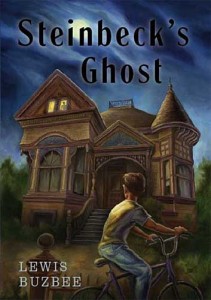
You recently wrote your first children’s book, Steinbeck’s Ghost. How did that happen?
Like I said, I wasn’t a voracious reader as a kid, so I missed a lot of great kids’ lit. But the very first bookstore I worked in was run by three wonderful women, who were all passionate experts about kids’ books. And they made certain that I read as much as I could, and that I understand, not only the importance of kids’ books, but the variety and expertise of kids’ books, their sophistication. So my whole adult life, I’ve been a reader of kids’ books. And I’ve always wanted to write my own.
I’m glad you did, just don’t eat up too much of the market share. Oh, wait. We”re not supposed to be in competition. Can’t I just quietly hate you?
You became a father relatively late in life. How do you think that’s affected you as a writer? As a reader?
Lord, what a question. It changed everything.
When my daughter was born, I was halfway through the second draft of a six hundred page novel that was all very clever and erudite and luminous. But I threw myself, gladly, into being a dad, changing diapers and staying up nights for feedings, strollers, all the rest. It was a blast. By the time I got back to that novel, I was disenchanted with it — it seemed so unessential, so small. And I immediately began writing a whole new crop of stories about what I felt were bigger things. That became After the Gold Rush, my first book of stories.
My daughter “restored me to life,” as Dickens said, reminded me what was essential. And since then, I’ve written so many books, with such urgency. She not only reminded me what to write about, but showed me, perhaps for the first time, why I was writing. Dude, seriously, it’s life and death stuff — that’s how it makes me feel.
Katherine Paterson has a wonderful line about that, reflecting on being a parent and a writer: “I can see that the very persons who have taken away my time and space are those who have given me something to say.” There it is, I couldn’t possibly say it better. Like we were talking about before — she said it for us, articulated that chaos of the heart, and I’m grateful to her for that.
God, what a great line. I wish I’d said that. Can we pretend? That’s the wonderful thing about being a parent, and I think a lot of people miss this part — especially the “workaholics”: my pleasures here are purely selfish; she gives me so much.
And then, of course, there was reading to her. She’s eleven now, and we still read together every night. But the first day she was home from the hospital, I read to her — Beatrix Potter, Maurice Sendak. And it’s been such a journey to follow her through that development, through all the picture books, then the chapter books, then the middle grade novels. Yes, that had a huge influence on my desire to get into the kids’ section.
What’s your daughter’s name? I’m guessing it’s Flannery, Harper, or Willa.
Maddy. Yes, Madeleine. Actually named after a character in the Bill Forsythe movie, “Comfort and Joy,” who is a kleptomaniac, and her boyfriend follows her around department stores watching her steal, and he’s always saying, in his Scottish accent, “Ach, Maddy; ach, Maddy.”
Ach, Maddy — that’s funny. What’s next for you?
My second middle-grade reader, The Haunting of Charles Dickens, will come out in September 2010, and I’ve just finished Mark Twain and the Mysterious Stranger, September 2011.
Quick idea here, Lewis, if the series is successful: Marcel Proust and the Madeleine Tea Cake. Kids are always clamoring for more Proust — plush toys, bed sheets, lunch boxes, 8-track tapes. Or how about, Ernest Hemingway and the Disappearing Absinthe. Maybe you could package it with “Death in the Afternoon by Chocolate” brownies or something. Hey, it’s your series — do with it what you’d like. I’m just typing out loud here.
I was thinking more like Kafka Goes Krazy. I think Kafka is the perfect karacter for kids to relate to. I mean, you know you did something wrong, and have to stand trial for it, but you just don’t know what it is you did. Plus, it’s got movie written all over it.
Actually, I think Kafka’s “Metamorphosis” is the most borrowed idea in children’s picture books. Imogene’s Antlers, anyone? A Bad Case of Stripes? There are many variations. And I love that idea today, waking up in a transformed body. It’s probably a great story starter in the classroom.
I’m just starting a new adult nonfiction book, along the lines of Yellow-Lighted Bookshop. It’ll be called Blackboard: The Life of the Classroom, and will concern itself with classrooms and what happens in them. It’ll include history, too, but also the memoirs of a student, and of a teacher.
Wow, huge topic, sounds interesting — I’ll look forward to reading it. Now strap in, Lewis, here comes The Lightning Round. Five favorite TV shows, all-time?
Simpsons, South Park, Cheers, M*A*S*H, iCarly (my new favorite).
Five best concerts you’ve ever seen?
Tom Waits on New Year’s Eve; Elvis Costello’s Spinning Wheel Tour; Bob Dylan’s Slow Train Coming Tour; Talking Heads’ Stop Making Sense Tour; Bruce Springsteen in San Jose, 1978.
I love Tom Waits, and he is a genius. But frankly, a lot of the more recent stuff is just too, well, obscure. I’m not a musical genius. I like songs. I have all his albums up through the early nineties. Then it stops. But I’d love to have lunch with him someday.
Five favorite bookstores?
City Lights; Green Apple Books; Booksmith; Books, Inc.; all in San Francisco. Shakespeare and Co., Paris, because it’s in Paris.
You are outside somewhere, peaceful under the night stars. There’s a song playing and a drink in your hand. What’s the song? What’s the drink?
Van Morrison’s “PIper at the Gates of Dawn,” with a Martini, Sapphire, shaken, very very cold, and only the faintest touch of Vermouth (one should only whisper the history of Vermouth to the martini).
Last five books you’ve read?
Listen, I was told there would be pie. Is there pie? No pie? Oh, okay.
I just met Rebecca Stead, ever so briefly. Got a signed copy of When You Reach Me for my kids. I don’t think she realized how fabulous I was, or else she would have been more excited. Don’t you think? A lot of talk about that book. How’d you like it?
It’s a great voice she has, and a real great, what I call “kid brain.” I also like that she and her publisher were willing to go back to the 70’s. Near history, not movie history. I dug it, completely. Like Konigsburg, she knows how intense every moment of childhood is, and she knows that kids are intensely involved with the lives of adults, too.
Wouldn’t now (cough, cough) be a good time to talk about my books? I mean, dude, throw me a bone here. It’s how we met, isn’t it?
I didn’t know you wrote. Oh, you’re that James Preller! Hmmm. It’s true. I recently read Bystander, and wrote you a somewhat unabashed fan letter. Because, like Stead and Konigsburg and L’Engle and Cormier, you get what the best kids’ writers get and what makes me want to keep doing this: kids are way, way smarter than we think they are, and their lives are as worthy of serious literature as adults. Perhaps more. Then I read Six Innings, which I loved, and I thought, crap, this guy is too good.
Yeah, baby!
But seriously, where’s my pie, Mr. Preller?
I lied about the pie. Listen, bro, thank you so much for hanging around, putting in all this time. I can only hope my Nation of Readers goes out and buys all your books. You should expect a huge spike in sales. Please except this new Kindle 2 as a parting gift. It’s lightweight, 20 percent faster than the original Kindle, and lasts four to five days without needing to be plugged in or whatever. Let’s see a book compete with that! Plus, you can use it as a doorstop.
Can you hand me the chainsaw, please? The chicken is getting antsy.
Last thought, as the credits roll . . .
. . . the nicest thing I can say about Lewis Buzbee is that after you talk to him, you want to go out and buy a book. You want to catch up on all those treasures you’ve missed. You want to walk into a good bookstore, run your fingers down those beautiful spines, bring the weather with you. We all feel it, everybody here. We’re readers. We love books; it’s at the core of everything we do. Thank you, Lewis Buzbee, for reminding us of that love.Now get outta here, ya big lug, before I hit you with a pie.
——-
FOR MORE INTERVIEWS . . .
If you enjoyed this interview with Lewis Buzbee, you might like interviews with other author/illustrator types:
Let’s pause a moment before the thrilling conclusion of “The Never-Ending Lewis Buzbee Interview” to answer some fan mail. Watch now as I reach my hand into the large barrel and select . . . a pickle? Hold on, wrong barrel. Ah, here we are!
Dear Mr. Preller,
Thanks for meeting me and Flat Brownie at Children’s Book Day at Sunnyside. I had a lot of fun even though the weather was a little wet and Bunnicula creeped me out. I was glad to get a picture with you since I really enjoyed your visit last spring to my school, Minisink Valley. I am making a scrapbook of my Flat Brownie with all the children’s authors and illustrators I can. So far I have quite a few.
Keep up the good work, and if you run out of ideas, let me know. I’ve got a pretty good imagination.
Your Pal, Molly
P.S. Here’s the picture of us. I think we both look pretty good, don’t you?
I replied:
Molly,
Great letter — you’re a very good writer. I’m a little jealous. When I was your age, I was drawing in mud with a stick. But I think our picture is nice! Though, um, what’s going on with my face? My smile looks lopsided!
I don’t have too much trouble getting ideas, my struggle is usually a matter of sitting down and putting in THE WORK. And for that, I’m afraid, there’s no one who can help me. In a sentence, I guess that’s the hard thing about writing. It’s all on you.
Hey, can I put up your photo — our photo — on my blog? Let me know!
JP
P.S. I so agree about Bunnicula. People walking around dressed up as giant costumed book characters always gives me the jibberwillies — Clifford the Big Red Dog, Curious George, Biscuit, very frightening!. Even worse, as a visiting author I get to go in the back room for refreshments. That’s where I’ll see some old bearded guy, red-faced, full of sweat, slumped in a chair, wearing a Clifford costume. On his lap, he’ll be resting Clifford’s enormous, vacant head. And here’s the thing: He’s miserable, this guy, wondering why in the world he took this job, dressed up like a giant red dog, wandering around the grounds, getting tackled around the knees by little kids. He’s thinking, “Eight bucks an hour just ain’t worth it.”
Sort of loses the magic for me.
——-
Molly’s mother wrote to me soon afterward, granting permission to use the photo. She added these charming details:
Molly is currently working on a series of books about a porcupine (named Porcupine) with a best friend who is a rat (named Sally). They like to have sleepovers and have a lot of snacks. Maybe one day she will be an author, too.
It would not surprise me in the least. I can’t wait to read Molly’s books!
I’m back for Part Deux of our chat with my lovely and talented co-host this week, author Patty Duke Lewis Buzbee. (To catch up with Part One, click here.)
As a nod to tradition, let’s open the show with a brief musical interlude, which expresses in musical terms how I feel about Lewis . . .
They don’t write songs like that anymore. Anyway Lewis, one of the things that comes through in your writing is that you love books, the physical objects themselves.
Books are unique tools. I’ve been thinking a lot about this lately. A CD, say, or a DVD, those are great tools, too. And have some physical pleasures to them. Even certain iPods are lovingly designed. But those objects are just mediums for the message — the sound comes from space still — if only the space in your ears. Or the movie appears on the screen, over there. But a book is the thing it imparts. You cannot separate the two. And because of this, I think, we have decided that books can be beautiful, sensual objects.
A bookseller knows this. Next time you go into a bookstore, watch the browsers. So much of how we choose a book is done with our hands. We pick it up, stroke it, turn it over, weigh it in our hands. We’re buying the thing itself.
Is your book available on Kindle?
No. Not this one. But, hey, I’m open to it.
It was significant to some viewers of Star Trek when Captain Picard pulled down a leatherbound edition of Shakespeare, or whatever it was he read. Actually, I believe he was a fan of the hard-boiled detective genre. Viewers were reassured by that vision of the technological future, which — let’s face it — frankly scares the bejeezus out of us. And of course, I have to mention our shared enthusiasm for Battlestar Galactica, where frak is a word and books are revered, treasured links to a broken past. Those scenes when Admiral Adama is reading to Laura Roslin.
There’s a great scene where one of the detectives is reading to his horse, who is quite ill. They’re in the stall together, and he’s reading to the horse from Faulkner, “another great horseman,” he says. Very moving. And of course, the final scene in Bradbury’s Fahrenheit 451, where all those people have each memorized one book, to preserve it.
It’s clear that the Kindle-monster is here to stay, and too much lamenting will do us no good. But I assert — very strongly — that the book is not going to disappear in the next five minutes.
It’s not a question, really, of either/or, for me, either books or computers, it’s a matter of both. Hey, if someone’s fearful of losing books, there’s a simple remedy. Go buy a book, turn off your damn computer, and read. Simple. World saved. Lamenting about it on Facebook does nothing. Read.
I ordered my copy of The Yellow-Lighted Bookshop from Amazon.com. Does that make me a bad person?
Not at all. Listen, for years people complained about the chain stores, and the ruination . . . yadda, yadda, yadda. Truth is, chain stores have been crucial to keeping alive the literary culture, the publishing business, the diversity of the books we have available to us. The same is true of Amazon. It’s here, it’s not going away, and it does a lot of work on behalf of writers and publishers everywhere. I’m not a Luddite . . .
. . . I just happen to love books and bookstores. And I don’t believe that the bookstore will be replaced, completely, by Amazon. I mean, I still need to get out of the house now and then. And we are Americans, so shopping is what we do best. Books, more than ever, in many ways, are more current than ever. They are more widespread than ever, and there are more of them than ever. And we will want to go to bookstores to buy them.
Listen, if it gets to the point where we can do everything we need to do on a computer — and I can think of three things, off the top of my head, that you can’t do via computer — then go ahead and shoot me. Really don’t want to live in that world.
True or False: The novel is dead, literacy is dead, the computer has triumphed.
Pshaw. Not a chance. In the nineteenth century, with the advent of the bicycle, the op-eds of that day declared the death of literary culture. We would all spend so much time on our bicycles, we’d never read again.
Case in point: “Butch Cassidy and the Sundance Kid.” Katharine Ross and that bicycle. They never read a thing in that movie.
Uh, Ms. Ross to you. And frankly, if I had a bicycle and that woman and a trusty sidekick and a loaded revolver — I’d never read again either.
Please don’t let thoughts of Katharine Ross distract you. But, gosh. Look at her . . .
We were discussing the death of the novel . . .
The novel was declared dead, once again, in 1962, I think. Before One Hundred Years of Solitude, Catch-22, and a thousand other great and important books. Humans are storytellers, we need stories. And long stories. We will build them one way or the other.
Like I said, computers are cool, but they ain’t everything. They’re just another thing. We’re a little bit obsessed right now with them — because we just invented them. We really have no idea what we’re going to do with them yet. It’s been, what, thirty years since they became user-friendly. Books have been around a lot longer than that.
And I want to say, right here, I also don’t believe the whole, “oh, we have such short attention spans” argument. People have always had short attention spans. And long ones. Right now, you know at least a dozen people who can tell you every single thing that happened on every episode of The Wire, or something else. We have huge brains.
I think you are such a good writer. You have this clean, direct style — it’s never, “Look at me, aren’t I clever?” I think when we read a book, it’s so important to have that feeling, to know we’re in capable hands. That this author, like a good limo driver, can take us where we need to go.
Thanks so much. The check is in the mail.
But again with the books. The writers I’ve studied and feel most drawn to are those writers who want to communicate with readers, not impress them. Even at fifteen, I knew there was no real cache in being a writer — dude, I was gonna be a rock star. But at fifteen I also felt the power of communication, what John Irving calls one genius speaking to another genius. I strive to communicate. When I want to impress you, I juggle.
Lewis! Put down the chainsaw . . .
the bowling ball . . . and the live chicken. Right now! I’m not kidding around.
Oh, they’re not for juggling.
You are a sick, twisted man. Nevertheless, I have to say, you are one of the few published authors that I can enjoy on Facebook. You don’t see it as an endless promotional loop . . . and I thank you for that.
I am so done with networking. It’s one of the great fallacies, don’t you think, of the twitterverse — somehow it will make us all rich and famous. My new motto: working without a net. Facebook is one large Post-It note. I’m just amazed that there are writers who spend so much time promoting themselves there. Shouldn’t they be writing?
In the end, for me, all the self-promotion is just so tedious. But here I am, knee-deep in bloggy blogness. Yet I contend there’s a distinction. A reader comes here by choice. I’m giving this stuff away, folks. And I try to keep the self-promotion to a minimum, because it’s boring, borderline tacky, and I don’t think it works. But I do feel that new authors, especially, are getting the message loud and clear from publishers and friends: “You’ve got to promote yourself relentlessly! You have to get out there — and sell, sell, sell!”
Now for a commercial interruption from Dennis Cass, who has struggled with some of the same issues . . .
My publisher suggested that I go on Facebook. And I did. But what I found, instead of a new way to pester people, was a few actual friends. And when I hang out with my friends, I’m not trying to sell to them. And I’d expect the same courtesy from my brother, Al, who is in the insurance business. I don’t want to hear about his work, either. “Al is drowning in paperwork!” — he’d sound like another author, and we don’t need that.
I love it when I’m supposed to stand up and cheer for the most minor accomplishments, too. Oh, I finished a chapter; oh, I applied for a grant. I mean, I’m happy for everyone, but seriously, it’s like doing an end-zone dance for tackling someone on 2 and 7 in pre-season. Too much chattin’, not enough chewin’.
It’s hard to talk about this without sounding a little mean-spirited. And I’m sorry for that. But . . . just do the work and shut up already. Pass along some info every once in a while, sure. But too much is a turn off.
We do live in this weird “provincialism of the contemporary.” If it wasn’t invented in the last twelve seconds, it ain’t worth it, that’s the prevailing ethic. Twitter, Facebook, all the rest, they’re so new. Next year they could be the new Pet Rock. We don’t have a clue, as a culture, what any of this new technology means, or what we’re going to do with it, or really, how it will change us.
Me, I’m going old school for the release of my next book: blimps.
Gee, I hope it’s a good year.
Uh, Mr. Preller, please step away from the jokes; someone could get hurt.
My favorite thing I ever posted as a status update on Facebook was this: Go to blogblogblog.com to read my new blog about why there are too many blogs. People actually looked it up. And it turns out there is a website — it’s weird and Japanese.
So is my dry cleaner, but that’s a story for another day. You seem alert to all the little treasures and surprises in each bookstore. You mentioned one in Vermont, Bear Pond Books, where two signs hang near the front entrance, each with an arrow pointing to a different half of the store. One sign read, FACTS; the other, TRUTH. You had a great line about that, “I’ll let you figure out which was for Fiction and which was for Home Repair.”
With me, home repair is definitely in the fiction section. Ask my family. When something breaks in the house, my daughter says, oh, it’s okay, mom can fix it.
You obviously have great affection for booksellers of all stripes. Perhaps we could take a moment to raise a glass (don’t worry, I’m buying) . . .
. . . to the idea that, as you said in your book, “all readers should be grateful that there are people foolish enough, rash enough, courageous enough, and pig-headed enough to open bookstores.”
Here’s to idiots everywhere! The world would be awfully dull without them.
Allow me to interrupt “The Never-Ending Lewis Buzbee Interview” to bid a not-so-fond adieu to the end of the baseball season for my beloved New York Mets . . .
File this one under: “How It Feels To Be a Mets Fan These Days.”
Hat tip to the hardworking Aaron Gleeman for first commenting on the photo. I’m basically just stealing Aaron’s act right now. As for the photo below. Woof.




)
)

)