
–

–
Here’s a quick story:
It was love at first sight. I first heard about Little Free Libraries five or six years ago. There are so many things to like: the community building, the celebration of literacy, the connectivity, and the creativity & craftsmanship of the objects themselves.
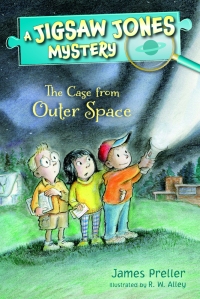
When I started writing a new Jigsaw Jones book — my first in ten years, my 41st overall — I knew I wanted to celebrate this small but powerful idea. Take a book, leave a book. So I centered the mystery in The Case from Outer Space around a note left inside a book found in a Little Free Library.
This one of the illustrations from my book, drawn by R.W. Alley:

I had to create the character who put up this particular Little Free Library. What should he or she be like? Well, wonderful, right? Giving, kind, literate, fun-loving, happy. I decided to model this character — a key witness in our story — after my friend, author Robin Pulver. (She writes the “Language Arts Library” series and the classic “Mrs. Toggle” books, which were also illustrated by R.W. Alley, so there was a nice symmetry to it: you can learn more about Robin here.)
 I didn’t ask Robin’s permission, I decided to surprise her. Fingers crossed, sensing she’d get a kick out of it.
I enjoyed writing that scene when my imaginary detective, Jigsaw Jones, interviews the fictional “Mrs. Pulver.” It was very meta. Here’s the essence of it, from Chapter 4:
I did push-ups on the Pulvers’ doorbell. A smiling woman with short hair answered the door.
I told her that I was a detective.
“How thrilling,” she said.
“I am working on a case,” I explained. “Do you mind if I ask you a few questions?”
I showed her my card:
NEED A MYSTERY SOLVED?
Call Jigsaw Jones or Mila Yeh, Private Eyes!
Mrs. Pulver whistled. “Wowee zowee.”
“It’s a living,” I said.
She told me about the library. She said that she read about Little Free Libraries on the Internet. “I thought it was a wonderful idea,” she said. “So I asked Harold to build one.”
I raised an eyebrow. “Harold?”
“My husband,” she replied. “He’s retired. I like to give him little jobs.”
I asked, “Have you noticed anything . . . strange?”
“Oh, Harold has been strange for years,” she said, laughing.
“No, I mean about the library,” I said.
She clasped her hands. “Lots of folks come and go. Friends, neighbors, even people I’ve never seen before. It’s lovely, actually. The books connect us.”
Here’s a sadly dark photo of Robin and me from last week’s Rochester Children’s Book Festival.
–

–
But wait, I have to tell you about one more cool connection.
Yesterday I received this beautiful book in the mail. A gift from the author herself. A stranger to me, but now a friend.
–

Margret Aldrich had discovered the Little Free Library reference in my book and was moved to send along a copy.
Once again I ask myself, How lucky am I?
Books really do connect us.
Margret included a kind inscription:
–

–


 Writers are not often given the opportunity to revise our work post-publication. We labor like the dickens throughout the writing process -– drafting, daydreaming, dithering -– until those last desperate hours of corrections. Then we let the book go scampering off into the wild. Not perfect, not ever perfect, but the best we could do at the time.
 I’d learned while writing the series to (mostly) avoid specific cultural references. But even so, I slipped up. So I needed to strike references to Britney Spears’ bellybutton (shaking head, even now), Blue’s Clues, baseball slugger Mike Piazza, and Barney the (annoying) Dinosaur. It would be more relatable for young readers if I shifted to generic descriptions, i.e., the hit song on the radio.


 with a Little Free Library!)


