Tag Archive for James Preller

A Jigsaw Christmas

Maybe the worst part of writing a series is the nagging sense that, after ten books or so, nobody really notices if the books are any good or not. Especially not your publisher. Your editor cares, for sure, but everyone else . . . shrug. The sum of your work gets reduced down to a number, the notion of “quality” gets subsumed by “quantity” — and the book is as good as its sales figures. I know, I know: Real World 101. But still.

So as part of my continuing “Stories Behind the Story” series, I’d like to put the focus on Jisgaw Jones Super Special #4: The Case of the Santa Claus Mystery. It’s one of my favorites in the series and it’s probably out of print.

When I wrote the book, I really tried to create a great holiday story — a story with value and content that could stand up to any of the Christmas classics. So I decided to tackle a tricky subject: Jigsaw gets hired to prove if Santa is real or not. Now I knew that I had a range of readers with a varying beliefs, and I felt a keen obligation toward them, so I was determined that my book would not spoil it for anyone. In essence, I wrote myself into a box, locked the lid, and like Houdini had to squirm myself out of it.

Here’s an early scene in Jigsaw’s basement office:

Sally Ann’s mood turned serious. She stared hard into my eyes. Her arms were crossed. “I want to meet Santa,” she demanded.

I cracked open my detective journal. “Santa?” I repeated, scribbling down the name. “Last name?”

“Claus,” Sally Ann said.

“Santa . . . Claus,” I wrote.

“That’s the one,” Sally Ann said.

“Big white beard? Wears black books and a red suit? Last seen driving a sleigh led by, let’s see . . .” I flipped through the pages of my journal and pretended to read, “. . . eight flying reindeer?”

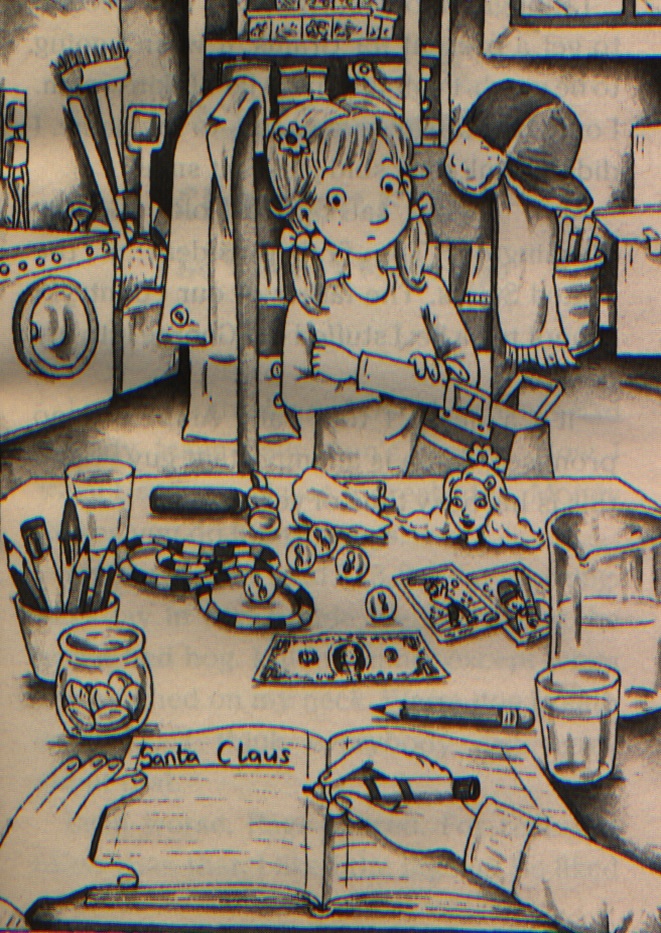
Sally Ann didn’t like being teased. She never cracked a smile. Instead, she rummaged inside her pink plastic pocketbook. She pulled out the head of a Barbie doll — that’s it, just the head. Sally Ann frowned and continued poking around. She pulled out some baseball cards, a tissue (used, I suspect), a handful of rocks, beads, a hammer (!), and other assorted junk.

“Here,” she finally said.

Sally Ann smoothed out a dollar bill on my desk.

Illustration by Jamie Smith.

She was serious.

Sally Ann Simms wanted to meet Santa Claus.

And it didn’t seem like she would take no for an answer.

I asked her why.

“We have business to discuss,” she grumbled.
And so the book begins, fueled by the mystery. Along the way, a number of  entertaining events occur — including a sly tribute to Dick Van Dyke. With the help of Reginald Pinkerton Armitage III, sort of standing in for the character “Q” in the James Bond series, Jigsaw planted a hidden camera on Sally Ann’s mantelpiece.

After Christmas,. the only thing left to do was to retrieve the photographic evidence from inside the camera . . .

By December 27, Eddie Becker had already left three telephone messages at my house. I didn’t return the calls. I already knew what Eddie wanted.

A photograph of Santa Claus.

He wanted to get rich. But I just wanted to get it over with.

Mila had said it from the beginning: “I don’t think we should mess around with Santa.”

I was finally beginning to understand what she meant.

After lunch I clomped through the snow to Sally Ann’s house to pick up the daisy camera. I brought Rags so he could play with Pickles. Sally Ann had built a giant snowman on her front lawn. Actually, it was a snowman and a snowdog. She even used a real leash.

I returned home not long after. I brought the camera into my bedroom and stared at it for a long time. I thought about a lot of things. About Santa Claus, about Christmas, and about what it meant. I thought about my parents, and Equinox, and the smiles on the faces of the people when we delivered their holiday meals.

I picked up the vase and turned a leaf, just as Reginald had showed me. A small camera popped out. I remembered his warning. If I expose the film to light, all the photos will be ruined.

“Whatever you do,” Reginald had said, “don’t pull these petals.”

Down the hall, I heard the phone ringing. Probably Eddie Becker again, I figured, eager for his big payday. I took a deep breath . . . held the camera under my lamp . . . and pulled on the petals.

Poof, no proof.

The film was ruined.

Some mysteries don’t need to be solved. I believed in Santa, and I believed in the spirit of Christmas, and I didn’t need to dust for fingerprints to prove it. My heart told me everything I needed to know.

I wasn’t going to mess with Santa. The big man deserved that much. After all, I figured I owed the guy.

Case closed.

A merry Christmas to all, and to all a good night.

NOTE: This book was dedicated to my editor at Scholastic, Shannon Penney (who remains a loyal blog reader), and also acknowledges the charitable work performed by the staff and volunteers at Equinox, a nonprofit community agency that seres the Capital District area of New York. Jigsaw and his family spend a brief part of this book volunteering at the very same Equinox.

Oh, hey, I might as well include this little scene, because I’m fond of it. Setup: It’s Christmas Eve and Jigsaw is trying to fall asleep. Remember that feeling, in bed on Christmas Eve, just wanting it to come. Jigsaw’s mother enters the room and rubs his back. He’s still just a boy.

“How did you like delivering those meals today?”

I was getting sleepy. “I liked it, I guess.”

“Is that all?”

“It felt like we were doing a good thing,” I said. “I guess that made me feel good, too.”

My mother bent down and kissed me on the cheek. “Funny how that works,” she said. “Good night, Jigsaw. You make me proud. See you in the morning.”

“Good night, Mom. I love you.”

“I love you, too.”

I was alone again. Now my eyelids were heavy.

I didn’t want it to end. Christmas Eve, the most magical night of the year. I just lay there, enjoying it. And then, drifting off easily, tired and happy, I slept.

Reminder: The Concrete Temple Theatre performs BYSTANDER this Friday, 11/4, in Hudson, NY

Just a reminder for those of you in the area . . .

Special thanks to the Hudson City School District Arts & Humanities Fund and the Berkshire Taconic Community Foundation for making this debut performance possible. I’m honored, surprised, and eager to see it — and wondering where this endeavor might take us before we’re through. Maybe to a school near you?

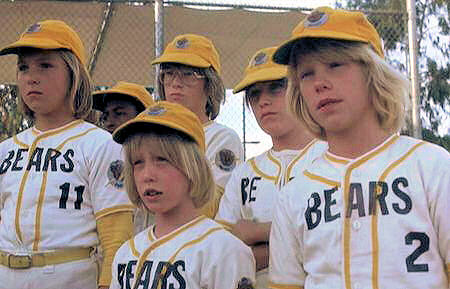
Appreciation: The Ending of “The Bad News Bears.”

To be clear up front, we are talking the 1976 original with Tatum O’Neil, Walter Matthau, etc.

By the way, a shout out to the names of these characters: Amanda Whurlitzer, Coach Morris Buttermaker, Ogilvie, Engelberg, Jimmy Feldman, Rudi Stein, Tanner Boyle, Ahmad Abdul Rahim, Kelly Leak and Timmy Lupus. The names seem perfect to me now, especially when heard through the muttering lips of Coach Buttermaker, “Listen, Lupus, you didn’t come into this life just to sit around on a dugout bench, did ya? Now get your ass out there and do the best you can.”

I’ve watched it several times, most recently about seven years ago. Great movie, though the language might startle you with its profanity and ethnic slurs. Pretty harsh by today’s politically-correct standards. The through-line of the movie moves inexorably toward the big, championship game. We’ve seen the Bears come together, struggle and lose, then learn to win, and now the stage is set for the film’s dramatic conclusion: The Big Game. We’ve seen this setup countless times before.

The first time I watched the movie, the game’s ending surprised me. It came down to a close play at home plate, the scrappy Bears about to tie it with two outs in the last inning . . . the baserunner slides, the catcher applies the tag, the dust rises . . . “Out!” the umpire calls.

Game over. The Bears lose.

What? Really?

For years I’ve marveled at (and appreciated) that decision by screenwriter Bill Lancaster and director Michael Ritchie. They didn’t allow the Bears to win the big game. Nope, they lost it. Because, when you think about it, winning was never actually the point to this story, not in a satire about Little League competition. But still, the Bears lost; it was shocking. Partly because you almost never see that in books and movies, for all sorts of reasons.

I might be more sensitized to endings than ever before, since I’ve been frequently queried about the ending to Bystander. I recently came across some of my early notes on the book that made it clear how I fully understood that my original ending lacked drama, it just didn’t hit it out of the park. I sensed that some readers might want more, particularly when considering their heightened feelings about fairness, justice. So I cooked up an alternative, a more satisfying ending, more complicated and conflict-oriented, and arrived at something pretty cool where the bad guy got it in the end. Not too shabby, way better from a purely dramatic point of view, but it didn’t satisfy me — because it didn’t ring true. Not to life as I knew it. So I reinstated my original ending, the one where life goes on without trumpets or tidy bows, unicorns or rainbows. The kid gets through it, basically. Survives. It gets better.

I don’t know what made me think of The Bad News Bears last night, but I remembered what happened in the scene immediately after the game. It was trophy time, that dreaded, heartless cheer, “Two, four, six, eight! Who do we appreciate?” The hated Yankees received a ludicrously-oversized trophy. And as consolation prize, the Bears were handed a dinky second-place trophy — and also, it should be recognized, offered grudging respect by the (still condescending) opposition.

It’s at this point, the movie’s true ending, when Tanner Boyle barks these immortal words:

“Hey, Yankees. You can take your apology,

and this trophy, and shove it straight up your ass!”

That was the film’s true ending, of course. It was never about the game. It was about winning respect, and self-respect. About being a team. In the end, Lancaster and Ritchie gave the Bears the much greater victory. There they were, hopping around like idiots, spritzing non-alcoholic beer on each other, happy and . . . triumphant. They lost the game, sure, so what, but ended the film on the perfect note. Pretty terrific, if you ask me.

See for yourself . . .

You need to a flashplayer enabled browser to view this YouTube video

Fan Mail Wednesday #126 (Across Shared Solitudes)

Here’s one from Matthew . . .

Hello Mr. Preller. First of all, I love your books. I was wondering what inspired you to write your awesome books? How old were you when you began writing? I like the Jigsaw Jones series the best. My favorite is The Case of the Million Dollar Mystery. With a million dollars on the line, I was so nervous the case wouldn’t be solved in time. I love books that keep me turning the pages just to see what happens, and this was definitely one of them. Thanks for taking the time to read this and thanks for writing such great books!
Matthew
I replied . . .
Mathew,
–
Thanks for your kind letter. It means a lot to me when readers take the time to reach out. It’s funny. As authors, we write in solitude, alone in a silent room (actually, I’m blasting the new Wilco CD right now). Reading is also a silent, solitary act. Yet somehow we communicate across those shared solitudes. You and me, together. Amazing.
–
When I was young, I used to make little comic books and sell them to the folks in my neighborhood. But in truth, I didn’t get serious about writing until college. That’s when I gradually came to love books, love reading: it fit my personality. At a certain point, I decided to try it for myself. Why not?
–
The curious thing is, I’m shy about certain things. I never want to embarrass myself, and that prevents me from being much of a risk-taker. For example, I never had the courage to act in a school play; I never dove off the high diving board in the town pool, worried that I might belly flop in front of so many people. Public dancing? Scary. But writing was something I could do by myself, in perfect safety. I could write and not share it with anyone. There was no one to laugh at me, poke fun at my failings.
–
So as writers, you and I can try new things, take new risks, without the worry of what others might think. Eventually, when you are ready (and not a moment before!), you might share your writing with a trusted friend or adult. Somehow that process worked for me, the boy who was always a little too concerned about what other people might think.
–
My best,
–
JP

The First Look of the Rough-Draft Book Cover, “BEFORE YOU GO”

And so it comes after all that waiting, the book cover. Via jpg these days, that’s how you get the first glimpse of it, clicking on a file attached to an email.

And it comes with caveats, apologies, explanations, assurances. The idea is not to get too literal (and they say this to writers, the most literal of all).

You wrote the book what seems a lifetime ago. Revised it, revised it again, and again, to the point where you’ve moved past it. You’ve gone from loving it to sick of it to almost forgetting what it’s about anyway. Curious, you might even read it again one day.

In the meantime, an art director, Rich Deas, reads the manuscript, searching for ideas, hoping images will come unbidden. It’s an opening-up process, where all possibilities are invited, explored, played with, ridiculed, winnowed down. Meetings are  taken, editors opine, directions are discussed and discarded. The sales folks has their say and everybody listens because, lest you forget, we’re all in the business of selling books. As the author, you’re out of the loop. A million miles away. It’s time for other people to do their jobs, time for their talents to shine.

You cross your fingers and hope.

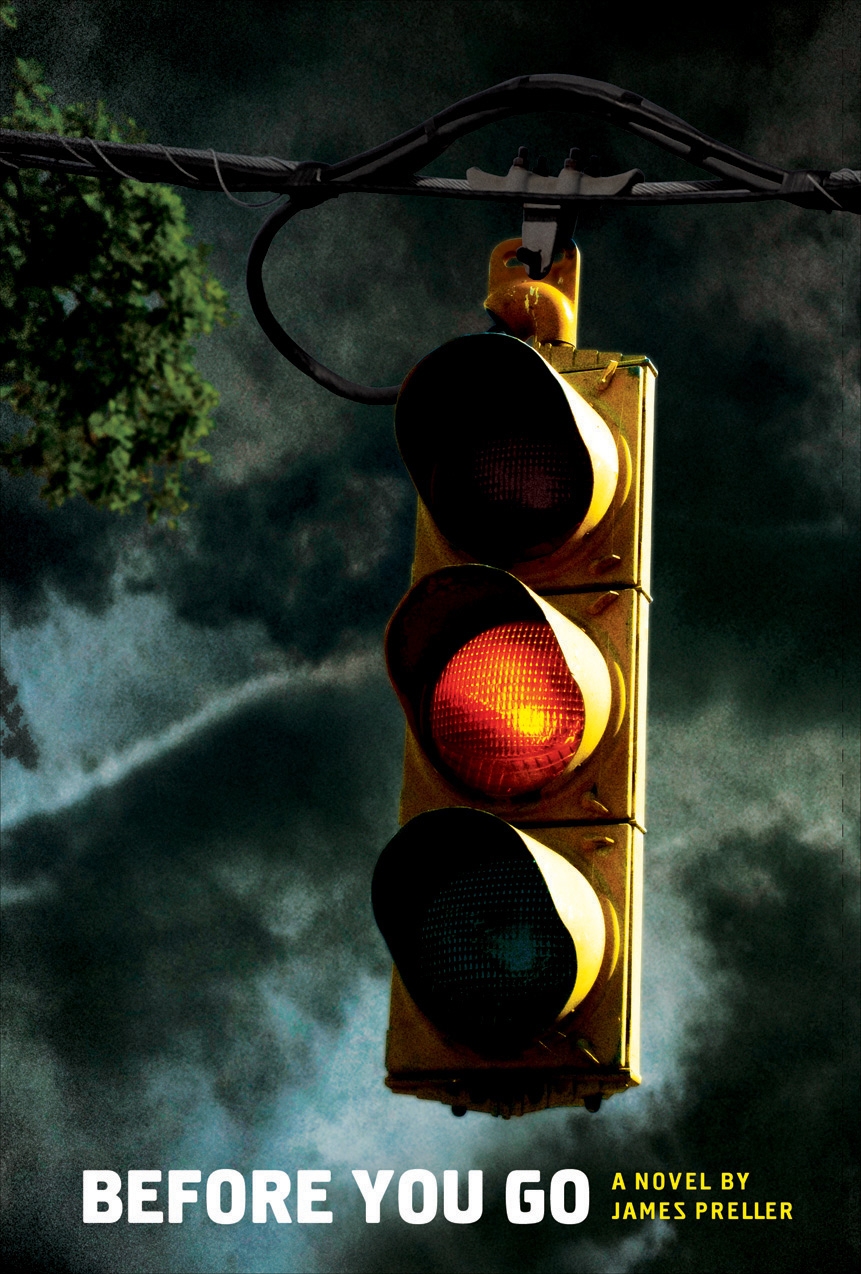
All preamble: Today I received an electronic file for the cover of my first Young Adult novel, Before You Go, to be published in Spring, 2012. What you see here, please understand, is a rough version. My editor, (the fabulous) Liz Szabla, told me, more or less, ‘It’s too this, it’s too that, and possibly not enough of something else. The type isn’t final — we’re still thinking about the type — none of it is final — but don’t you love it? We all love it. Rich is still tweaking it. He wants to make changes, I’m not sure what. He’s tweaking right now. I can practically hear the tweaking going on across the hall. You know Rich. He sees it all in his head. Tell me what you think. Don’t you love it?”

Here it is, folks. The first glance at the art director’s first draft, the rough cover treatment for my new book.

Some days it really is fun to be an author. Yes, Liz, I do love it.

I wonder what the final will look like.