Tag Archive for Bystander Preller

Fan Mail Wednesday #111 (Re: Book Titles)

–
Don’t you love the icon that I use for every Fan Mail Wednesday? A word of explanation for younger readers: It’s an illustration of something we used to call “a letter.” You see, long ago, we used to — and you’re not going to believe this — write words on actual paper (made from trees!) to our friends and relatives and business associates. Then we’d place the paper in a sealed envelope, called an ENVELOPE, and then . . .
–
Nevermind.
–
A girl sent this one via the interwebs. I removed her name for privacy:
–
Hi, I was at the school that you were at today at Vail Farm 3/30.  I was wondering how you come up with titles because I’m a writer too. I’m writing a book that is about a girl who gets picked on a lot just like the book bystander. But just so you know I didn’’t steal it from you.  But any way I can’t come up with a title for it so that’’s all I want to know.
Love,
X
–
I replied:
Hey, X. Thanks for writing. You must have been one of those students with your hand raised when we ran out of time. Sorry I didn’t call on you.
–
Titles are a tricky business. I can’t say that I’m an expert. With books like Six Innings and Bystander, I had those titles very early on. In fact, writers will often plug in a “working title” for a book in progress. It’s not the final title, or at least doesn’t seem to be, it’s just something handy to call the untitled book. For Six Innings, my working title was . . . Six Innings. That was always the concept for the book from the beginning, very clear in my mind. So when it came time to officially name the book, I used the working title.
–
With Bystander, my first title idea was Predator. That’s because I began by focusing my research and note-taking on the bully character, Griffin Connelly. But after a short while, I became convinced that the real story was with the bystanders. In life, there are a few bullies and some victims, and then there’s the rest of us, the overwhelming majority, the bystanders. We are often silent, yet hold all the real power. I knew it should be the focus of my book, and the title. Of course, there are all sorts of bystanders. The floaters and the enablers, the watchers and the cheerers and the ones who simply walk away — all with our own roles to play in the schoolyard drama. Few of us are purely innocent.
–
Speaking of bullies, have you ever noticed that they almost always need an audience? They don’t bully unless there’s somebody to watch it, to cheer them on, to laugh. Fights are the same way. It’s interesting when you think about it, isn’t it? What would happen if there was no audience? Do bullies need bystanders in order to exist? Are we their oxygen?
–
Back to titles: In many cases, writers don’t have a title until the book is finished. Editors have told me not to worry about the title, just write the story, worry about the title later on. It can be hard, because you do need a good title. I wanted my title for Justin Fisher Declares War to be Justin Fisher Declares War on Fifth Grade, but that was vetoed due to length. I never felt that we got that title right.
–
–
When I begin a book, I often purchase a composition notebook. My working title for Justin was Talent Show. Maybe I should have stuck with that.
–
–
Here’s the first page from that notebook. I wrote it in the Bethlehem Library in Delmar. I had this idea of Justin defacing a poster in school and it’s the first scene I wrote, event though it doesn’t happen until Chapter Four of the book.
–
Often writers will go back over a story and see if there’s a word or phrase in the text that somehow stands out. You’ll see that a lot when you read books, the book’s title buried somewhere deep in the pages of the book. I’d recommend that strategy for you. Reread your story. Does a character say something that could work as a title? Is there a symbol in the book that somehow represents a character or an idea?
–
With Jigsaw Jones, my publisher wanted a title from me before I even wrote the book or, in some cases, knew what it was about. It drove me crazy.
—
The other strategy is to ask for help. That’s what I do. I’ll have a reader — my editor, almost always — read the manuscript and we’ll talk about titles together. Sometimes it takes another person who has some distance from the story to see what it’s really about. And isn’t that nice, when someone can give you the title?
–
Lastly, brainstorm. I’ve created long lists of potential titles. Then you can review them, whittle them down, and maybe share them with other people. Maybe even people who haven’t read your story. Which titles appeal to them? Is there a title that gets them curious? Nowadays this is called “crowd-sourcing,” when you simply ask a bunch of random people for their opinions.
–
Anyway, sorry, long letter. Good luck with your story. It’s always nice to meet a young author.
–
JP

An Author’s Adventures in Skype

–
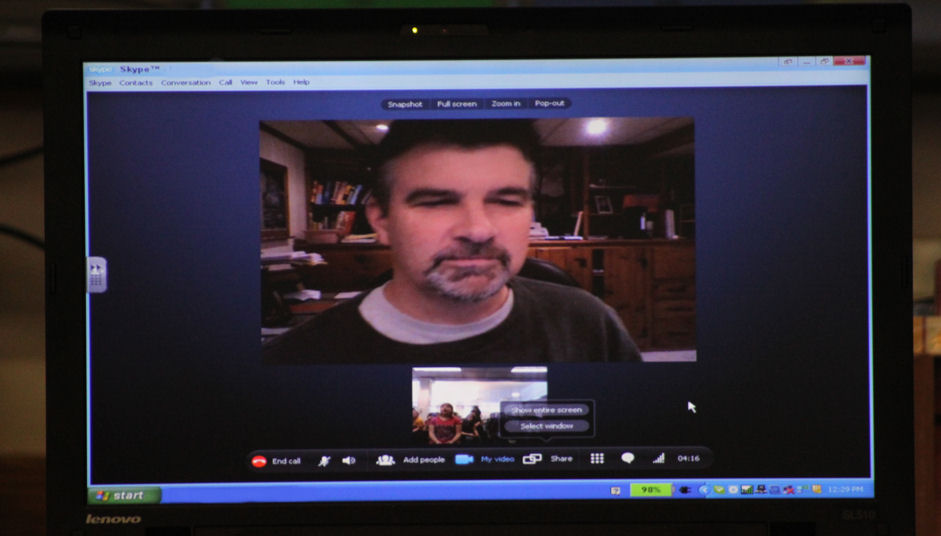
Okay, this is pretty terrifying in a Mothra kind of way . . .
–
–
Yes, that’s my giant gob projected on a viewing screen. The picture was taken during a recent Skype visit. Quick, here’s a couple of other shots:
–
–
–
–
I’m still in the early stages of figuring out this Skype business. I’m not even sure how I feel about it yet, or whether I can (or should) fit them into my schedule. That said: It is undeniably cool to connect with kids from far-away places, schools I’d never visit if not for this amazing technology. So I’m leaning yes.
–
And it is amazing, as tired and cliched as that word sounds. Suddenly we’re looking at each other, waving, laughing, talking, snorting. It’s craziness and I think students really do feel a thrill.
–
The photos are from my first-ever Skype visit. Since I didn’t know what I was doing, just fumbling around, I didn’t charge a fee. And I still don’t. Though that might change down the road if I decide to pursue this in any kind of organized fashion. The visit was a result of an enterprising teacher, Tyler Samler, who reached out to me after reading Bystander with his class. We decided on a 20-minute Q and A session. I enjoyed it, despite having to comb my hair. However, I found it difficult to read the audience. In person I’m pretty good at glancing around the room, recognizing when I’ve got their full attention or when, perhaps, it’s slipping away. With Skype, I was less certain. Hopefully I’ll get better at that with practice.
—
Tyler wrote to me after the session:
The Skype session was awesome!  You’ve acquired some life long fans here at Hyde Park Elementary School. After the session we went around and had each student give imput and share their opinions.  It was a really good response. They enjoyed your sense of humor and your kindness. I think they were greatly enriched to have this opportunity. You’re a wonderful storyteller!
–
Thank you so much.
–
Tyler
–
NOTE: I reached out to gifted author (and swell all-around person) Mitali Perkins for advice on Skyping and she directed me to author/teacher Kate Messner, because “Kate is the real expert.” After a few seconds digging, I found this excellent blog post by Kate, which is a pretty good primer on Skyping from both the school and author perspective. If you’re a teacher, you should check it out.
–
For authors, Darcy Pattison wrote an impressive primer. She offers a lot of great tips, from lighting, to looking at the camera, all the way to suggestions for bathroom breaks. Darcy thinks of everything. The truth is, I would have never dreamed of putting on lipstick if it weren’t for Darcy.
–
Really. I mean it. I just have naturally rosy lips.

BYSTANDER in Paperback: New Cover, Old Hype

Good news for schools interested in using Bystander as part of a “One Book, One School” program, or on Required Summer Reading lists, or as part of an anti-bullying initiative: The book will be available this May in paperback.

Read: Cheap, cheap, cheap!

Or, at least, cheaper.

Take a look at the new cover . . .

“Preller has perfectly nailed the middle school milieu, and his characters are well developed with authentic voices. The novel has a parablelike quality, steeped in a moral lesson, yet not ploddingly didactic. The action moves quickly, keeping readers engaged. The ending is realistic: there’s no strong resolution, no punishment or forgiveness. Focusing on the large majority of young people who stand by mutely and therefore complicitly, this must-read book is a great discussion starter that pairs well with a Holocaust unit.” —School Library Journal, Starred Review.

“Plenty of kids will see themselves in these pages, making for painful, if important, reading.”— Publishers Weekly.

“Expertly written and rich on multiple levels, “Bystander” weaves a realistic tale of the bully, the bully’s targets and the physical and emotional pain that the victims suffer. It explores what might happen when someone decides to no longer be a bystander and to do something about the bully’s behavior.” — Kendal Rautzhan, Nationally Syndicated Columnist

“Should be required reading for students in middle school or just getting ready to enter middle school.” – Literate Lives.

One Book, One School: Some Photos & Reflections

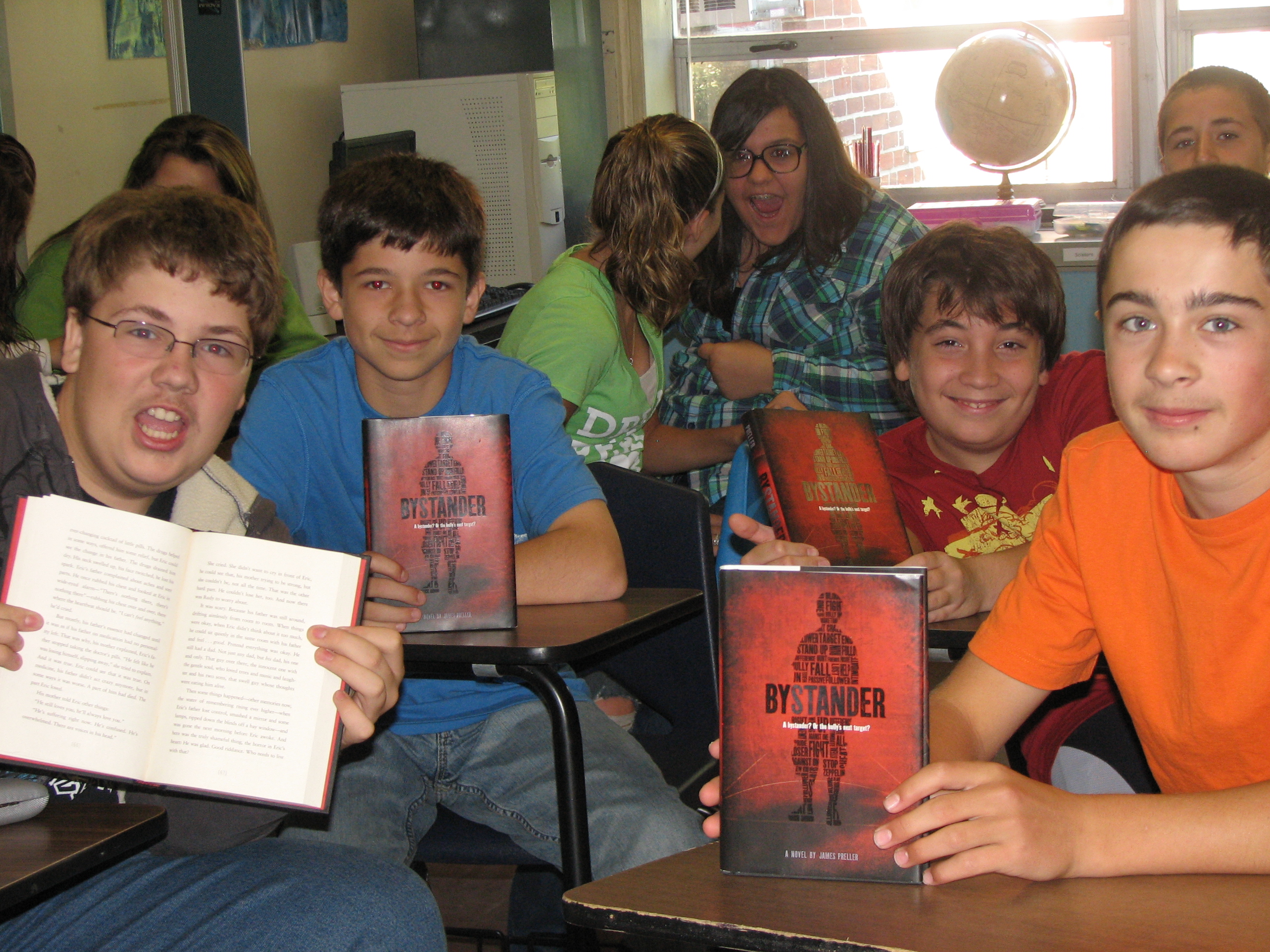
I love this photo, somehow it says everything. This is why you write for children, those faces up there.

A while back I posted about how Bystander was being featured in some special “One Book, One School” reading programs. Lately I’ve been getting more requests in that area, and all I can say is that I love the idea of a shared reading experience that cuts across, and unifies, an entire school. It’s a tremendous honor when the educational leaders of a school select my book for that purpose. Stunning, amazing.

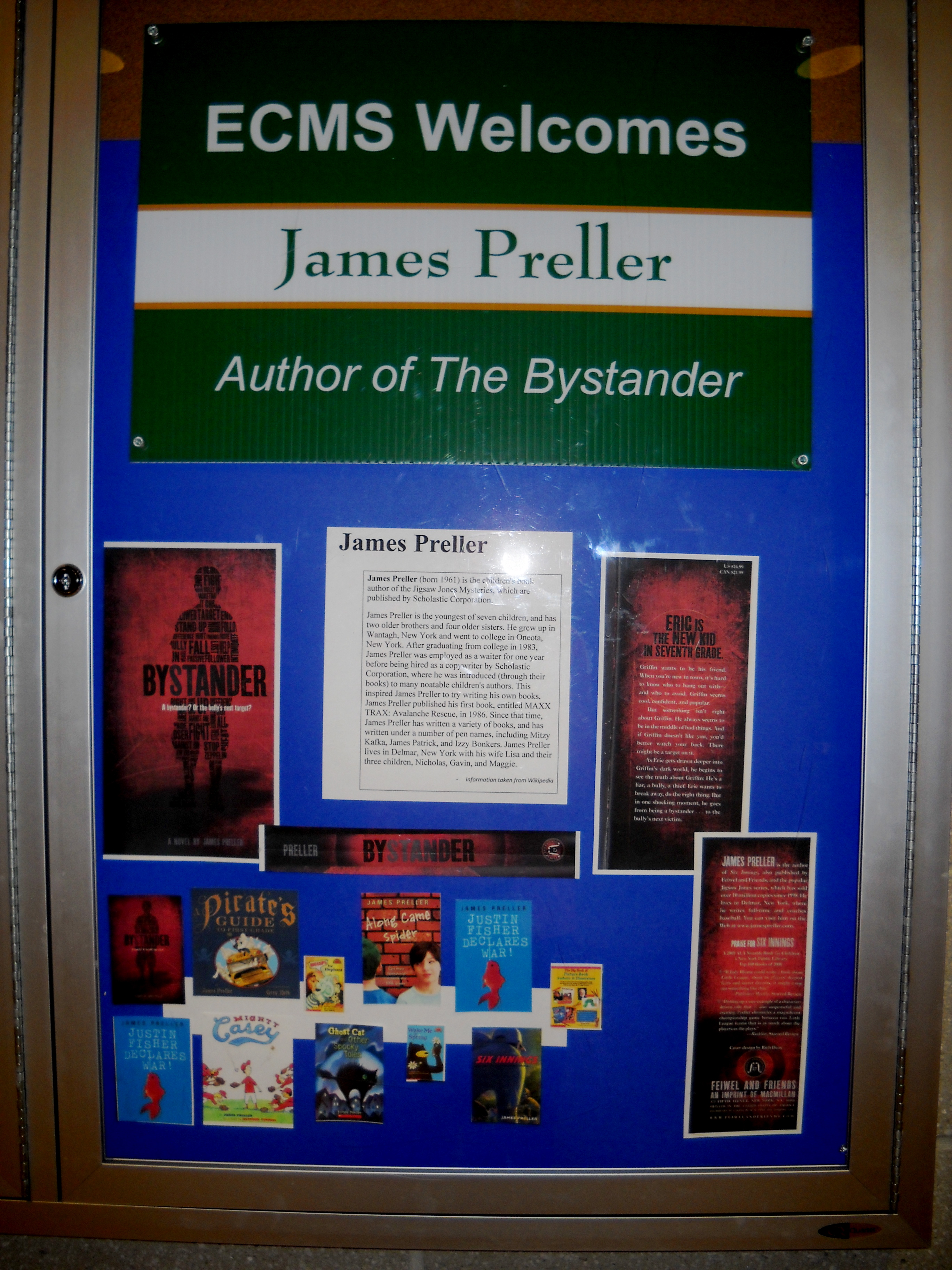
I was recently sent some photos by Joan Scott, the Library Media Specialist at Ephraim Curtis Middle School in Sudbury, MA. Here’s a few more:

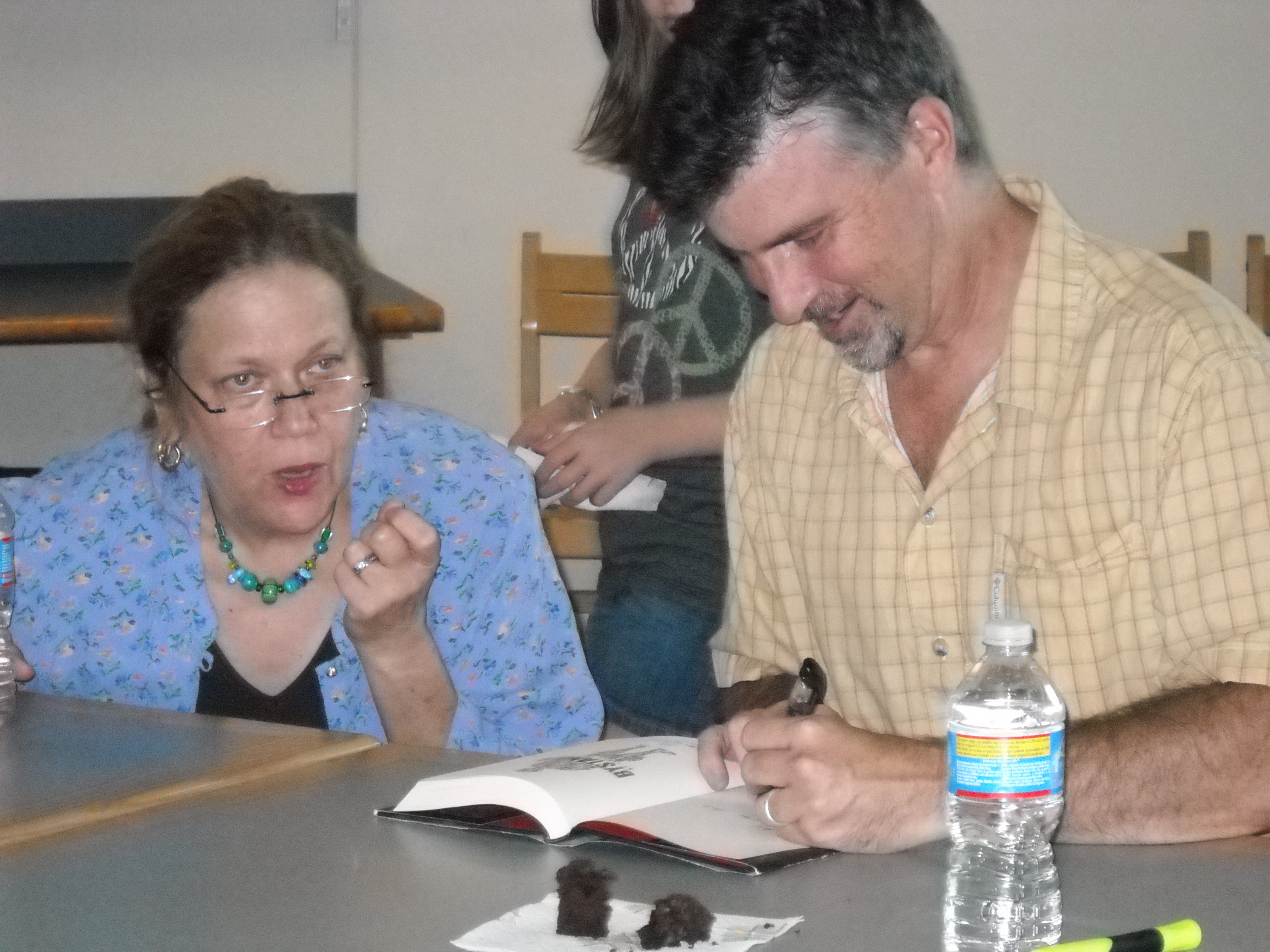
For this particular visit, I was able to enjoy lunch with a select group of students. It’s just so much fun to sit down with these kids and really talk together — and for me, to hear them speak, and watch them fiddle with their Oreos, and listen as they share their thoughts and more than a few laughs.

I’m sorry that I can’t recall the name of this particular teacher, but it’s a great opportunity for me whenever I get the chance to sit down with real teachers in the trenches and learn from their perspective.

I’ve said it before. Just as in every other aspect of life, what a school puts into an author visit has a direct correlation to what the students get out of it. At Ephraim, the students were focused, prepared, and engaged — and that’s the key to a successful author visit, and a tribute to everyone at the school.

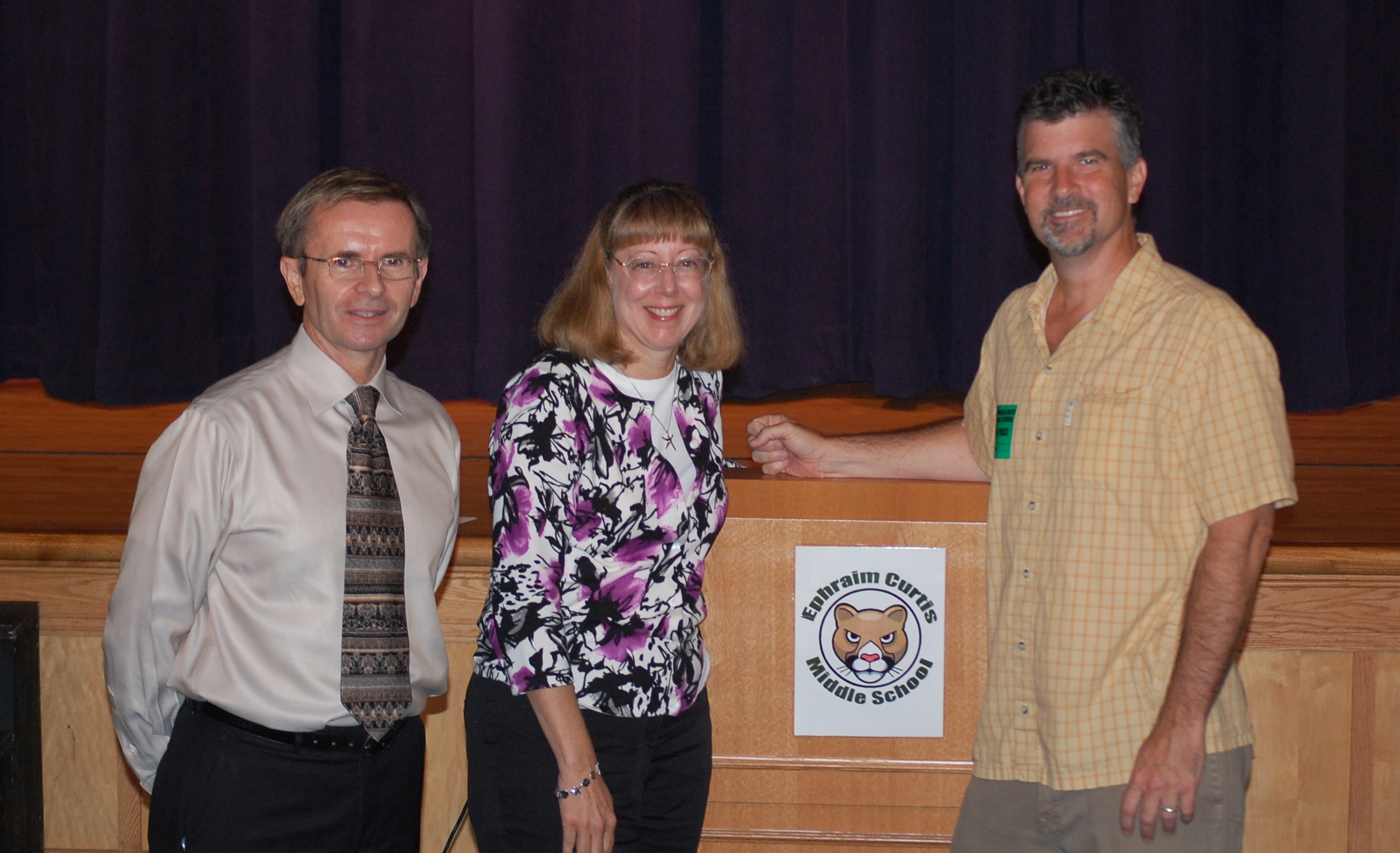
Here I am with the school principal Stephen Lambert and Joan Scott, who spearheaded the event. On some visits, I never meet the principal, as they are busy people with demanding jobs. Other times, I’ll meet one whose presence, whose attention and personal commitment, sends a powerful message to every student. This topic is important to us, we place value on this moment, and we care about you. Throughout the day, I chatted with this Principal Lambert and I can’t begin to express how impressed I was. Our conversations were wide and thought-provoking. Conclusion: This is a good man attempting to do the absolute best for the students and fellow educators in his school.

Honestly: Is this a remedy for bullying? Do events like this help? No one can say for sure. It can’t be measured. But I do believe that open honest dialogue, back and forth, feels like a crucial step in the right direction. Change can’t happen in a day. And a single book isn’t going to amount to much. But when an entire school comes together like this, the message is loud and clear:

We are a community of learners, we value things like respect and tolerance and compassion, because we understand that learning can’t begin without those qualities firmly in place.

In an interview earlier this year, I was asked: Is there anything that readers of [Bystander] can take from this story in order to better deal with bullies? I replied:

There are no easy answers. Quick story: My oldest son is sixteen. I often worried when he didn’t talk about his feelings. He’d clam up. Then I realized, he doesn’t necessarily have the vocabulary to even know what he’s feeling. To paraphrase Ron Burgandy in “Anchorman,” he was trapped inside a glass booth of emotion. Language is important, it’s a tool to help us perceive things, name things, understand. It’s common for kids to say something like, “Oh, I didn’t know that was bullying; I was just making fun of her shoes.” Like any good book, hopefully Bystander enriches the way readers understand their world.

I’m grateful I was able to spend a day at Ephraim Curtis Middle School, and inspired by their effort to address the issue with open, ongoing, thoughtful communication. Everybody pulling on the same oar. My thanks to everyone who helped make it possible. For those who may be curious, please know that Bystander will be published in paperback in Fall, 2011.

“One Book, One School”

I don’t know where to begin, what to say.

Let’s start with a couple of photos that were recently sent me from Hastings Middle School in Fairhaven, MA.

On Thursday, 9/16, all the students, staff and faculty at Hastings participated in a “One Book, One School” Event. This past summer all students read the same book, Bystander. Of all the books in the world, they selected mine. Amazing. The books were purchased with generous donations from individuals and community organizations. The half-day culminated in book discussions, art projects, role-playing, and more — all tied into my book. The goal of this event was to bring the topic of bullying into the classroom and have the entire school participate in the process. Students were asked to take a pledge: “Take a Stand! Don’t be a Bystander, Be a Hero!”

One of the day’s organizers, Ann Richard, sent along this follow-up note:

Mr. Preller,

We all loved the book and had a great time with the discussion.  We sent this press release out after the event with some great photos. I have included them for you to see.

The students created wonderful posters and really seemed to get a lot out of the day.  We used the discussion questions from your publisher as a starting point and created some vocabulary lists and other activities to round out the day.  Each classroom had one poster that they all signed to pledge to not be bystanders, and the entire faculty and staff signed an entire bulletin board to pledge as well.  We also all received a sticker that said, “Don’t be a bystander, be a hero.”

Other area schools are considered using the books in their curriculum this year because we were so successful with it.

Thanks again for such a great book!

And now I return to the same place where I began this post, a little tongue-tied, not knowing where to begin, or what to say, except . . . thanks. I’m honored and grateful.

And, yes, encouraged.

—–

Tomorrow night I head off to visit a school for another “One Book, One School” event, this one at Ephraim Curtis Middle School in Sudbury, MA. So after dinner I powered up the iPod, sat down with my Sharpie and a glass of water, and signed 650 book plates. I’ve always had a lousy signature, and still maintain that nothing beats a handshake, but I feel blessed each time somebody asks.