Tag Archive for Along Came Spider

Spider in Stock!

One of the salient features of Amazon.com is that it lists the sales rank of every item. So a hypothetical author could — hypothetically speaking — click on his or her book to get a sense of sales. While Amazon represents a small sample of total sales, I’ve always found it generally indicative of the big picture: a semi-unreliable barometer. My editors have warned me against looking, since it becomes a nervous tick, like picking at a scab: “Don’t do that, leave it alone, it’s disgusting.” But . . . we all do it. Because authors at their core are scared witless that nobody cares, and amazed (relieved, gratified, stunned) when anyone does.

I learned today that Along Came Spider — that hotly-awaited tome about the trials and tribulations of fifth grade — is now in stock. The current sales rank is #1,209,311. In English, folks: One million, two-hundred and nine thousand, three hundred and eleven. Ouch. Okay, it’s early yet, maybe the rest of the world hasn’t caught on. (Or, er, maybe it has?!) Isn’t that what every author fears the most? You write the book, somehow manage to get it published, and the world collectively yawns.

We shall see. In the meantime, I’ll do my part. Give me an oar and I’ll put my back into it. To that end, I’ll blog about the book every now and then, provide some inside story into the making of this legendary book. More to come, soon. Until then, come on, friends, let’s get that number under one million — I’ve got two cats and a goldfish to feed!

Spider on the Blogs!

A fresh copy of my upcoming book, Along Came Spider (Scholastic, August), arrived in the mail last week. That’s a righteous moment for any author/illustrator: the first book off the presses! And always it’s the same story. Your editor tells you how she could only get one copy, purloined off somebody in marketing, but there’s surely more somewhere in the warehouse, and pretty soon (maybe) they’ll find them.

And nothing happens for a few weeks, while you cling to your sole copy of the book, holding it out to friends for a brief sniff and greedily pulling it back, like Gollum and his precious ring.

On the cyberfront, Spider has gotten a couple of reviews from blogs. So far, so good. I think the reviewers are right in that it’s a simply-written story about complex feelings. I guess it’s noteworthy in the sense that these kinds of stories — basically: friendship under duress — are more commonly written about girls, as if boys suffered none of these emotional/ethical conflicts, as if, in fact, boys had no interior lives at all. (We just like trucks, right? And noises that go BOOM.)

They are also correct in that I didn’t do anything flashy with the writing. It’s funny, I feel like my entire post-college writing career has been a long process of learning how to get out of the way. Or, that is, un-learning much what they taught me in college! I’ve come to increasingly admire restraint, simplicity and austerity, sentences like, oh, “A minute later he was snoring” (Steig, Doctor De Soto). Unadorned, absent of any look-at-how-clever-I-am writing. I suppose I’m sensitive to this aspect of writing because, as a particular brand of male ego, I’m so vulnerable to it. When I’m at my worst, I gild the lily. So I’ve come to perceive that trait as the Enemy Within, the danger I need to purge against: overwriting, AKA, showing off. That’s where revision comes in, pulling the purple prose off the bone, like picking cotton candy off the cardboard cylinder.

Anyway, here’s some links and money quotes from the reviews:

* * * * *

From Ignacio Guerra at Alan Online:

James Preller delves into the hostile and confusing world of adolescence and illuminates how yearning for acceptance and popularity can sometimes strain a friendship. This exposé on the complicated social dynamics of school is a fascinating joy to read with excellent readability and flow!

* * * * *

From Nan Hoekstra at Anokaberry:

Preller tells an everyday story with eloquence and empathetic grace. These ordinary (amazing) kids are growing up — daily making their own way, raised by parents, guided by teachers and events. Often in groups, always alone, trying to figure themselves and others out. No under or overstated angst here, the author just tells us about it, and lets the characters speak . . . Thanks James Preller, for (another) outstanding contribution to literature for precious children.

* * * * *

By the way, I’m amazed by book reviewers. How do they read so much?! You look at Nan’s site, or so many others, and it’s like, “Do they just read all the time? When do they eat?” I am genuinely grateful, and somewhat awed.

Arnold Lobel: An Appreciation

I cannot think of any work that could be more agreeable and fun than making books for children.” — Arnold Lobel

As an author, I’m often asked to list some of my favorite writers. Of course, it’s impossible. There are too many. But one name always comes to my lips, Arnold Lobel. And I think the reason is this: his total commitment to children’s literature. To me, he was the master.

A while back I had the opportunity to write brief profiles of 75 children’s book authors and illustrators for a book titled, in lunk-headed fashion, The Big Book of Picture-Book Authors & Illustrators (out of print, alas). I interviewed many amazing people — James Marshall, Barbara Cooney, Bill Martin, Jr., Barbara Park, Bernard Waber, Trina Schart Hyman, Kevin Henkes, etc. — but, unfortunately, I was too late for Arnold Lobel. He died after a long illness on December 4th, 1987. But I did my research, read most of his books, found his classic acceptance speech for the Caldecott Medal, and came away with great respect. I love the “Frog and Toad” titles, of course, and Fables, and Ming Lo Moves the Mountain, and my personal favorite, Whiskers and Rhymes. But more than any individual book, I most love his bright, shining spirit — his commitment to his craft — his intelligence — his deep feeling — his legacy.

Time rolls forward. These days, at social events, some good fellow will sidle up beside me, possibly curious about this palpable oddity, a real live children’s book writer in his midst. And he’ll ask, not unkindly, “Do you think you’ll ever try to write a real book?” Meaning, of course, an adult book.

I’m not insulted, much. I’ll just smile and say maybe, perhaps, I don’t know, but right now I’m pretty challenged trying to write children’s books.

When I first began to conjure the dream of becoming a writer, children’s books were not on my radar. I wanted to write great, important books and poems for deep-thinking adults. My dream did not include titles like Hiccups for Elephant or Wake Me In Spring. I used to frequently wonder if I was on the right path, and it’s a question that never entirely goes away, though it haunts me less and less. I think of Arnold Lobel and I am reassured by his pride, his deep belief in his work, his love of children’s literature. It comes down to, like he said, single-minded dedication. No half-measures. No apologies. “One of the secrets of writing good books for children,” Lobel once commented, “is that you can’t really write books for children; you must write books for yourself and about yourself.”

I couldn’t agree more.

In my upcoming book, Along Came Spider, there’s a school librarian who plays a minor but critical role in the story. Her name? Miss Lobel. Now you know how I dreamed up the name!

Book Covers

Above, you should (maybe, possibly, hopefully) see the cover to my new hardcover book, Along Came Spider, due for publication this September (Scholastic, ages 8-12). Except, well, that used to be the cover until about three weeks ago. You see, I got a phone call from my editor at Scholastic, the newly-engaged Shannon Penney, who explained that, essentially, some folks on the sales staff at Scholastic hated the cover. After some internal debate in the NY office, they decided to create “a new look.”

I was then sent the new cover:
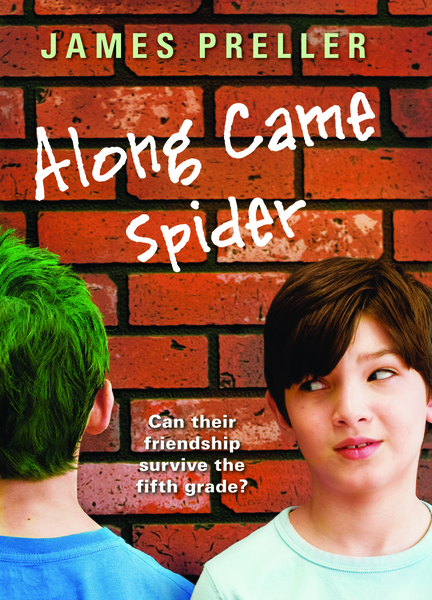
Quite a difference, no?

I was recently at a regional conference for librarians (CASDA), participating in a panel discussion. The subject of covers came up and there seemed to be quite a lot of interest. Some in the audience seemed genuinely surprised at how little control we, the authors, had. Of course, control varies according to the status of the author, the style of the publisher, the deadline, and the book. But for the most part, writers don’t have final word. Or much say at all. And I think that’s fair, since the publisher is the one who is out there trying to sell the book. Sure, we can make a fuss about things, but there’s a risk to that — nobody likes a “difficult” author.

Hey, let’s face it, book-making is a collaborative process. I think you have to let people do their jobs. And when the sales force says, “We can’t sell a book with that cover,” well, I’m not going to throw my body into the gears of that machine. Because I want the book to sell, too (sue me), and I’m not the expert.

Now, is this new cover an improvement? I don’t know, but it certainly communicates different things than the original. To begin, I thought the first cover was brilliant graphically: a bold, arresting visual presentation that suggested the school environment. It looked cool, almost like a poster. But at the same time, sort of vague; you don’t come away knowing much about the story. Yet the vagueness was appealing; it was evocative. Or so I thought at the time. Besides, after you read the book — if you read the book — you’ll then “get” the cover. It will all make sense.

The second cover — now forever known as the real cover — established a totally different look by using photography. That’s always a difficult medium, especially for writers, because the nature of photography provides a specific, concrete image. It defines. It limits. We now know exactly what Spider Stevens looks like, whereas before it was open to our personal interpretation, up to our imaginations. What this cover does do, however, is it quickly lets us in on the story. A glance tells us that it’s about two boys. One has green hair and seems to be staring at a brick wall; he might be an odd duck. Then there’s the tagline: “Can their friendship survive the fifth grade?” All in all, the new cover effectively conveys the central strand of the book. But it also limits because the book certainly isn’t about only that. There’s Miss Lobel, the librarian. And the fabulous Ava Bright. And basketball. And . . . pencils!

I don’t really have the answers. There are no firm rules about what makes a good cover. Or what, precisely, a cover should do (other than, I guess, encourage you to open the book). What do you think? So far, no one has used the “comments” section to this blog. Here’s your big chance!