Archive for The Fall

A Writer’s Dilemma: The Challenge w/ Cell Phones

moby6

Let’s start by looking at this clip below. The illustrated video, created by Steve Cutts for Moby’s new song, “Are You Lost in the World Like Me?” is dark and disturbing. You can even watch it with the sound off, since my interest is almost entirely with the story told by the visuals.


Wow, right? A bleak look at cell phone addiction. Or maybe it’s just a slightly exaggerated look at our world?

Contemporary cell phone culture presents unique challenges to any children’s book writer. Not the phones themselves, of course, but the way in which so much of contemporary teen life is spent on those phones. A quick Google search reveals reports that claim young adults will take more than 25,000 selfies during their lifetimes. More than 93 million selfies are taken each day; and so on and so on. You get the picture.

moby5

In that regard, cell phones must be considered central to any telling of realistic fiction. It’s where so much of their lives are played out. But, confession: that’s not the version of life I’m personally interested in exploring. Maybe this reveals me for what I am — an old guy who grew up in a time before cell phones and personal computers. Their world is not my world. Maybe it’s beyond me. And yet I’m typing this on a laptop with an Apple phone at my side.

None of this was an issue for Mark Twain or Zora Neale Hurston.

moby4

How do writers of children’s literature deal with phones? How do we tell contemporary stories? One way, of course, would be to embrace the phone fully. Make it a central character — that’s where the drama plays out, so dive right in. That’s a legitimate approach, but feels gimmicky. I also suspect that technique would quickly become dated.
In my books, I’ve dealt with phones in a number of ways.
Here are a few:

* I recently wrote a new Jigsaw Jones, The Case from Outer Space. The characters are in second grade, so cell phones are not an issue. Nice!

img_2054

* In my “Scary Tales” series, phones present a different sort of challenge. The phone makes the world less scary. I don’t want a kid who is trapped in a cave to be able to pick up her phone and call 911. And the inverse is especially true — any sense of isolation, of disconnectedness, raises their discomfort. In I Scream, You Scream, the phones are confiscated before a thrill ride (no photos). Other times, the Wi-Fi is mysteriously down (Good Night, Zombie). I’m often trying to get the phone out of the way.

img_1992* In The Fall, a book that deals, in part, with teenage cyber-bullying, there’s no way to pretend that phones don’t exist. My characters send and receive texts, and “cell life” is inherent in the story. Interestingly, while the phones enhance our ability to connect electronically, they can also limit our real-time connections. Here’s a moment in the story when Sam recounts his second meeting with Morgan. They are both walking their dogs off-leash behind the middle school. They talk a little bit, thanks to the dogs. And then, this:

I stared at my phone, scrolled.

Morgan pulled her cell out of a coat pocket.

We stood there in awkward proximity, alone on a field, playing games with our phones. Silence drifted over us like clouds.

I pocked the cell.

“Bye,” I said.

I don’t remember if she answered me, but Morgan called to Max, “See ya, boy!”

* For The Courage Test, a father and son go on a long camping trip together. It would have been perfectly valid for them to lose a signal at different points in the story (and they do). But I still had the problem — if you can call it that — of a kid with his phone. Rather than ignore it completely, I wrote a scene where they are driving along in Montana. William is playing a game on his phone, not, to his father’s mind, fully appreciative of the landscape. They argue about the phone. The argument escalates.

He holds out his hand, gesturing for the phone.

Now, this next part is funny.

Hilarious, almost.

And it’s also incredibly, fabulously stupid, because I can be such an idiot sometimes. My father has pushed me into a corner. We are in the middle of nowhere. Wi-Fi is spotty at best. Back home, at Puckett Field, there’s an All-Star practice tonight — a practice that I’m missing, for a team I can’t play on, because my ex-dad wants to haul me across the universe. 

My right index finger pressed the button on the armrest. The window slides noiselessly down and I immediately feel it, the wind and whoosh of summer heat.

I turn and can’t resist, so with a flick of my wrist I pitch my phone out the window. 

Problem solved.

* In Before You Go, possibly my only true YA, Jude has a phone and uses it. But at the same time, I mostly write around it — to a point that might present a picture that’s somewhat untrue to life as it is currently lived. Again, it’s hard to move a story along if people are constantly staring at Youtube videos and Snapchat. Or maybe you can? But yuck.

* Picture books, where characters can be talking pigs or pogo-sticking hyenas, offer another way for a writer to sidestep phone culture. Just create an alternative world and write for very young children. Though lately I’ve seen a few picture books where kids are dealing with parents who won’t stop looking at their phones.
unknown

* Write Historical Fiction. Set stories in a time before cell phones. The same is true for dystopian novels and science fiction. “Electricity’s out, folks, you’re going to have to talk among yourselves!” Maybe that’s why we see so much of it these days?

I share these musings not because I have the answers, but because I think it’s an issue which confronts contemporary writers. Phones are awfully tedious, and people staring at phones — while super realistic: just look around! — is even worse.

What do you think? Can you think of books that dealt with phones in an innovative or effective way? In our efforts to be realistic, do we need to incorporate more phone-drama in our books? Thoughts?

The idea of writing that Civil War story never looked so good.

FAN MAIL WEDNESDAY #233: In Which an 8th Grader Offers Some Writing Advice, i.e., “I don’t want to be rude or anything . . .”

postalletter-150x150
– 
Meet Rebecca. She’s everything I love about middle schoolers — the intellectual curiosity, the spirit, that sense of becoming — and more:
 
​Good afternoon Mr. Preller,
Hi. I don’t necessarily know about you and your books much; I wouldn’t really call myself a dedicated reader to you in particular because, to be 9780312547967perfectly honest with you, I picked up ‘Bystander’ a few days ago and am just now getting into it. So far, it is a really good book that I believe is addressing a great topic. Your books, like it explains on your blog, is written for grade schoolers to middle schoolers. I am currently in 8th grade [ed note: school and town deleted] in Missouri. I’m well aware that this may so far seem that I’m trying to get you to come to my school or something or other, but I’m really not. I just wanted to say, I love how you are writing these books for children of all ages with such serious topics. It’s really great that a man like you is spreading the word through a book that is going around so quickly to such a widespread audience. Blah, blah, blah, I know you must get this a lot.
 
Me, being an aspiring author, I just wanted to give more of what I might think have/will impact the book or future books you write. I understand you are an actual author who I am currently emailing my 8th grade opinions to, and I know that you probably may never read this, but it doesn’t hurt to try. If you’re planning on writing any more books, which I hope you are, you could put more in the first person. I, personally, think ‘Bystander’ would be better as a first person novel. With the whole bullying topic of the book, you would get more out of Eric, the main character, as if the book were in his perspective. Don’t get me wrong I’m not dishing the book, but showing grade schoolers that there’s more than just the third person writing they have always been seeing could increase their tastes in reading and help them develop a future of late nights finishing lovely books, like yours.
 
I’m well aware that you can’t change a book that you’ve written already, but maybe for the future?
 
Keep on Rocking,
Rebecca 
 
P.S. I am so super sorry about how this may seem. I don’t want to be rude or anything; that is not the purpose of this email. You are a great author and I wish to become someone like you in my future. Don’t ever change without your own permission. Thanks.
I wrote back:
 
Rebecca,
 
Thanks for this most awesome of emails. Believe me, I don’t get emails like yours all that often. You’re an original. And by the way, I’ve actually never — weirdly — been to Missouri. So I’m open to an invitation.
 
THE FALL explores similar themes as BYSTANDER, but shifts to a first-person POV. Readers might enjoy comparing the relative strengths and weaknesses of those choices in perspective.

THE FALL explores similar themes as BYSTANDER, but shifts to a first-person POV. Readers might enjoy comparing the relative strengths and weaknesses of those choices in perspective.

You strike an almost apologetic tone at the end, so let me start there: Don’t be silly! Express away! As a reader, your opinion is always valid. And as an aspiring writer, you bring a writer’s perspective to that opinion. In this case, you could be right — and you certainly aren’t wrong. The question of first person compared to third person comes up for every book. There are strengths and limitations to each approach. I’ve written books from both perspectives, though I don’t think I often analyze it too deeply. It’s more of a feeling, I guess. Some books seem right from the first-person perspective — you hear it coming from a very specific voice — and you want that character front and center all the way through. In other books, well, not so much. For some books, I’ve even tried it both ways in early drafts, exploring the differences. There are certain freedoms in a third-person narrative that are not available in the first person. And also, I’ll confess, I come across so many YA novels that are written in the first person that I get very, very tired of it. The writing in a first-person book, depending upon that character, tends to be looser, more informal, the way people really talk. As an extension, that perspective limits the syntax available to language that character would believably use. With first person, there are places you can’t go.

 
For Bystander, though I wrote it in third person, I decided to hug very close to Eric’s point of view (a limited omnipresence, if you will); I didn’t go for a full omniscient POV, bouncing around inside a variety of skulls. On the other hand, I recently had an idea for a book that would be told from multiple perspectives. A lot of characters at the same event. So to me, the way we decide to tell the story is a revelation of the story itself. At the same time, you could tell that story from third- or first-person perspectives. Decisions, decisions. 
 
Illustration from SWAMP MONSTER by Iacopo Bruno.

Illustration from SWAMP MONSTER by Iacopo Bruno.

In a scary story I recently wrote for younger readers, I needed the third person to pull it off. I wanted to write about my human characters, but later I wanted to go deep into the swamp and reveal more of the swamp monster. Part of the suspense in the story is that, for a time, only the reader realizes there’s a monster in the woods. To the three children in the book, well, they are just walking deeper into the woods. They don’t know what they are getting into — but the reader does. You see the difference there?

 
I didn’t write a sequel to Bystander, but I did write a companion book that explores many of the same themes and ideas, titled The Fall. It is written in the first person, with the concept being that it is entirely told from the perspective of a boy writing in his journal. Booklist reviewed it, “A rare glimpse into the mind of a bully . . . . Pair this with Jay Asher’s Thirteen Reasons Why.
 
Keep reading like a writer.  Books are truly the best education for anyone who wishes to write. Read widely, read deeply, read often. And yes, thank you for reading my book.
 
James Preller
 –
And so Rebecca replied:
 
Mr. Preller,
 
Hi again! I honestly did not expect you to reply so quickly, let alone at all. And I would love to thank you for answering my question, even reading this email is an extraordinary honour. I love the way you worded this to explain why you decided to write your book this way, I mean, you are a well known author.
 
A quick plug for my new book, THE COURAGE TEST. It's a literary road trip along the Lewis & Clark Trail and, yes, there's a bear, both metaphoric and literal.

A quick plug for my new book, THE COURAGE TEST. It’s a literary road trip along the Lewis & Clark Trail and, yes, there’s a bear, both metaphoric and literal.

Third person is an art which some people can’t wrap their stories around correctly to get such personality from the characters without blatantly spelling it out. You have that talent. Sticking close to Eric’s point of view, like you do, provides the third person flare while contributing glimpses of first person to the story. I am only human though and, personally, think, still, that first person may have been a better choice, but, as you said, there are reasons why you decided this for your story. It was a calling of sorts. For example, if you were to use a first person POV for this book (or any piece of writing really) you would have less ‘tag’ lines, as I call them, to describe who was talking. Especially the main character. Having less use of words ties you down as writer and limits, as you said, how you can write your story.

 
As for your other book, ‘ The Fall’, I would love to get my hands on it. The way you handle this topic is absolutely phenomenal.  You wrote ‘Bystander’ so well that I will surely enjoy reading way more of your delightful books. Thank you, once again, sir and I’ll have to work on that invitation.
 
Yours Truly,
Rebecca
 
(By the way: I could not believe it in class today when I powered up my laptop, accessed gmail, and saw your name pop up. I freaked out in class, turning into a mad woman, full of hysteria, tears rolling down my cheeks. I was so gosh darn excited to read whatever it was you took the time to write. You are truly inspirational!)
 

THE FALL in Paperback Has Landed: To Celebrate, Here’s a Super-Short Excerpt

As an author, even after all these years, I never quite believe it until I have the actual book in my grubby little hands. Well, the box arrived yesterday and a few books cooperated for this photograph:

img_1992

As a reminder, this book may be seen as a companion to, and extension of, the themes first presented in Bystander. If readers enjoyed that book, they could pick up this one next — though, admittedly, it’s a little tougher, a little darker. Or start with The Fall and ignore Bystander altogether. It’s your life!

Before I get to the excerpts, some review quotes:

 “It was 2:55 am as I finally gave up on the notion of sleep.  Having started reading THE FALL by James Preller earlier in the day, I knew sleep would not come until I had finished Sam’s story.  Now, having turned the last page, it still haunts me and will for quite some time.” — Guys Lit Wire.

“Told through journal entries, Preller’s latest novel expertly captures the protagonist’s voice, complete with all of its sarcasm, indifference, and, at the same time, genuine remorse.” — School Library Journal.

“Readers will put this puzzle together, eager to see whether Sam ultimately accepts his role in Morgan’s death, and wanting to see the whole story of what one person could have, and should have, done for Morgan. Pair this with Jay Asher’s Thirteen Reasons Why (2007).” — Booklist.

“With its timely, important message and engaging prose style, Sam’s journal ought to find a large readership.” (Fiction. 10-16) — Kirkus.

“I didn’t realize the emotional impact this book had on me until the very last sentence when it brought tears to my eyes. This was a heartbreaking and beautiful story about friendship, bullying, and the aftermath of all of it.” — Expresso Reads.

Now for the actual four-chapter excerpt, pages 151-158. Yes, each unnumbered chapter is super short:


FACE MEETS FIST


    In retrospect, I don’t think getting punched in the face was that bad. I kind of liked it. I mean, I’m not recommending it. “Oh, yes, you simply must try the Punch-in-the-Face, it’s divine. Far superior to the Knee-to-the-Groin and half the calories!”

     Fact: Fergus Tick went blam and I went boom. Hitting the ground was worse than the punch -– no disrespect to Fergus, who packs a wallop, but that concrete was hard.

     To my surprise, I did not see stars. Pretty little birdies did not circle my head, chirping tunelessly. None of the typical things I expected after a lifetime’s education watching Loony Tunes cartoons. I got hit, I fell, and my coconut throbbed but didn’t crack. That was it. Fergus’s fist caught me on the right cheek below the eye -– Fergus was a lefty, who knew! Maybe a tougher kid staggers back but keeps standing. Not me. I flopped like a spineless jellyfish.

     One punch and done.

     Message received, loud and clear.

     Surprisingly: Fergus was the one who looked frightened, and so did Athena, who stood watching. My confession in speech class shook them up. I had broken the code of silence. I said out loud what I had done to Morgan Mallen. I spoke the unspeakable. I owned the thing that nobody else wanted. And even though I didn’t point fingers at anyone else, I could see that it scared Athena to the core.

     She didn’t look so pretty from my viewpoint on the ground. She looked like she’d just swallowed a poisoned apple. There was something evil in her soul and she was rotting from the inside out.

     The fallout after Morgan’s suicide had not been a good experience for Athena Luikin. I watched her closely those days and weeks after Morgan’s death. I followed her movements, where she sat, what she did, and I saw that she had become damaged goods. If Morgan was the dead girl, Athena was the one we blamed. At first, Athena put on a brave face, the tough girl who didn’t give a hoot. Over time, cracks appeared. Everyone knew Athena was the one most responsible for harassing Morgan. In a way, she fell victim to her own game. Athena was tagged, too. Her tag read: BULLY. One by one, Athena’s friends faded into the background until she stood virtually alone, if not for the unwavering loyalty of Fergus Tick.

     Rumors went around that Athena was transferring to a private school in another town. “Good,” we said. One morning, a FOR SALE sign appeared on her front lawn. There was talk of a lawsuit, damages and courtrooms. The reign of the Queen was over.

     So there I sat on the ground, head going boom-ba-boom, ba-boom, ba-boom, fuzzzzzz.

  “Get up,” Fergus demanded.

     (So you can punch me again? I don’t think so.)

     “Leave him,” Athena said. “Come let’s go, Fergus.”

     And go they did.

     I waited for my head to clear. It wasn’t so awful, it felt like waking up any school morning, that torturous distance between head-on-the-pillow and feet-on-the-floor.

     I needed a hot shower. Or maybe a long hot bath. Morgan once said, “Baths make everything better.” It was time to find out if she was right.

     Despite all that, deep down, I felt fantastic. Like a million bucks. Terrific, awesome, happy.

     (How weird was that?)

     I wasn’t on the wrong side of life anymore. I was now an enemy of the bad guys -– and it felt great. I tasted something sweet in my mouth, a new flavor, but I couldn’t figure out what it was until I spat.

     Oh, blood.


I KNOCKED  


    I decided to do it. I had to.

     I stood at her front door yesterday.

     I breathed in and out, in and out.

     Steady as a willow in a hurricane.

     And I knocked.

     Bark, BARK, barkbarkBARKbark!

     I’d forgotten about Larry. The lunatic mop.

     I suddenly, fiercely, insanely wished I had a mint. I breathed into my open palm. Yuck, gross. How was my hair? What was I doing here?

     Time passed.

     And the door creaked open.

     The mother was standing there, wheezing slightly, sizing me up. The expression on her face said, What now, dear Lord, what now?


THINGS I LIKE  


     This is a list of random things I like.

     I like baseball games that last extra innings. “Free baseball,” we call it. I like weekends without homework, watching my little sister sleep with her puffy lips and how the saliva dribbles out of the corner of her mouth. I like my bed made with the blankets folded down nice and perfect, just right. I like the cold, numb feeling of a package of frozen peas on my swollen face. I like the last bell of the school day and the sound in the hallways of a hundred lockers slamming joyously shut and the big hum of let’s get outta here, let’s go. I like funny videos with absurd cats (I realize it’s a big joke to some people, but I do). I like memories of old vacations, camping trips and card games and nickel antes. I like the stars in the sky when the night is warm and silent. I like the sound of a swing and a miss on the baseball diamond, the absence of sound followed by a fastball popping into the catcher’s leather glove, the whoosh-and-pop combo. I like that just-beginning feeling when you see a girl and think, wow, that’s all, just WOW, and you know you have to find a way to stand next to that girl somewhere, somehow. I like a brand new box of my favorite cereal, when I know it was bought just for me. I like turning on the radio and a great song comes on that same instant. I like laughter, and promises kept, and friendly waves across open fields. I even like Morgan’s lunatic dog that barkbarkbARKed with the soul of wolf.

     I like being alive, and today I am, right now, saying yes to life. Yes, yes, and yes.

 
WORDS   


     Larry pounced on my shoes, barkbarkbARKing!

     “You remember me, don’t you, Larry?” I said.

     “And you are?” the mother asked.

     I didn’t have a good answer. And in fact, I never expected to see the mom. That wasn’t my plan. Yet here she was, a fairly gigantic woman in a huge floral housedress. She might have weighed three hundred pounds. She smelled of butterscotch and a scent that reminded me of Morgan, the faint whisper of booze.

     She eyed me suspiciously, the door only half-open, ready to slam shut.

     (I am Sam, Sam I am.)

     All I had to do was open my mouth. It’s all anybody ever wanted me to do, my parents, Mr. Laneway, Morgan. “Just talk,” they said. “It’s easy. Try it. Say one word. Start with your name . . .”

     Seriously?

     What good would that do? My name is . . .

     Use.

     Less.

     Ness.


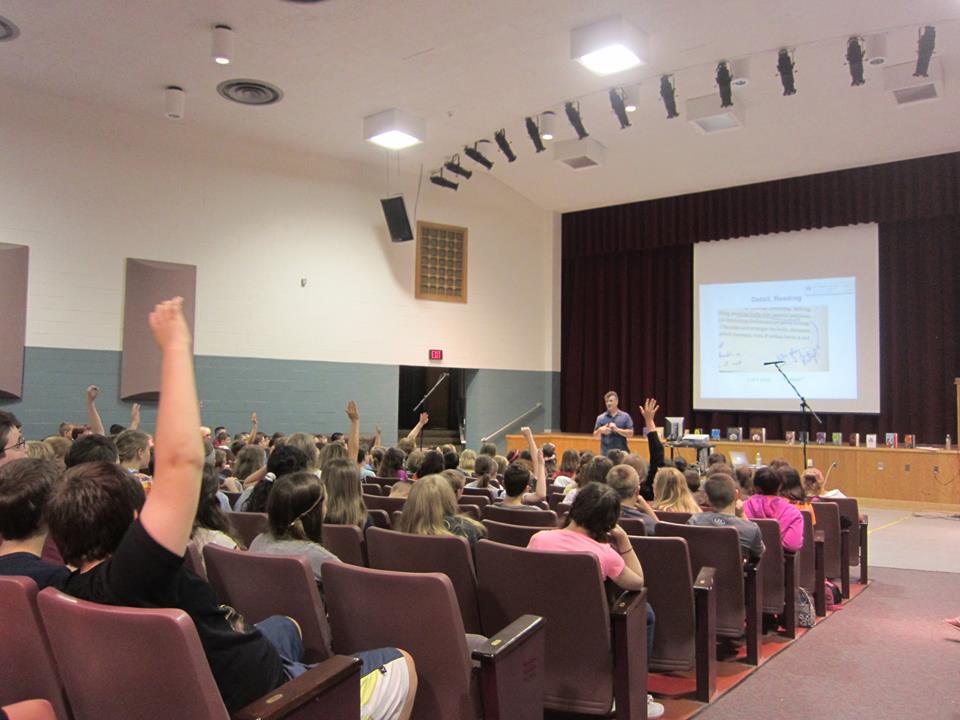
YES, I LOVE TO DO SCHOOL VISITS -- EVEN SCARY MIDDLE SCHOOLS!

YES, I LOVE TO DO SCHOOL VISITS — EVEN SCARY MIDDLE SCHOOLS!


Author Event, Today, June 11th, 3:00 @ Barnes & Noble, Colonie Center

COME SEE US!

Local Author Roundup Flyer

Barnes & Noble, 131 Colonie Center, Suite 355, Albany, NY 12205 – (518)-438-1728

Joseph Bruchac – Saratoga Springs, NY: Joseph Bruchac is an Abenaki writer and traditional storyteller. Author of over 130 books, his experiences include running a college program in a maximum security prison and teaching in West Africa.

Code Talker: Throughout World War II Navajo code talkers sent messages in an unbreakable code that used their native language. This is the tale of Ned Begay, a sixteen-year-old code talker. His grueling journey is eye-opening and inspiring.

Nancy Castaldo – NY: Nancy Castaldo is the author of several nonfiction books for curious kids, the Regional Advisor for the Society of Children’s Book Writers and Illustrators, and a reviewer for the Historical Novel Society. See more at www.nancycastaldo.com.

The Story of Seeds: Something as small as a seed can have a worldwide impact. Castaldo chronicles where our food comes from, and more importantly, where it is going as she digs deeper into the importance of seeds in our world.

Eric Devine – Waterford, NY: Eric Devine’s Young Adult fiction has been listed by YALSA, Booklist, and the Junior Library Guild. He is also a veteran high school English teacher.
More at: ericdevine.org, facebook.com/ericdevineauthor, or Twitter: @eric_devine

Press Play: When Greg captures footage of brutal and bloody hazing by his town’s championship- winning lacrosse team, he knows he has evidence that could damage as much as it could save. Is revealing the truth worth the cost?

Laura Diamond – Albany, NY: Laura is a board certified psychiatrist and author of young adult fantasy, dystopian, & contemporary novels. When she’s not writing, she’s working at the hospital and catering to her feline furbaby overlords.

The Zodiac Collector: For Anne, the Renaissance Faire means another ruined birthday for her and her twin sister, Mary. This year, she conjures up a spell that will make their birthday party a whirlwind event. Little do they know that it’s a literal request.

James Preller – Delmar, NY: James Preller is an award-winning author. He has published a wide- variety of books for all ages, from picture books to young adult, including the popular “Jigsaw Jones” mystery series and BYSTANDER.

The Fall: In this heartbreaking and beautiful story about friendship and bullying, told through journal entries, Sam explores and ultimately accepts his role in Morgan’s death. “With its timely, important message . . . Sam’s journal ought to find a large readership.” — Kirkus.


13 Questions & Answers: On Childhood Memories, Writing Advice, Favorite Fictional Worlds, and More

One thing about being a published author is that every blue moon your publisher asks you to do things. For example, I was just called on to answer a series of questions which will be published in the back matter of the paperback edition of The Fall (coming in October, 2016).

This is not usually my favorite thing to do. I enjoy talking about the work, the writing, but I’m not a fan of questions that focus on personality. At the Albany Teen Con this past year, the day’s events got kicked off with questions from the audience addressed to the panel of authors. Almost every question focused on personality. What’s your favorite food, etc. I realized that readers like to know this stuff, and that I have to get over it (to the degree I’m able).

So here you go, Dear Nation of Readers, a sampling of some of the Q & A which will appear in paperback later this year. The complete version is simply more than any single blog reader should be required to endure.


When did you realize you wanted to be a writer?

pen-and-notebookAs a young kid, ages 8-10, I used to invent these elaborate dice games that revolved around baseball. Roll a seven, the batter strikes out; roll a three, he hits a double. I filled entire notebooks with the box scores of these imaginary games. Looking back across the decades I realize that: 1) Dice games? OMG, I’m getting old; and 2) I was experiencing, and passionately seeking out, the core experience of being a writer. I was alone with an empty notebook and a pen in my hand. Later in life, those fictional baseball statistics became words and stories. The clear dream of desiring to become a writer happened in college.

What’s your favorite childhood memory?

There are so many and they come in such a disordered jumble, like the splatters of an action painting by Jackson Pollack. I have snippets and impressions. Overall, the feeling is of being small in a crowded household. Being safe, being loved, being entertained. One story: I shared a room with two older brothers, John and Al, when I was quite young. John had an electric guitar and at night, he would turn off the lights and scare me with it. He’d hit a low note, make creepy noises in a deep voice, and I would hide in the darkness under the bed –- shivering with fear and loving it.

What were your hobbies as a kid? What are your hobbies now?

Do kids have hobbies? It seems like the wrong word for it. I’m sure I was pretty sports obsessed; I was active and athletic. Music has always been a presence in my life. The accumulated family record collection was pretty incredible, and for some reason I really connected to those records at a young age. The thing I wish for every young reader is to have passions, interests, things that get your blood pumping. In general, for me, that’s usually connected to the arts in some way. Books, movies, music, paintings, etc. But I have to admit, thinking about my teenage years, we spent a lot of time hanging out. Getting together with a few friends and doing a lot of nothing much. When I look at the lives of my own children, that’s a part that seems missing in today’s world. There’s just not enough free time. I loved hanging out! Is that a hobby?

What book is on your nightstand now?

James Marshall's fabulous characters, Martha and George.

James Marshall’s fabulous characters, Martha and George.

I mostly read adult books. I just finished with Norwegian Wood by Haruk Murakami, who is a beautiful writer; the book before that was Intruder in the Dust by William Faulkner. Now I’m reading a nonfiction book about the civil rights movement in Birmingham, Alabama, 1963, Carry Me Home, by Diane McWhorter. On the children’s front, I just reread every “George & Martha” book by James Marshall. They are hilarious and perfect.

What sparked your imagination for The Fall?

After I wrote Bystander, I received many requests for a sequel. And I always thought, well, no. I felt satisfied with that book, finished with those characters. But I realized that I was still interested in the subject matter, the social dynamics of young people at that age. I began to feel a degree of sympathy for the so-called bully. I wanted to try to write something from the bully’s point of view, perhaps to show a fuller picture than I was seeing in other books and articles. When I read in the newspaper about a girl who had killed herself because of being “terrorized on social media,” I set down the newspaper and immediately started writing in my notebook. It was that direct. I knew I wanted to tell the story of a boy who wrote some terrible things on her social media page. I kept wondering, “Can we be defined by the worst thing we do?”

What challenges do you face in the writing process, and how do you overcome them?

I’ve published more than eighty books in my life. The gift that comes with that is an awareness that sooner or later, eventually, I do get around to putting words on the page. In the words of a writer friend, “I know I can land the plane.” Even so, part of my “process” is that I go through unproductive periods. I’m lazy, unfocused, distracted, a mess. A period of self-loathing eventually sets in. It happens every year, these creative lulls, and every time I grow to hate myself for it. And yet, every time, I fight my way out of it. I recently learned something from cooking (and I hate to cook). It’s the idea of marinating. The chicken tastes so much more flavorful after we marinate it for a period of time. Now I see those quiet, supposedly “unproductive” times as perfectly necessary and valid; it makes for a better, richer book at the end. Even when it looks like I’m not productive, hey, check it out: I’m marinating!

If you could live in any fictional world, what would it be?

CourageTestFrontCvrI’m not really a “fictional world” kind of guy. The real world is quite enough for me. I am curious about the past, however, so if I could have a magical tardis like Doctor Who, and travel from place to place, and time to time, that would be great. The thing is, I believe that books do that for us. Books are the tardis, the magic portal into other worlds. I just finished a manuscript titled The Courage Test, and in order to write it I had to read in depth about the Lewis and Clark expedition of 1804-06. What an amazing time, when America was new and wide-open and little known. When I want a fictional world, I read a book.


Who is your favorite fictional character?

I don’t make lists of favorites. First place, second place, third place, and so on. I’m just not built that way. Instead, they all sort of co-exist swimmingly in the gumbo of my mind. I love Gandolph and Hermione, Wilbur and Atticus Finch, the character in Hemingway’s Old Man in the Sea (did we ever learn his name?), that fabulous fat-bellied father in Hop on Pop. As a writer, I really enjoy slipping into the fictional world of Jigsaw Jones. He’s always a good time.

I do love writing about these two characters, entering their world.

I do love writing about these two characters, entering their world.


What’s the best advice you have ever received about writing?

Jane Yolen talks about “BIC.” Butt in chair! If you want to write, you have to sit down and do it. Talking about it won’t get the work done. Also, from other sources, write from the heart. And . . . the day you send out a book submission, start a new one. The worst thing you can do is sit around and wait for someone else’s approval. Be true to yourself, that’s another one. Trust that good work will find its way into the world. And lastly, you don’t have to write your book in order! You can bounce around. Write the scene that feels most urgent at that moment. You can always go back and fill in the empty spaces at

The new paperback cover to THE FALL (September 2016). Now available only in hardcover.

The new paperback cover to THE FALL (September 2016). Now available only in hardcover.

a later time. Every book is different, and requires different things from me as a writer. For The Fall, that was a book I very much wrote out of sequence. I think this was because of the journal format. By the end, I had a lot of separate piece I had to weave together, like sewing a patchwork quilt. The challenge was that Sam’s mind -– like any mind -– would bounce freely from the present to the past and back again in an instant. One minute he’s remembering something that happened a year ago, then he’s back in the present moment looking at the rain outside the window. Writing a book that offered up that time-traveling experience was a real challenge, since I didn’t want to confuse the reader in the process. Um, er, what was the question?


What advice do you wish someone had given you when you were younger?

I don’t know, I think life has to teach you through experiences as you go along. I’m not convinced that anyone can tell us the secrets, you know? We have to stumble along and fall and learn and grow. When I look at my own children, I wish for them to be open to new people, new experiences. Not be too judgmental. To greet the world with open arms and an open mind. But I can also see that part of growing up, developing into your own unique self, is to look at aspects of the world and think: “Not me, not me, not me.” In a sense, we need those walls to build a sense of our own home place. So do I have any advice? Be kind, be kind, be kind.

What do you want readers to remember about your books?

Every book is different, so is every reader. Simply to be remembered at all is the goal. To have somehow made a lasting impression, whatever it might be, is a huge accomplishment for any writer. I hope that my books are open enough –- porous, in a way -– that each reader is free to respond in his or her own way. It’s not a case of, “Here, this is the message.” It’s more like, let’s take this trip down the path. Keep your eyes and ears open, keep your heart open. The thoughts you have along the way are entirely your own.

If you were a superhero, what would your superpower be?

Flawless grammar. Yes, I’d be the dullest superhero in the world (not the most dullest).

What would your readers be most surprised to learn about you?

chicken_lgI can juggle a chainsaw, a bowling pin, and a live chicken. Also, I didn’t know that I’d be a writer at an early age. I wasn’t even much of a reader. It came later. In my teens, as I said early, my main focus was on hanging out. I’m pretty good at it, by the way. So that’s what I’d say to you, Dear Reader: Hey, you never know!