Archive for Along Came Spider

First Review: Along Came Spider!

The process of getting a hardcover book published takes time. There’s the idea, the talking about the idea, the research and rough notes, the first draft, the endless revision, the rejected covers, the final cover (see top of main page), the galleys, the proofreading, the advance copies for reviewers, the binding, the waiting. So much time passes, and distance stretches, that you begin to wonder if it will ever actually become a Real Book.

That’s how it’s been for Along Came Spider, published by Scholastic and edited by the redoubtable Shannon Penney, due in stores this August. But today I got a jolt when a friend tipped me off to a review at a blog called Literate Lives. Outside of a few close friends and a couple of local classrooms, this is the first response from The Outside World I’ve gotten to the book. Making it, officially, real. It wasn’t all a dream. (See review, below legendary, goofy clip from Dallas, Season Nine — speaking of dreams — for my older readers, who remember these things.)

You need to a flashplayer enabled browser to view this YouTube video

The review so accurately describes the book, I’ll copy it here in full:

I’ve read a lot of books recently about girls trying to make sense of friendhsips and themselves, so it was a delightful surprise to find and read an advance review copy of a book that deals with boys trying to find where they belong in Along Came Spider, by James Preller (due out September 2008).

James Preller is probably most known for his Jigsaw Jones mystery series, but this book is much more character driven than the series.

This book has two main characters: Spider Stevens, a “typical” 5th grade boy, and Trey Cooper, Spider’s neighbor and childhood friend. The story takes place during the boys’ 5th grade year in Mrs. Wine’s classroom. Trey appears to be mildly autistic, though that is not explicitly stated in the text. Instead, there is the scene where Trey realizes his pencils are not as sharp as he’d like them to be: “… if Trey boke a penil tip, or noticed that his supply of perfectly pointed pencils was running low, Trey had to respond – immediately, ASAP, pronto.” And then when his teacher gets mad at him, he doesn’t understand why, and tries to get her to smile by quoting statements off Mrs. Wine’s Creating Smiles poster — only none of the phrases he chooses are appropriate to the situation. Trey seems to have difficulty with social cues. Then, there is the scene where he gets in trouble at recess, and has to stand at the wall. For him, that is a relief from the hectic and loud playground. So, he stands facing the brick wall, contemplating each individual brick.

Up until fifth grade, none of Trey’s behaviors or comments have bothered Spider; if anything, he has appreciated the wonderful brain Trey has and the way he can be so focused on a topic for a long period of time. They have been great friends. They play together at home, they walk to school together, they even do projects together. But in fifth grade, other kids start to pay attention to Spider, and he has an opportunity to be part of the “cool” boy group. But it will most likely mean Spider will have to leave Trey behind to be part of this other group.

The rest of the story deals with their separation as friends, and how they both grow a little as individuals. James Preller has also included a character that should make the 100 Cool Teachers in Children’s Literature started by A Year of Reading. Her name is Ms. Lobel, the school librarian in the boys’ school. She is one amazing lady!!!!!!!!! Her perceptiveness and kindness truly know no bounds, and her ability to see things the way Trey does is amazing!

The story concludes in a very satisfying, realistic way, but that’s all I’m giving away because this is a book you need to read. I think that all adults in education, as well as students, need to read this book because it gives a thoughtful, insightful look into the minds of children like Trey. We all encounter them at sometime in our careers, and I hope, like the amazing Ms. Lobel, we can start to look at the “Treys” in our lives differently, instead of just looking at them as being different. There is a huge distinction in that mindset!

Thanks to James Preller for such a wonderful, thought-provoking story!

Arnold Lobel: An Appreciation

I cannot think of any work that could be more agreeable and fun than making books for children.” — Arnold Lobel

As an author, I’m often asked to list some of my favorite writers. Of course, it’s impossible. There are too many. But one name always comes to my lips, Arnold Lobel. And I think the reason is this: his total commitment to children’s literature. To me, he was the master.

A while back I had the opportunity to write brief profiles of 75 children’s book authors and illustrators for a book titled, in lunk-headed fashion, The Big Book of Picture-Book Authors & Illustrators (out of print, alas). I interviewed many amazing people — James Marshall, Barbara Cooney, Bill Martin, Jr., Barbara Park, Bernard Waber, Trina Schart Hyman, Kevin Henkes, etc. — but, unfortunately, I was too late for Arnold Lobel. He died after a long illness on December 4th, 1987. But I did my research, read most of his books, found his classic acceptance speech for the Caldecott Medal, and came away with great respect. I love the “Frog and Toad” titles, of course, and Fables, and Ming Lo Moves the Mountain, and my personal favorite, Whiskers and Rhymes. But more than any individual book, I most love his bright, shining spirit — his commitment to his craft — his intelligence — his deep feeling — his legacy.

Time rolls forward. These days, at social events, some good fellow will sidle up beside me, possibly curious about this palpable oddity, a real live children’s book writer in his midst. And he’ll ask, not unkindly, “Do you think you’ll ever try to write a real book?” Meaning, of course, an adult book.

I’m not insulted, much. I’ll just smile and say maybe, perhaps, I don’t know, but right now I’m pretty challenged trying to write children’s books.

When I first began to conjure the dream of becoming a writer, children’s books were not on my radar. I wanted to write great, important books and poems for deep-thinking adults. My dream did not include titles like Hiccups for Elephant or Wake Me In Spring. I used to frequently wonder if I was on the right path, and it’s a question that never entirely goes away, though it haunts me less and less. I think of Arnold Lobel and I am reassured by his pride, his deep belief in his work, his love of children’s literature. It comes down to, like he said, single-minded dedication. No half-measures. No apologies. “One of the secrets of writing good books for children,” Lobel once commented, “is that you can’t really write books for children; you must write books for yourself and about yourself.”

I couldn’t agree more.

In my upcoming book, Along Came Spider, there’s a school librarian who plays a minor but critical role in the story. Her name? Miss Lobel. Now you know how I dreamed up the name!

Book Covers

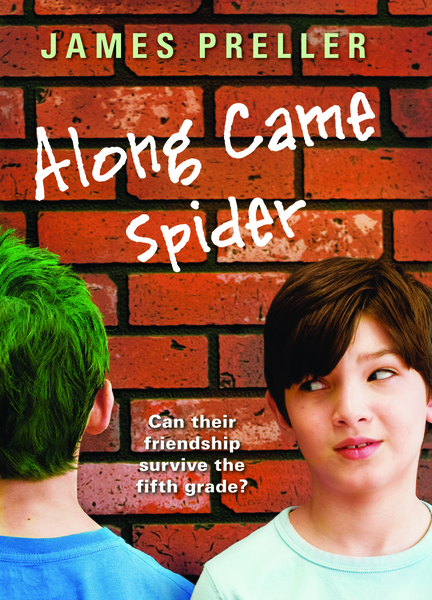
Above, you should (maybe, possibly, hopefully) see the cover to my new hardcover book, Along Came Spider, due for publication this September (Scholastic, ages 8-12). Except, well, that used to be the cover until about three weeks ago. You see, I got a phone call from my editor at Scholastic, the newly-engaged Shannon Penney, who explained that, essentially, some folks on the sales staff at Scholastic hated the cover. After some internal debate in the NY office, they decided to create “a new look.”

I was then sent the new cover:

Quite a difference, no?

I was recently at a regional conference for librarians (CASDA), participating in a panel discussion. The subject of covers came up and there seemed to be quite a lot of interest. Some in the audience seemed genuinely surprised at how little control we, the authors, had. Of course, control varies according to the status of the author, the style of the publisher, the deadline, and the book. But for the most part, writers don’t have final word. Or much say at all. And I think that’s fair, since the publisher is the one who is out there trying to sell the book. Sure, we can make a fuss about things, but there’s a risk to that — nobody likes a “difficult” author.

Hey, let’s face it, book-making is a collaborative process. I think you have to let people do their jobs. And when the sales force says, “We can’t sell a book with that cover,” well, I’m not going to throw my body into the gears of that machine. Because I want the book to sell, too (sue me), and I’m not the expert.

Now, is this new cover an improvement? I don’t know, but it certainly communicates different things than the original. To begin, I thought the first cover was brilliant graphically: a bold, arresting visual presentation that suggested the school environment. It looked cool, almost like a poster. But at the same time, sort of vague; you don’t come away knowing much about the story. Yet the vagueness was appealing; it was evocative. Or so I thought at the time. Besides, after you read the book — if you read the book — you’ll then “get” the cover. It will all make sense.

The second cover — now forever known as the real cover — established a totally different look by using photography. That’s always a difficult medium, especially for writers, because the nature of photography provides a specific, concrete image. It defines. It limits. We now know exactly what Spider Stevens looks like, whereas before it was open to our personal interpretation, up to our imaginations. What this cover does do, however, is it quickly lets us in on the story. A glance tells us that it’s about two boys. One has green hair and seems to be staring at a brick wall; he might be an odd duck. Then there’s the tagline: “Can their friendship survive the fifth grade?” All in all, the new cover effectively conveys the central strand of the book. But it also limits because the book certainly isn’t about only that. There’s Miss Lobel, the librarian. And the fabulous Ava Bright. And basketball. And . . . pencils!

I don’t really have the answers. There are no firm rules about what makes a good cover. Or what, precisely, a cover should do (other than, I guess, encourage you to open the book). What do you think? So far, no one has used the “comments” section to this blog. Here’s your big chance!