Archive for September 13, 2009

Hills Gleam Dimly: Karla Kuskin (1932 – 2009)

“I put it down and I begin to understand it better.” — Karla Kuskin.
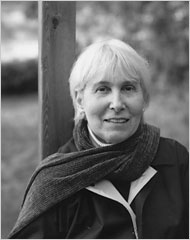
Karla Kuskin died in late August, 2009. I was away on vacation at the time, off the grid, not even looking at newspapers, so I missed it. I’d like to spend a few minutes today in appreciation of Karla Kuskin, to note a poet’s passing with due respect. At a time when much of children’s poetry aspires only to imitate Dr. Suess, here was a woman who wrote with sophistication and depth — feeling, heart, soul, and wit. Poems for children, yes; but she did not pander, she was not writing down; she lifted up.

I interviewed Karla many years ago, almost decades, for a profile that was eventually collected in this book, which I gather you can still find in some dark, dank corners of cyberspace. Worth checking out, I think: dated somewhat, but with golden nuggets inside. Awesome insights directly from Vera B. Williams, Aliki, Cynthia Rylant, Kevin Henkes, Eric Carle, Tony Johnston, Carlotte Zolotow, Barbara Park, James Marshall, and many, many others (75 in all). Anyway, I liked Karla immediately. She was unpretentious, yet serious about her craft; easy to talk to, genuine and funny. My highest compliment: She was a true artist.

The main challenge of the book was that my editors at Scholastic wanted the short profiles to work on two levels. For adults, as well as for children. In remembrance of Karla, here’s an excerpt from that book:

Though sense and silliness, bouncy rhymes and flowing rhythms, Karla shares her love of poetry with young children. A mood, a memory, a sound — anything can spark a poem. And anyone can write one, Karla believes. “Poetry can be as natural and effective a form of self-expression as singing or shouting,” she says.

Karla has always loved listening to the rhythm of words. She states, “I am a firm believer in reading aloud because, I suppose, I loved it so much as a child.” Grateful for a childhood in which reading was an everyday family activity, Karla believes that “when you are exposed to poetry when you are little, it stays with you for the rest of your life.

“When I am working on a book of poetry,” Karla says, “I jot down everything on any scrap of paper at hand; I pay attention to what’s going through my head. I’m much more aware of language, words, rhythm, description. I try to hang on to these ideas, because if I don’t write them down, they’re gone forever.”

It is Karla’s hope that readers of her poems will, in turn, write poems of their own. As she says, “If you read, you write.” Karla realizes that most children will not grow up to become professional writers. “The important thing about writing is that it helps the writer discover his or her own thoughts and feelings.

“In difficult times,” Karla confides, “I’ve always found that to write out what I feel is very helpful. I put it down and I begin to understand it better.”

Nice, right?

The New York Times ran a leisurely obituary, it wasn’t in hurry to be over, and it touched on highlights obvious and some less so. They concluded with this untitled poem by Karla, from Near the Window Tree, and I loved it.

Write about a radish

Too many people write about the moon.

The night is black

The stars are small and high

The clock unwinds its ever-ticking tune

Hills gleam dimly

Distant nighthawks cry.

A radish rises in the waiting sky.

Remembering . . .

You might be moved to read this, by Sarah who blogs at The Reading Zone.

Some Recent Adirondack Photos

The last gasp of summer, some photos from our sublime vacation on Rainbow Lake in the Adirondacks. There’s nothing quite like a cabin by a lake, some high peaks nearby, and a willing family to share it with.

And yes, I’m just showing off here.

Fan Mail Wednesday #59 (Thursday Edition!)

Check it out, y’all: Fan Mail Wednesday is busting out all over the place, spilling onto Thursday, causing a ruckus. My three kids started school yesterday: Maggie, 3rd grade; Gavin, 5th; and Nick, 11th. And after a long, wonderful, and highly disruptive summer, I’m thrilled to re-enter the routine. As kids in the 70’s, we’d blast “School’s Out” by Alice Cooper on the last day of school. You’d hear that meaty guitar riff and your spirits would soar: freedom! Now as a parent, I want a song that works that same way on the FIRST day of school, as my kids board that bus: a monster guitar hook, a blast of freedom! Somebody please write that song because I want to play it right now.

Oh yeah, the mail. In this rare case, I’m using some full names with permission  . . .

Hi Mr. Preller,

My name is Lester Betor and I am a 5th grade teacher at Slingerlands Elementary School.  You visited my classroom a few years ago on Baseball Day!  We enjoyed your visit.  I just wanted to let you know that a colleague and fellow fifth grade teacher suggested that we begin our school year by reading your book, Along Came Spider.  I just finished reading it and wanted to let you know how much I enjoyed it.  As a fifth grade teacher, I have had a Trey, a Spider, an Ava, and a Ryan in my class.  I also work next door to the library and enjoy our version of Ms. Lobel.  The Slingerlands fifth grade teachers will enjoy reading Along Came Spider as our first read aloud of the school year and trust that it will set a tone of mutual respect, tolerance and kindness.  I also wanted to piggyback on your acknowledgement of Chris Porter.  My son Andrew had Mrs. Porter several years ago and we couldn’t agree more.  Chris is an outstanding teacher and an admirable colleague.  Thanks for sharing your story of Trey and Spider.  We hope it will inspire our students to follow our Slingerlands Motto:  “Always our Best.”

Sincerely, Lester Betor

I replied:

Lester, yes, I do remember you — you had a lot of energy and, as I recall, used an effective poem or technique for getting the kids to quiet down. Does that ring a bell?

It was very kind of you to write.

Baseball Day, yes, I remember lots of caps and jerseys and fresh-faced kids spitting out brownish chunks of chewing tobacco. But perhaps my recollection is not entirely accurate. That was even before I wrote Six Innings and Mighty Casey. I’m always happy to celebrate baseball, though this year, let’s try not to discuss my hapless, unwatchable New York Mets.

I’m proud of Spider. I don’t think it was a great seller — it’s a quiet book, with nary a wizard or vampire in sight, and I suspect that boys don’t immediately gravitate to it — but I’ve always believed that in the hands of a good teacher, it could be a meaningful one in the classroom. I’m grateful whenever teachers and librarians can help a reluctant reader discover this story. It’s a particular honor that you find it worthy for kicking off the school year. Along with Six Innings, Along Came Spider was named by The New York Public Library in its 2008 list of the “100 Best Books for Reading and Sharing.” So thanks for doing exactly that.

You can see the full list by clicking frantically right here. It could be a good resource for future reading.

JP

Lestor wrote back to confirm my hazy memory . . .

Hi James,

When I taught 3rd grade, I used the following to quiet them down:  “Eyes are…watching, ears are…listening, hands are…quiet, feet are…still, lips are…smiling.” You have a good memory. I haven’t used that since I last taught grade three.  Feel free to use my email in your fan mail.  My email was sincere and very accurate.  We loved Spider.  My best to your children with the start of the new school year.

Take care, Lester

Me, again:

Yes, eyes and ears! I’m pretty sure I copied that down and used it in a Jigsaw Jones book, just can’t remember which one! That’s right, I stole it from you. Didn’t you receive the royalty check? Hmmm, probably lost in the mail. Have a great school year, and thanks again for the inspiration.

JP

My Brother John . . . in BYSTANDER

When I was writing the first draft for BYSTANDER, I had to contend with the issue of the new boy in town, Eric Hayes. I knew he would have a problem with a bully — but why? My sense of bullies is that they are  cunning, predatory, keen and careful in the targets they select. So Eric, I decided, needed some kind of vulnerability. Something subtle, but nonetheless something that an astute boy could perceive, the way the wolf pack selects the weakest in the herd.

I thought of my brother, John, eight years my elder, who had been living with a diagnosis of Schizophrenia for many years. He had been married in college, and quickly had two beautiful boys, my nephews. But it could not last. John went through many stages of mental illness, from terrible times to placid years of dulled medication. He was unable to be a husband, and struggled to be any kind of father. As the boys grew older, the distance became more acute, their fragile relationship almost untenable. Everyone did their best. All of us. But it was not good enough. Not even close.

As I wrote the book, I allowed John to stand in as a loose model for Eric’s absent father, like a shadow cast by a guttering flame. I didn’t do much with the character, it was not where I intended the book to go, so I quickly explained him away, took a few traits from John, a few moments from his life (he used to send my son, Nick, these crazy CDs in the mail, out of the goodness of his wild heart, as some act of connection). Eric’s father in the book would do the same.

For Eric, it was simple. His father was not there anymore; and worse, he was sick in a challenging way, one that was difficult for a 13-year-old boy to understand. His father went off the meds, as my brother did, as so many others who suffer from mental illness do. Because the medications can bring their own kind of death.

So the mother took her two boys and moved to Long Island. There: I had what I needed for my story, Eric’s vulnerability. And I had that other important thing, a little bit of soul.

Here comes the bizarre part. One day after I turned in that first draft to Liz Szabla, I received word that John had died in his home in Virginia. Suddenly, irrevocably, gone. A final loss after endless years of loss. Heartache, suffering. I thought of his boys. What did they feel? How have they felt all these years? I thought of my book, and how John had hovered around its edges like a ghost, a spectral presence that was felt, but scarcely heard.

Liz and I talked about it. John’s tragic life and death. The book, in Liz’s view, was almost clean. It barely needed revision. Yet we both knew that I’d have to honor this strange almost spiritual coincidence, and dig deeper, and do more to flesh out this character, my brother, Eric’s father-in-the-mind.

I wrote a new chapter that focused on Eric and the absent father, Chapter 11. I added small pieces in a couple of other places. A scene at Jones Beach. Changed the ending of the book, the longing expressed in that final sentence. Here’s a few paragraphs from Chapter 11, with Eric reflecting on life with his father in Ohio, and later, without:

It was scary. Because his father was still around, drifting aimlessly from room to room. When things were okay, when Eric didn’t think about it too much, Eric could sit quietly in the same room with his father and feel . . . good. Pretend everything was okay. He still had a dad. Not just any dad, but his dad, his one and only. That guy over there, the innocent one with the gentle soul, who loved trees and music and laughter and his two sons, that swell guy whose thoughts were eating him alive.

Then some things happened — other memories now, the water of remembering rising ever higher — when Eric’s father lost control, smashed a mirror and some lamps, ripped down the blinds off a bay window — and was gone the next morning before Eric awoke. And here was the truly shameful thing, the horror in Eric’s heart: He was glad. Good riddance. Who needs to live with that?

People can lose a leg. People can get their hands stuck in machines and have their fingers torn off. Terrible car accidents robbed people of their sight, their ability to walk, their dreams and hopes of a healthy future. But there was nothing worse — nothing on this earth, of that Eric was sure — than losing your mind, your peace of mind, because that was like losing your self. It was losing everything.

His father was a walking absence, a faint duplicate, a watered-down version of his former self, without substance enough to cast a shadow.

There was no way Eric could tell Griffin Connelly that story. So he told bits and pieces and white lies. Eric wondered if Griffin sensed it, the whole truth, if somehow Griffin already knew, saw into Eric’s secret heart and smiled.

——

I dedicated the book in memory of my brother John, loving father to David and Ryan.